Every climate compliance conversation happening in the US right now is about one state. California's SB 253 has a hard deadline in November, and the companies it covers are scrambling to get Scope 1 and 2 data assurance-ready.
That's the deadline everyone's watching. It's not the only one moving.
New York has spent the last year quietly building a parallel reporting regime — and a companion bill modeled directly on SB 253 is already advancing through the state legislature. If your compliance radar only has one blip on it, you're missing the second aircraft.
And if you're a mid-market manufacturer, here's the part that should actually get your attention: neither law technically applies to you. That's not good news. It's why you won't see this coming until it shows up as a customer requirement instead of a regulation.
The deadline everyone knows
SB 253 — California's Climate Corporate Data Accountability Act — requires US companies with more than $1 billion in annual revenue that do business in California to report Scope 1 and 2 emissions, with third-party assurance phasing in starting next year. The California Air Resources Board pushed the first-year reporting deadline from August to November 10, 2026, which is now about nine weeks away.
Companies over that $1 billion threshold are, for the most part, aware of this and building toward it. What most of them haven't fully mapped yet is where their own data is going to come from — because a large share of their Scope 3 footprint sits with suppliers who've never heard of SB 253 at all.
The deadline almost nobody outside compliance teams is tracking
New York is running two tracks at once, and they're easy to conflate.
Track one is Part 253, a facility-level mandatory GHG reporting program. Its first milestone — an emissions monitoring plan for a narrow set of high-emitting facility types — was due September 1. That date has already come and gone with almost no coverage outside environmental law circles. The deadline that actually touches a much wider set of manufacturing plants is the GHG monitoring plan requirement for any facility emitting more than 10,000 metric tons of CO2e a year, due before the end of this year.
Track two is the Climate Corporate Data Accountability Act — New York's version of SB 253. It applies at the corporate level, not the facility level, to companies over $1 billion in revenue doing business in the state, and it would require the same Scope 1–3 disclosure with third-party assurance. It's already passed the state Senate. It's currently sitting in an Assembly committee, one governor's signature away from becoming the second state with a law that mirrors California's.
Two states, two different mechanisms, converging on the same underlying ask: verifiable emissions data, assured by a third party, tied to a specific reporting cycle.
Why this is a mid-market problem even though the thresholds say it isn't
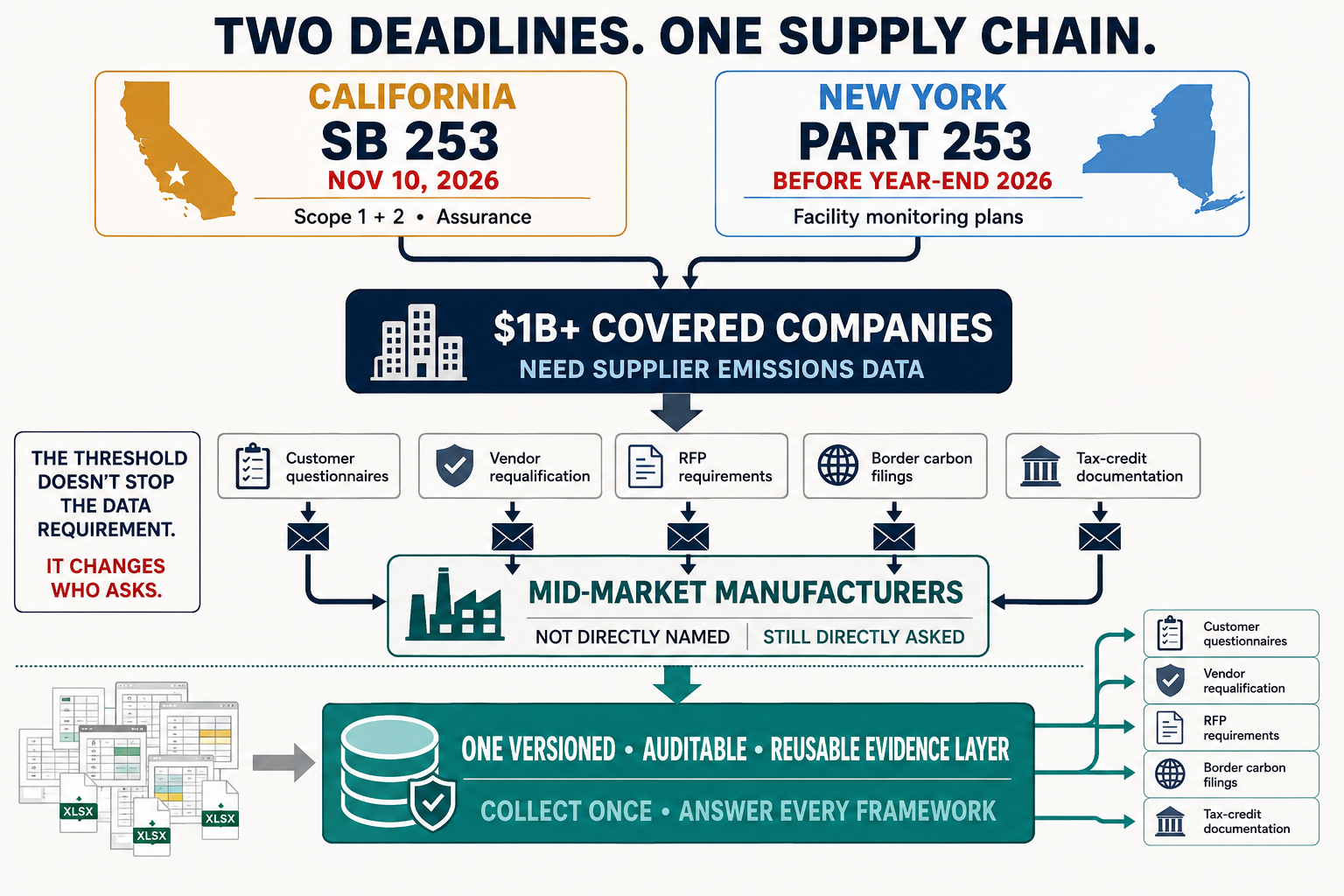
Here's the thing about a $1 billion revenue threshold: it doesn't stop the data requirement, it just moves who's asking for it.
The $1B+ companies covered by SB 253 and (soon, possibly) the CCDAA still need Scope 3 data to complete their own disclosures. That data comes from their supply chains. So a mid-market manufacturer who ships components to one of those companies is getting asked for exactly the same emissions figures — just through a procurement questionnaire instead of a state filing. The same manufacturer selling into the EU is fielding a similar ask through border carbon adjustment requirements. The same one applying for federal tax credits tied to emissions performance is filling out yet another version of the same form.
None of these individually feel like "compliance." Each one shows up as a one-off request — a vendor requalification, an RFP requirement, a new line item in a customer's supplier code of conduct. That's exactly why mid-market teams miss the pattern: there's no single calendar entry that says "climate law." There's just an increasing number of people asking for the same numbers, with less and less patience for a different spreadsheet each time.
That's the actual mid-market exposure here — not a statute with your company's name on it, but a growing set of counterparties who now expect an answer you don't currently have in a defensible, repeatable form.
What being ready actually looks like
The fix isn't rebuilding a compliance file for every framework that lands on your desk. It's building the data once, in a form that holds up regardless of who's asking.
That means one versioned, auditable record of your emissions data — collected on a consistent methodology, with a clear chain of custody — that can answer a customer's Scope 3 questionnaire, a state disclosure requirement, and a border-adjustment filing from the same underlying source. Not five spreadsheets maintained by five different people trying to remember which numbers went where last time.
For mid-market manufacturers, this is the difference between treating each new request as a fire drill and treating it as a formality — because the data was already sitting there, ready to be pulled.
Where OCEANS fits
OCEANS is built for exactly this pattern: one audit-grade evidence layer, versioned and defensible, that answers whatever framework asks next — instead of a system built for the last one that showed up.
If you're a mid-market manufacturer starting to notice more of these requests landing in your inbox, that's not noise. It's the pattern showing up early. Worth getting ahead of it before it's a deadline instead of a questionnaire.
Sai Praneeth — Founder, OCEANS Sustainability
OCEANS™ Sustainability
OCEANS™ Sustainability is carbon-accounting software for growing US manufacturers, a product of TheEvenity Pvt Limited. The Founding Design Partner Program is now open.