OCEANS™ METHODOLOGY
Transparent calculations begin with a documented methodology
Understand how OCEANS™ Sustainability approaches organizational boundaries, activity data, emission factors, Scope 1, Scope 2 and Scope 3 calculations, estimates, uncertainty and calculation traceability.
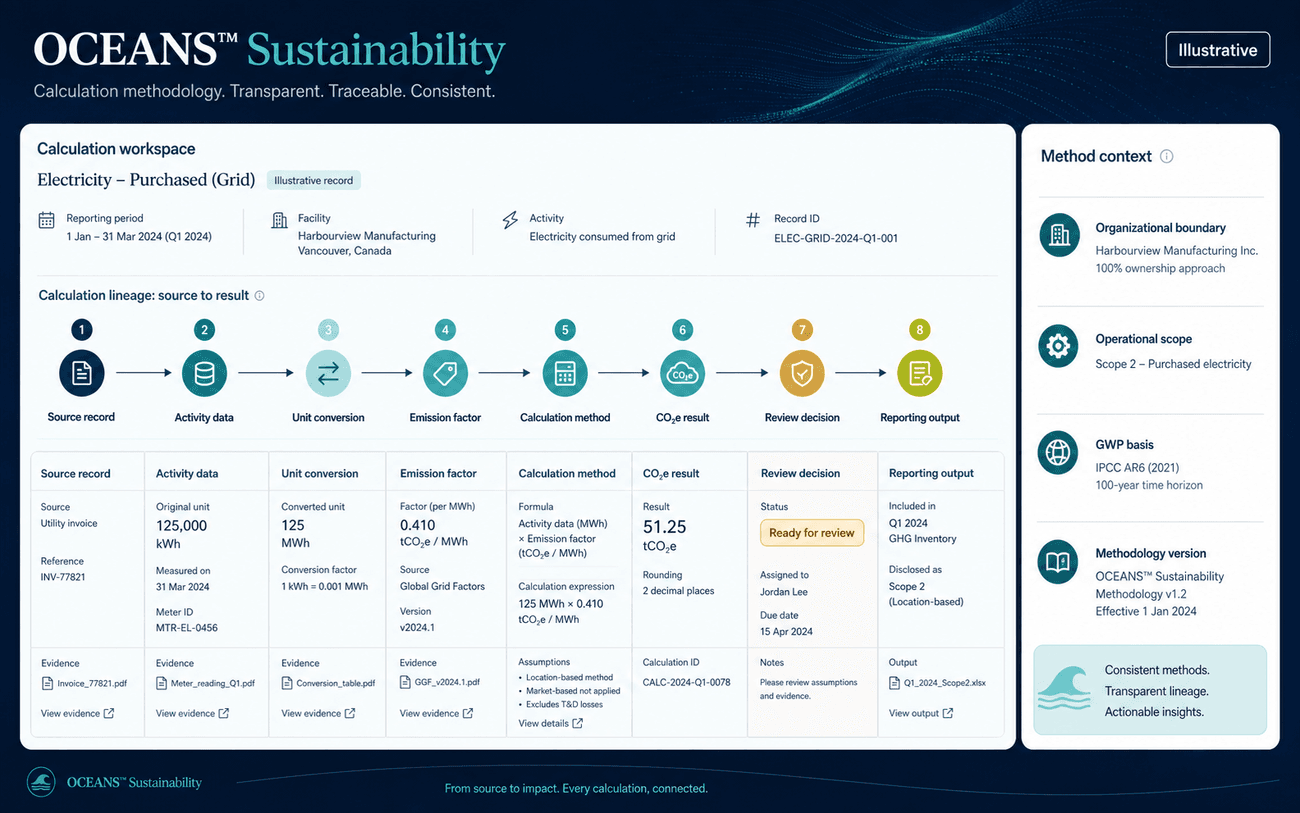
Understand what was calculated, how it was calculated, and where improvement is still required.
On this page
The principles behind our approach
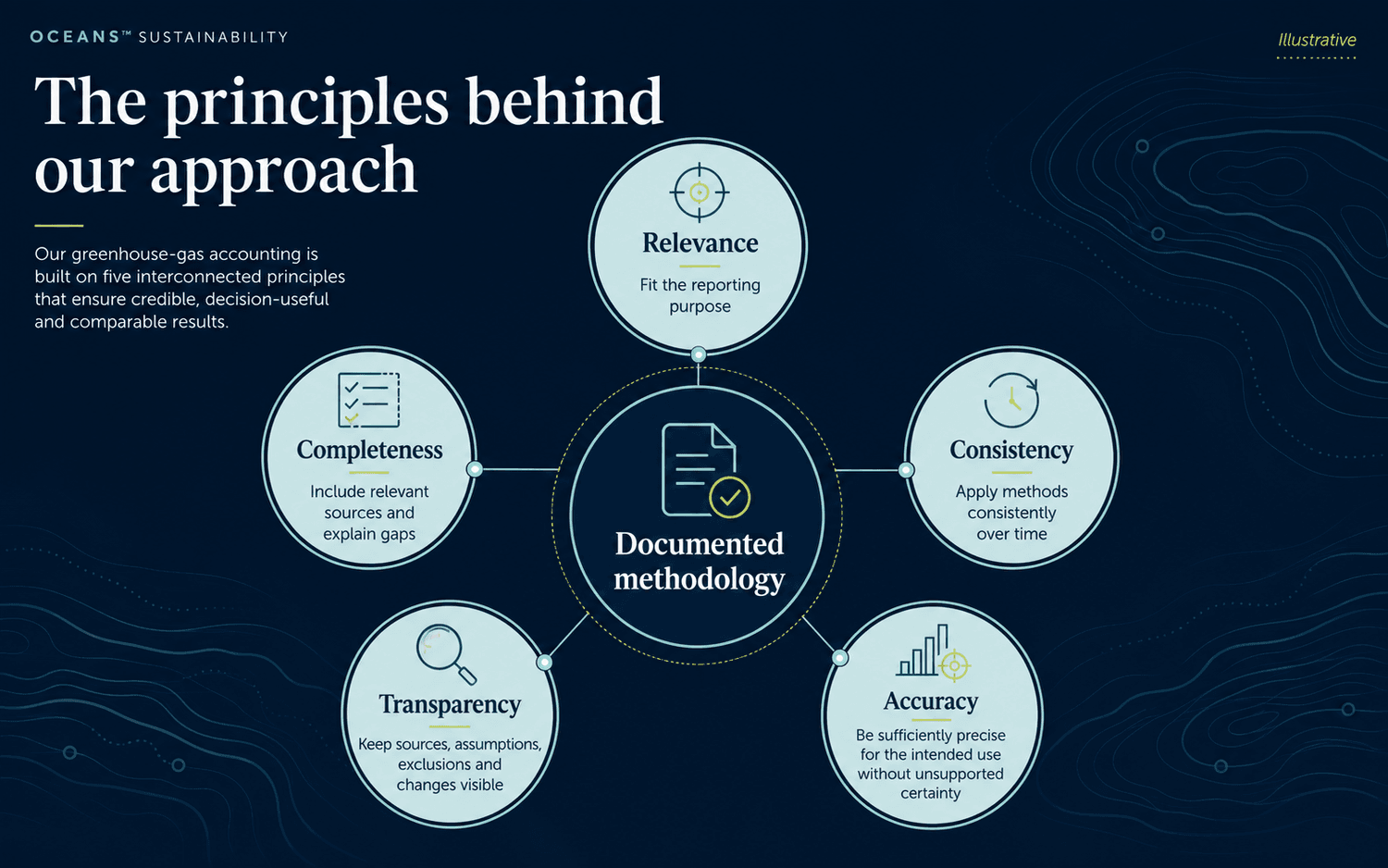
Relevance
The inventory should reflect the emissions sources and business activities relevant to its intended users and reporting objective.
Completeness
Relevant emissions within the selected boundary should be included. Exclusions and missing information should be identified and explained.
Consistency
Calculation methods should be applied consistently across entities and reporting periods so results can be meaningfully compared.
Transparency
Data sources, emission factors, assumptions, estimates, exclusions, and methodological changes should remain visible.
Accuracy
Data and calculation methods should be sufficiently precise for their intended use, while avoiding unsupported claims of certainty.
These principles reflect the established foundation of corporate greenhouse-gas accounting — they are not, by themselves, proof of formal certification.
Built around recognized greenhouse-gas accounting concepts
The OCEANS™ methodology is designed around concepts established by widely used greenhouse-gas accounting guidance, including:
- GHG Protocol Corporate Accounting and Reporting Standard
- GHG Protocol Scope 2 Guidance
- GHG Protocol Corporate Value Chain Scope 3 Standard
- GHG Protocol Scope 3 Calculation Guidance
- Relevant IPCC methodologies
- Applicable national and regional emission-factor sources
OCEANS™ claims formal conformity, certification, or assurance only after the complete methodology and its implementation have been independently reviewed.
The calculation
Converting business activity into greenhouse-gas emissions
For many emissions sources, OCEANS™ applies the following general calculation:
GHG emissions = Activity data × Emission factor
The result is converted into carbon-dioxide equivalent (CO₂e), a common unit that expresses the climate effect of different greenhouse gases relative to CO₂:
CO₂e = Quantity of each greenhouse gas × Applicable global-warming potential (GWP)
Example: 10,000 kWh of electricity × the applicable electricity emission factor = calculated electricity-related emissions.
Activity data may include
Some sources may require mass-balance, supplier-specific, engineering, process, or other calculation approaches rather than this basic formula.
Every calculation begins with a clear purpose
Before calculating emissions, OCEANS™ Sustainability is designed to record the intended purpose of the inventory. This may include:
- Establishing a first carbon baseline
- Preparing an annual corporate inventory
- Responding to customer requests
- Supporting a sustainability disclosure
- Understanding Scope 3 hotspots
- Calculating a product footprint
- Monitoring changes over time
The intended use affects the required boundaries, data detail, calculation methods, and review process.
What is included
Define which parts of the organization are covered
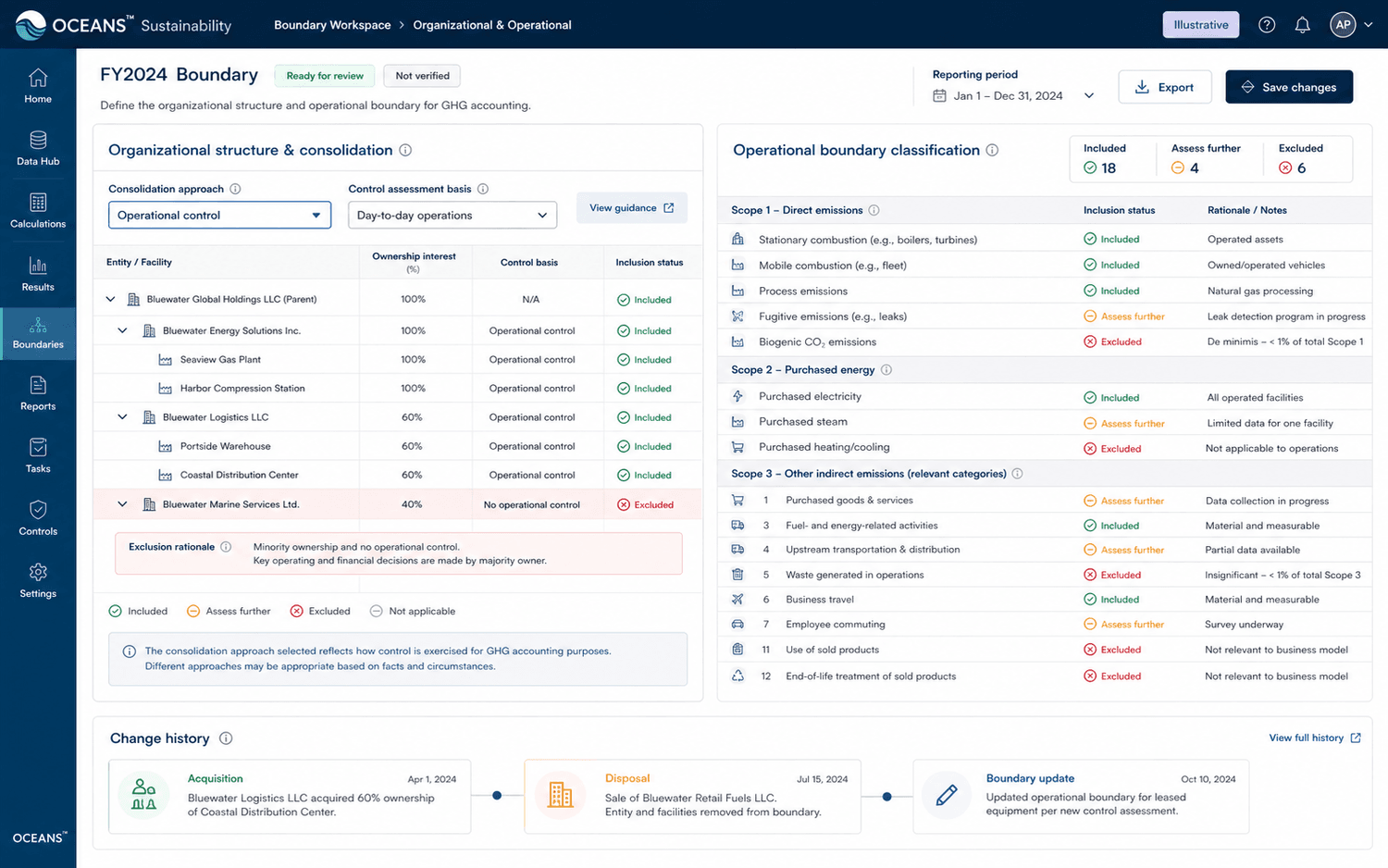
The organizational boundary determines which entities, facilities, operations, and investments are included in the inventory. Common consolidation approaches may include:
Operational control
The organization accounts for emissions from operations over which it has authority to introduce and implement operating policies.
Financial control
The organization accounts for operations over which it can direct financial and operating policies with a view to gaining economic benefits.
Equity share
The organization accounts for emissions according to its economic interest in an operation.
OCEANS™ Sustainability is designed to record
The appropriate approach depends on the organization's structure and reporting requirements.
Classify emissions across Scope 1, 2, and 3
Scope 1 — Direct emissions
Emissions from sources owned or controlled by the reporting organization.
- Stationary combustion
- Mobile combustion
- Process emissions
- Fugitive emissions
Scope 2 — Purchased energy
Indirect emissions associated with purchased or acquired electricity, steam, heating, or cooling consumed by the organization.
Scope 3 — Other value-chain emissions
Other indirect emissions that occur across the organization’s upstream and downstream value chain.
The GHG Protocol defines Scope 1 as direct emissions, Scope 2 as indirect emissions from purchased energy, and Scope 3 as other indirect value-chain emissions.
The generated boundary example above is fictional and marked "Ready for review" — not independently verified.
Data inputs
Use the most relevant activity data reasonably available
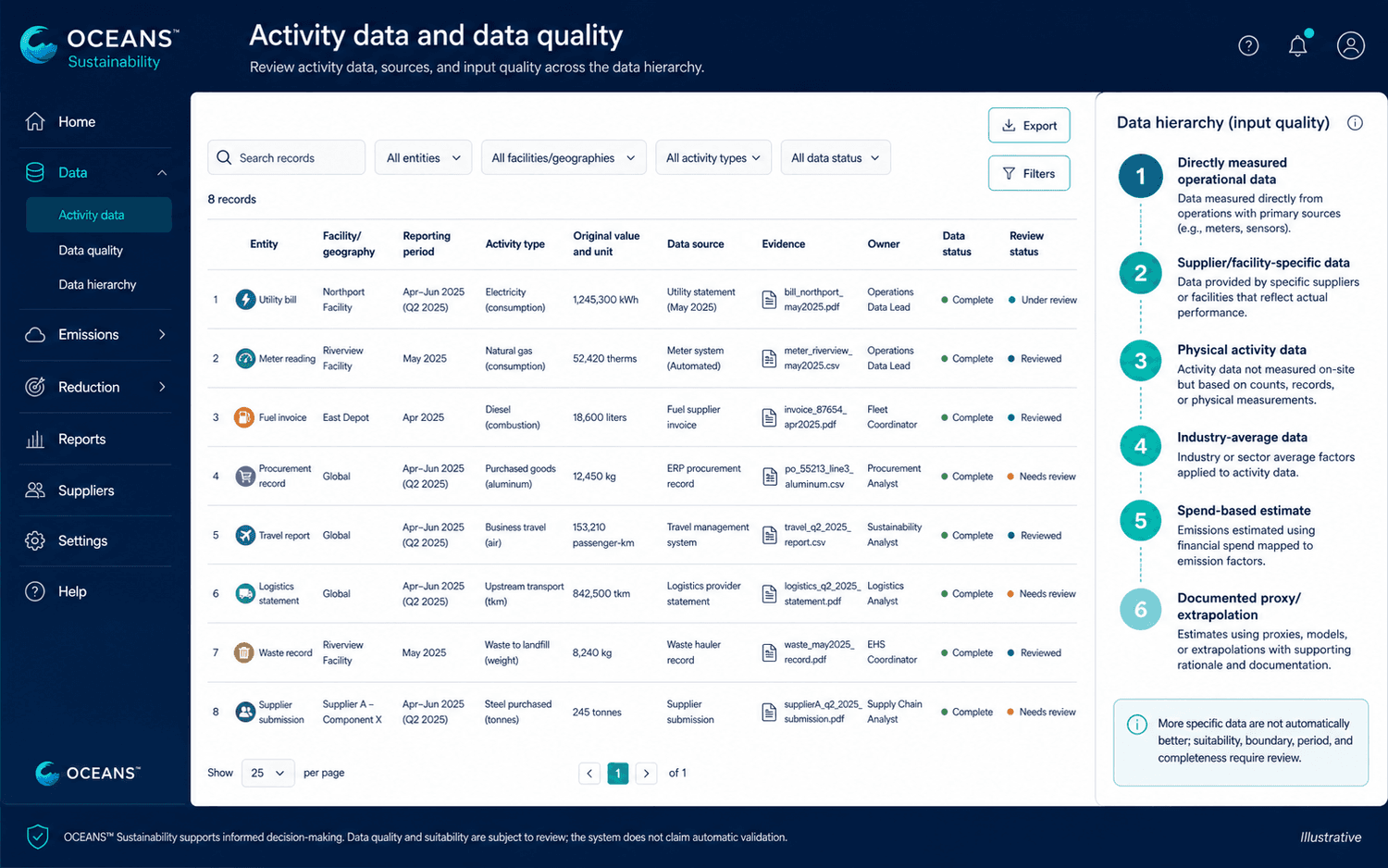
Potential sources
Context retained for every input
Prefer more specific data where it is suitable and available
- 01
Directly measured operational data
- 02
Supplier-specific or facility-specific data
- 03
Physical activity data
- 04
Industry-average data
- 05
Spend-based estimates
- 06
Documented proxies or extrapolations
More specific data are not automatically better; suitability, boundary, period, completeness, and methodology still require review.
Emission factors
Match each activity with an appropriate documented factor
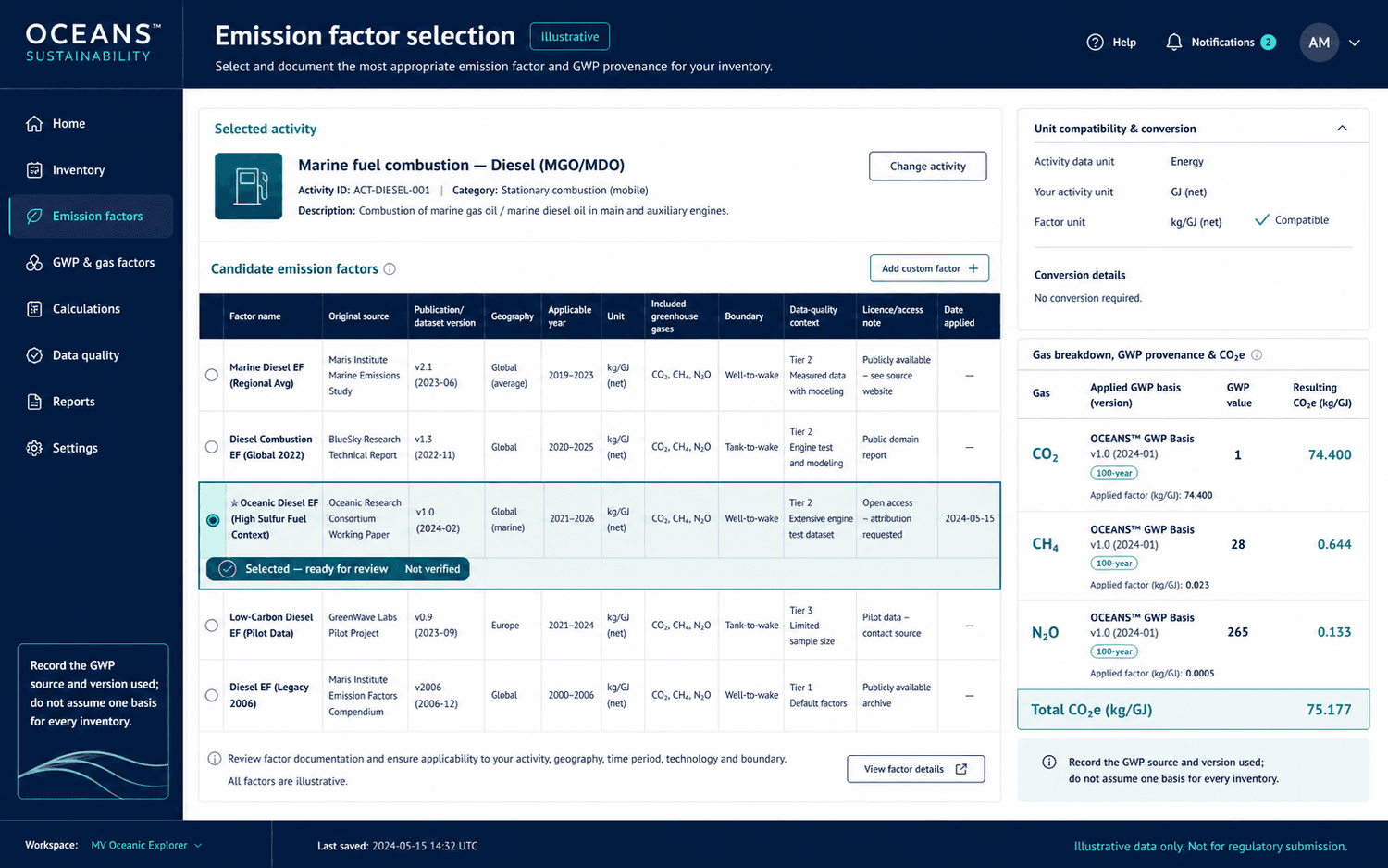
Factor selection should consider:
For every factor, OCEANS™ Sustainability is designed to retain
Proprietary factor databases are not listed here unless OCEANS™ holds the necessary licence.
Express different greenhouse gases in a common unit
Different greenhouse gases have different effects on the climate. Global-warming potential (GWP) values are used to convert individual gases into carbon-dioxide equivalent (CO₂e). OCEANS™ Sustainability is designed to record:
The same global-warming-potential basis is applied consistently within an inventory unless a reporting requirement specifies otherwise. The specific IPCC assessment used is displayed within the calculation and methodology record, not hard-coded into marketing copy.
Calculating emissions across Scope 1, 2, and 3
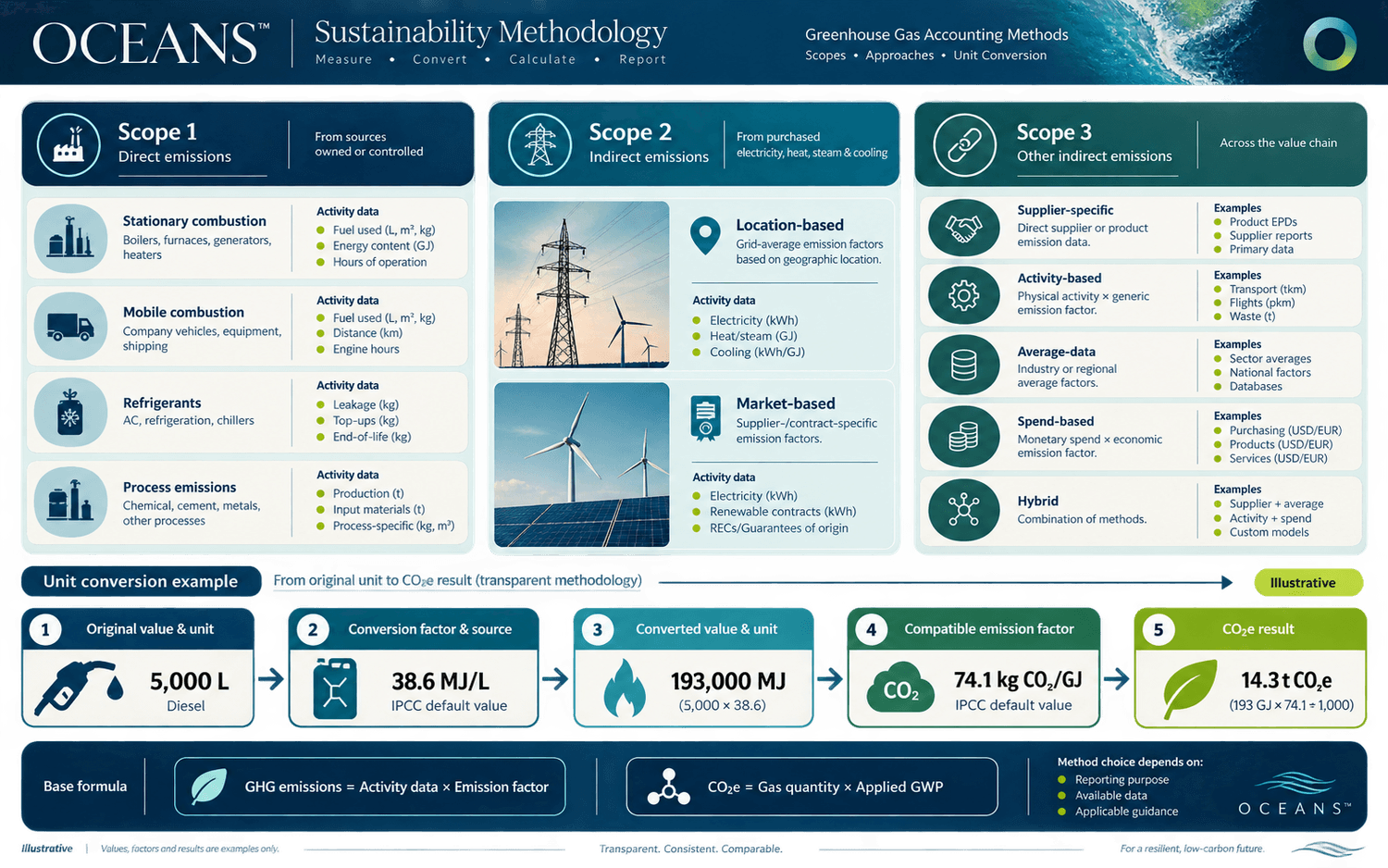
Scope 1 — direct operational emissions
Stationary combustion
Fuel consumed × applicable fuel emission factor
Mobile combustion
Fuel consumed or distance travelled × applicable emission factor
Refrigerants
Refrigerant released × gas-specific global-warming potential
Process emissions
Production activity, material balance, direct measurement, or applicable sector methodology
The selected method depends on the available data and the nature of the source. Direct measurement may be preferred where reliable information exists.
Scope 2 — purchased energy
Location-based method
Uses average electricity-generation emission factors representing the grid where consumption occurs.
Market-based method
Uses qualifying contractual or supplier-specific information where applicable and available.
The current GHG Protocol Scope 2 Guidance describes accounting for purchased electricity, steam, heat, and cooling.
Scope 3 — value-chain emissions
Supplier-specific method
Uses emissions or activity information relating to a specific supplier, product, or service.
Activity-based method
Uses physical quantities such as mass, distance, energy, or units purchased.
Average-data method
Uses industry-average lifecycle information for a product, material, or activity.
Spend-based method
Uses financial expenditure and environmentally extended economic factors.
Hybrid method
Combines supplier-specific and secondary information.
Scope 3 should improve progressively as broad estimates are replaced with more relevant physical or supplier information.
Preserve every conversion between input and result
Business data and emission factors may use different units. OCEANS™ Sustainability is designed to document all conversions required to make them compatible, retaining the original value, source unit, conversion factor, resulting value, and destination unit. Examples include:
References to specific standards, factors, or instruments inside the illustrative visual above are examples, not proof of OCEANS™ support, licensing, acceptance, or conformity.
Uncertainty
Make estimates visible and improvable
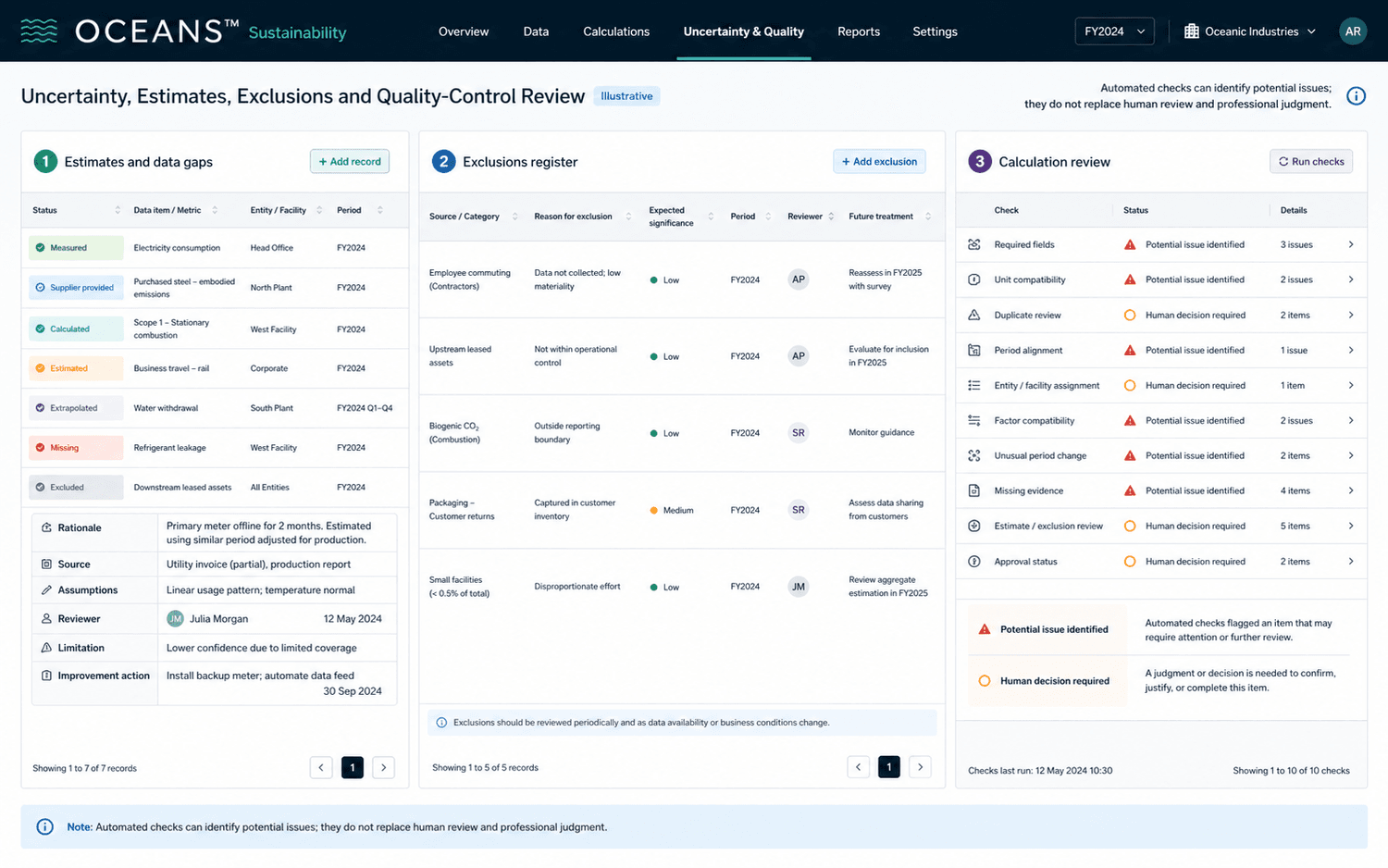
Incomplete information does not always prevent an initial calculation, but estimates must be clearly documented. For each estimate, OCEANS™ Sustainability is designed to record:
Data status examples
Measured
Directly measured from source records.
Supplier provided
Reported by a supplier or partner.
Calculated
Derived from other recorded inputs.
Estimated
A documented approximation.
Extrapolated
Inferred from a related, available data point.
Missing
Not yet available.
Excluded
Outside the defined boundary or not calculated.
Transparency about uncertainty is more credible than unexplained precision.
Explain what has not been calculated
An inventory may contain exclusions because a source is not relevant, information is unavailable, or the calculation is outside the defined boundary. Every exclusion records:
Exclusions are not used solely to improve the appearance of reported performance.
Calculation review
Review the inputs before relying on the outputs
Potential controls may include:
Only checks confirmed in the current implementation are shown above.
Automated checks can identify potential issues; they do not replace human review and professional judgment.
Keep a complete path from source record to reported result
- Source document
- Activity data
- Unit conversion
- Emission factor
- Calculation method
- CO₂e result
- Review decision
- Reporting output
This lineage helps users investigate results, explain changes, and prepare information for internal or external review.
Preserve consistency when information changes
Activity data, emission factors, organizational structures, and calculation methods may change over time. OCEANS™ Sustainability is designed to record:
Formal base-year recalculation rules reflect the reporting standard or program applicable to your organization — OCEANS™ does not invent a universal threshold.
A living methodology
Update methods without losing historical context
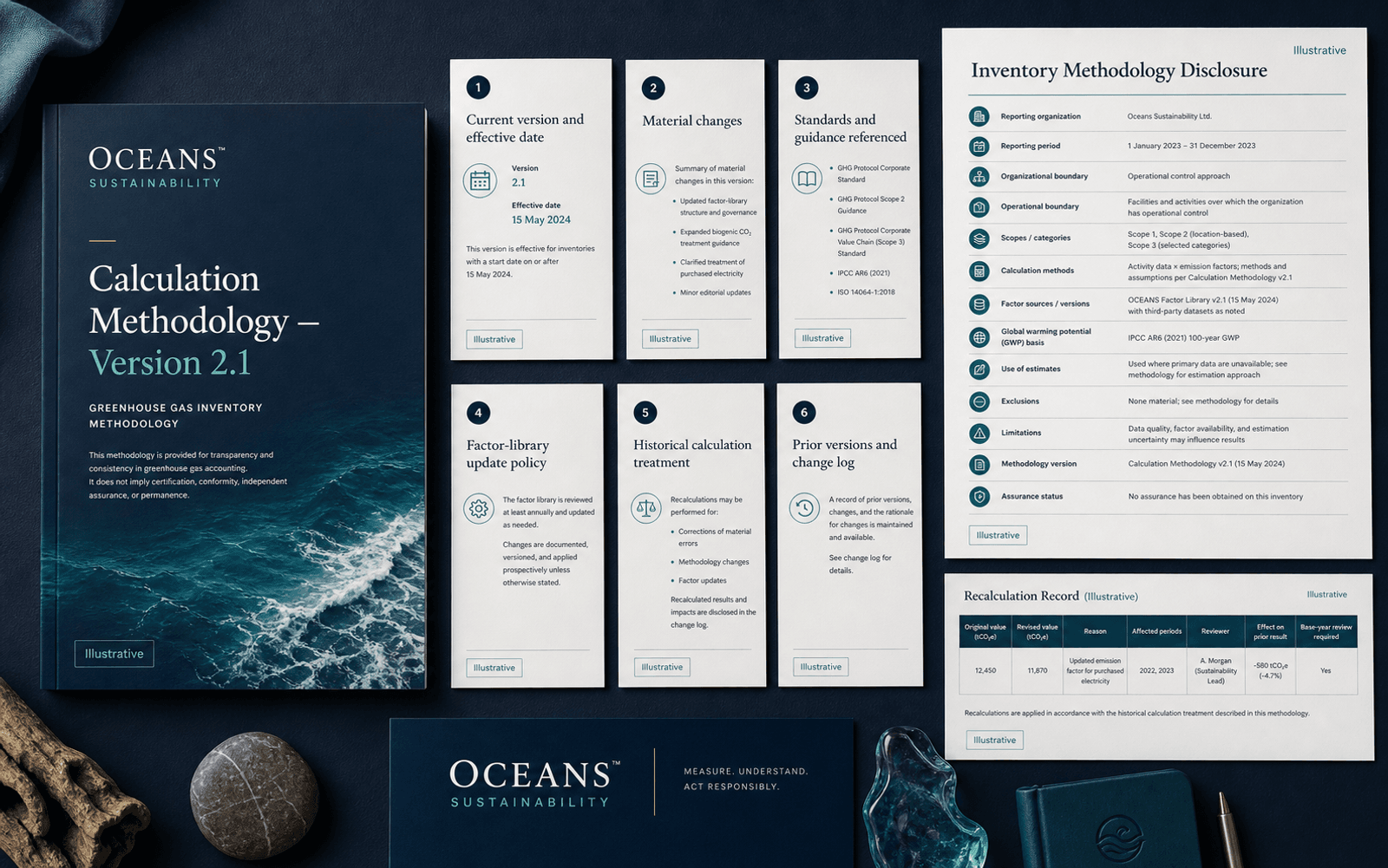
Greenhouse-gas accounting standards, factor datasets, and reporting requirements evolve. OCEANS™ Sustainability is designed to publish:
Current version record
- Version
- 1.0
- Effective date
- 2026-08-31
- Last reviewed
- 2026-08-31
Initial publication of the documented calculation methodology.
Dates, standards, factor-library policies, versions, and calculations shown in the illustrative report above are examples — not OCEANS™ commitments unless confirmed and configured.
What OCEANS™ Sustainability is designed to disclose with every inventory
- Reporting organization
- Reporting period
- Organizational boundary
- Consolidation approach
- Operational boundary
- Emissions scopes and categories
- Calculation methods
- Factor sources and versions
- Global-warming-potential basis
- Estimates and assumptions
- Material exclusions
- Data-quality limitations
- Methodology version
- Verification or assurance status
Standards continue to evolve
As of 2026-08-31
GHG Protocol and ISO are developing a consolidated corporate accounting standard, with public consultation planned for Q2 2027 and publication planned for Q4 2028. Plans and timelines may change; OCEANS™ reviews its methodology as authoritative guidance evolves.
- Key standard development updates (FAQ) (opens in a new tab)
- Corporate suite standards and guidance update process (opens in a new tab)
- Standards development and governance repository (opens in a new tab)
Last reviewed 2026-08-31.
Software supports review. It does not replace independent assurance.
OCEANS™ Sustainability helps organize data, calculations, assumptions, evidence, and review history. It does not independently verify customer-provided information or issue an assurance opinion.
Where independent assurance is required, it is performed by a qualified provider using the applicable assurance criteria.
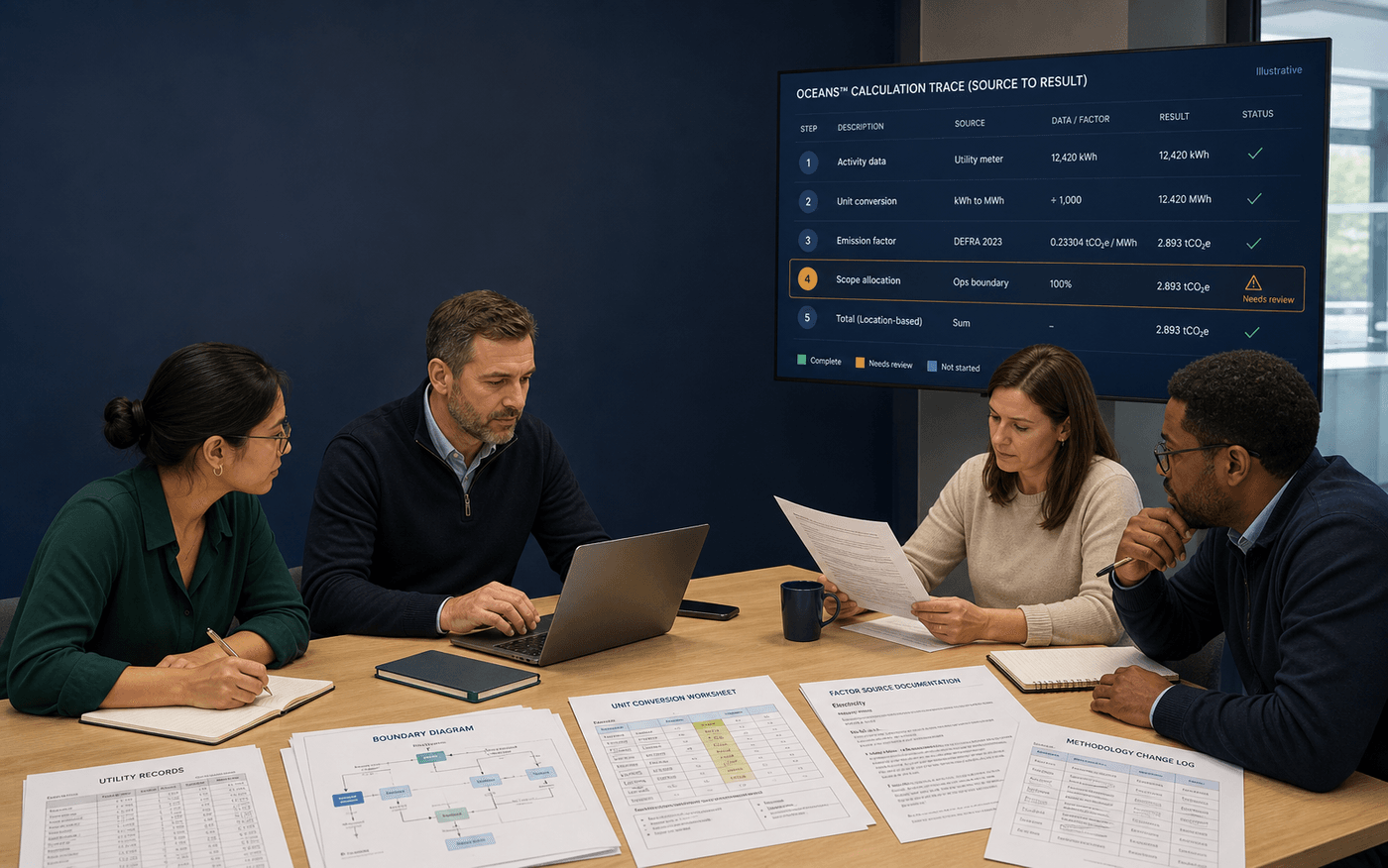
Methodology in practice
Boundaries, factors, and methods are reviewed by people, not just software
Sustainability, data owners, finance and control, and technical specialists typically review boundary decisions, unit conversions, factor documentation, and methodology changes together.
Frequently asked questions
What accounting principles does this methodology follow?
Five principles: relevance (reflecting emissions sources relevant to the reporting objective), completeness (including relevant emissions within the boundary and explaining exclusions), consistency (applying methods consistently across entities and periods), transparency (keeping data sources, factors, and assumptions visible), and accuracy (sufficient precision without unsupported claims of certainty).
How is an organizational boundary established?
Using one of three consolidation approaches: operational control (accounting for operations the organization has authority to set policy for), financial control (operations it can direct financial and operating policy for), or equity share (based on economic interest in an operation). The selected approach, included entities, and any exclusions are recorded.
What is the difference between the location-based and market-based Scope 2 methods?
The location-based method uses average electricity-generation emission factors for the grid where consumption occurs. The market-based method uses qualifying contractual or supplier-specific information where applicable and available. Both are distinct, documented methods rather than interchangeable defaults.
How are Scope 3 emissions calculated when supplier-specific data isn’t available?
Five methods are used depending on data availability: supplier-specific, activity-based (physical quantities such as mass or distance), average-data (industry-average lifecycle information), spend-based (financial expenditure and economic factors), or hybrid (combining supplier-specific and secondary information). Which method was used is recorded alongside the result.
What happens when a previously reported calculation needs to be revised?
A recalculation preserves the original and revised values, the reason for the change, the affected reporting periods, the methodology version, reviewer and approval status, the effect on previously reported results, and whether a base-year recalculation is required.
Understand the methodology behind every emissions result
See how OCEANS™ Sustainability is designed to connect activity data, emission factors, assumptions, evidence, and review decisions in one transparent calculation workflow.