If you've been hoping federal emissions reporting would just quietly go away, 2026 gave you a lot of reason to believe it might. It's also the year that hope became a liability for anyone who acted on it.
What Actually Happened
In February 2026, EPA finalized the rescission of the 2009 Greenhouse Gas Endangerment Finding — the legal foundation that gave the agency authority to regulate GHG emissions from vehicles under the Clean Air Act. EPA itself has called it the single largest deregulatory action in US history. Alongside it, EPA proposed eliminating Greenhouse Gas Reporting Program (GHGRP) obligations for 46 of 47 source categories, meaning most of the roughly 8,000 facilities that have reported emissions data annually since 2010 would no longer have to.
Here's the part that matters for your plant, though: none of that has actually taken effect yet.
The GHGRP repeal is still a proposal, not a final rule. EPA received more than 50,000 public comments on it — a striking number of them from businesses arguing the program should be kept, at least in part. The 2025 reporting deadline has been pushed twice, most recently to October 30, 2026, and EPA's own regulatory agenda signals it may push again. As of this writing, the current reporting requirements under 40 CFR Part 98 remain legally in effect. The program is, in the words of one law firm tracking it, in limbo — not gone.
That distinction is easy to miss in the headlines and expensive to miss in practice.
Why "EPA Is Backing Off" Doesn't Mean You Can
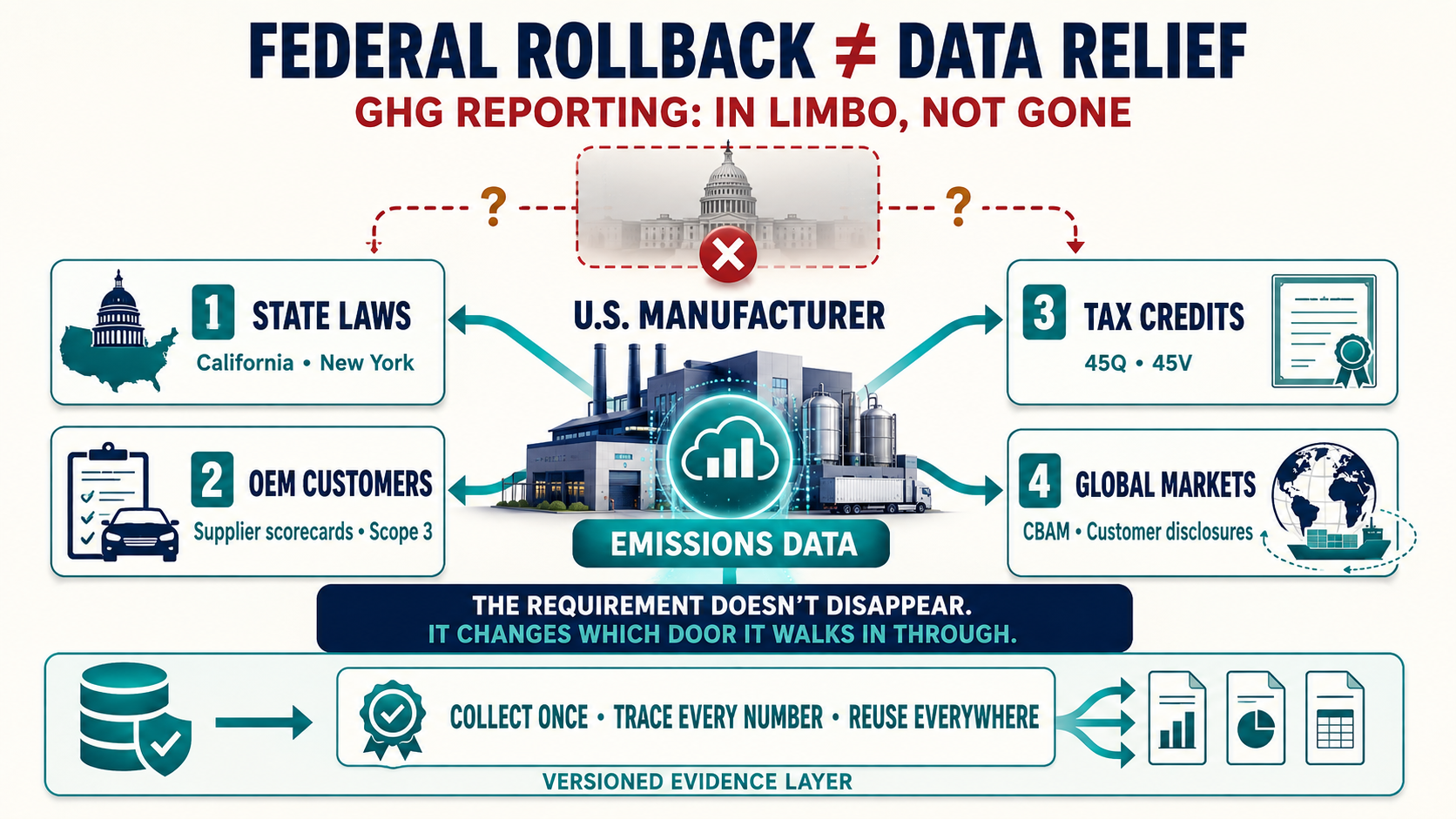
Here's the uncomfortable math for a mid-sized manufacturer: even in the best case for EPA's rollback, at least four other sources of pressure don't move an inch.
1. Your states are moving the opposite direction. As federal reporting has gone into limbo, states have expanded their own programs to fill the gap. California's SB 253 requires large companies to disclose Scope 1 and 2 emissions starting November 2026, with Scope 3 following in 2027. New York has a mandatory facility-level program with plans due September 2026, plus a proposed corporate-level law modeled on California's. If you supply into either state — or supply a company that does — the federal rollback changes nothing about what's coming.
2. Your OEM customers were never waiting on EPA. GM's Supplier Carbon Neutral Program, Ford's carbon disclosure process, and Stellantis's Scope 3 surveys are contractual requirements between you and your customer, not federal mandates. Nothing happening in Washington changes what shows up in your inbox from an automaker's procurement team. If anything, as federal data disappears, OEMs are likely to lean harder on supplier-reported data to fill their own disclosure gaps under state and international law.
3. Tax credit eligibility is quietly tied to the same data. The Treasury Department has incorporated GHGRP methodology directly into how it calculates eligibility for credits like 45Q and 45V. When EPA proposed the rollback, Treasury had to issue emergency guidance just to keep those credit calculations functioning. If your company touches carbon capture, hydrogen, or other credit-eligible activity, the emissions data you'd stop collecting under a full EPA rollback is the same data your tax position depends on.
4. Global customers and export markets aren't deregulating. The EU's Carbon Border Adjustment Mechanism and customer disclosure requirements in other markets don't recognize a US federal rollback as a reason to stop asking for your emissions data. Exporters who let their reporting infrastructure lapse now are the ones who'll be rebuilding it under a deadline later — for an audience that was never going to accept "EPA doesn't require it anymore" as an answer.
The Real Risk Isn't the Rollback. It's What Companies Do Because of It.
The predictable reaction to headlines like "largest deregulatory action in history" is to relax. Pause the data collection. Deprioritize the tracking system. Wait and see.
That's precisely the mistake the businesses filing comments against the GHGRP repeal are trying to avoid. Their argument to EPA wasn't sentimental — it was that this data has real, ongoing value for tax credit access, foreign market compliance, and demonstrating lower-carbon production to customers who are willing to pay for it. Companies that stop collecting now, betting on a rollback that's still legally unresolved, are the ones most likely to be caught flat-footed when a state law, an OEM questionnaire, or a Treasury rule requires exactly the data they just stopped tracking.
The pattern across every scenario — federal rollback finalized, federal rollback reversed by litigation, states filling the gap, OEMs tightening their own requirements — is the same. The data requirement doesn't disappear. It just changes which door it walks in through.
What This Means for US Manufacturers Right Now
The smart move isn't betting on which way Washington lands. It's decoupling your emissions data from any single regulatory program, so it doesn't matter whether the next request comes from EPA, CARB, New York, or a Ford procurement portal.
That means:
- Data that's collected once and reusable everywhere — not rebuilt from scratch for each new questionnaire or reporting regime.
- A traceable, versioned record — because "the rule changed" is not an answer an OEM auditor, a tax authority, or a state regulator will accept for a number you can't source.
- A system built for the pattern, not the headline — one that assumes regulatory whiplash is the normal state of things in 2026, because right now, it is.
This is exactly the gap OCEANS was built to close. It's not a compliance product tied to one framework that might disappear in the next Federal Register notice — it's an audit-grade evidence layer underneath all of them: versioned emission factors, full data lineage from source to report, and a structure that answers BRSR, SB 253, OEM scorecards, and whatever comes out of EPA's "subsequent final actions" from the same underlying data. For a US manufacturer trying to stay ahead of a regulatory environment that's moving in three directions at once, that's the difference between reacting every time the news changes and already having the answer ready.
FAQ
Has EPA eliminated the Greenhouse Gas Reporting Program? Not yet. EPA has proposed eliminating obligations for 46 of 47 source categories, but as of the most recent deadline extension, the current requirements under 40 CFR Part 98 remain legally in effect, and no final rule has been issued on the broader rollback.
If EPA reporting goes away, do I still need to track emissions? Very likely yes — through state programs like California's SB 253, direct OEM customer requirements, tax credit eligibility rules tied to GHGRP methodology, and international market access requirements that don't depend on US federal law.
When is the next GHGRP reporting deadline? The 2025 reporting year deadline has been extended to October 30, 2026, though EPA's regulatory agenda suggests this could be pushed again while the broader rollback proposal remains unresolved.
Does the endangerment finding rescission affect manufacturing facilities directly? The rescission primarily removed EPA's authority to regulate vehicle GHG emissions. Facility-level reporting under the GHGRP is a separate, still-pending action — but both reflect the same broader deregulatory direction worth watching if you're planning compliance infrastructure.
Regulatory direction in Washington doesn't change what your customers, your state, and your tax filings require. OCEANS gives US manufacturers one audit-ready evidence layer that holds up no matter which framework asks next. See how it works.
Sai Praneeth — Founder, OCEANS Sustainability
OCEANS™ Sustainability
OCEANS™ Sustainability is carbon-accounting software for growing US manufacturers, a product of TheEvenity Pvt Limited. The Founding Design Partner Program is now open.