Short answer: no. No US federal law requires ISO 14064. There's no statute that says "you must certify to this standard."
But if a customer questionnaire, an auditor, or your own compliance team keeps bringing it up, there's a real reason — California just wrote it into the rulebook for how it plans to check companies' emissions numbers. And once one major regulator treats a standard as acceptable proof, "not legally required" starts to feel a lot like "required in practice."
Here's what's actually true, what's still a proposal, and what it means for your reporting.
The ISO 14064 Question, Quick Scan
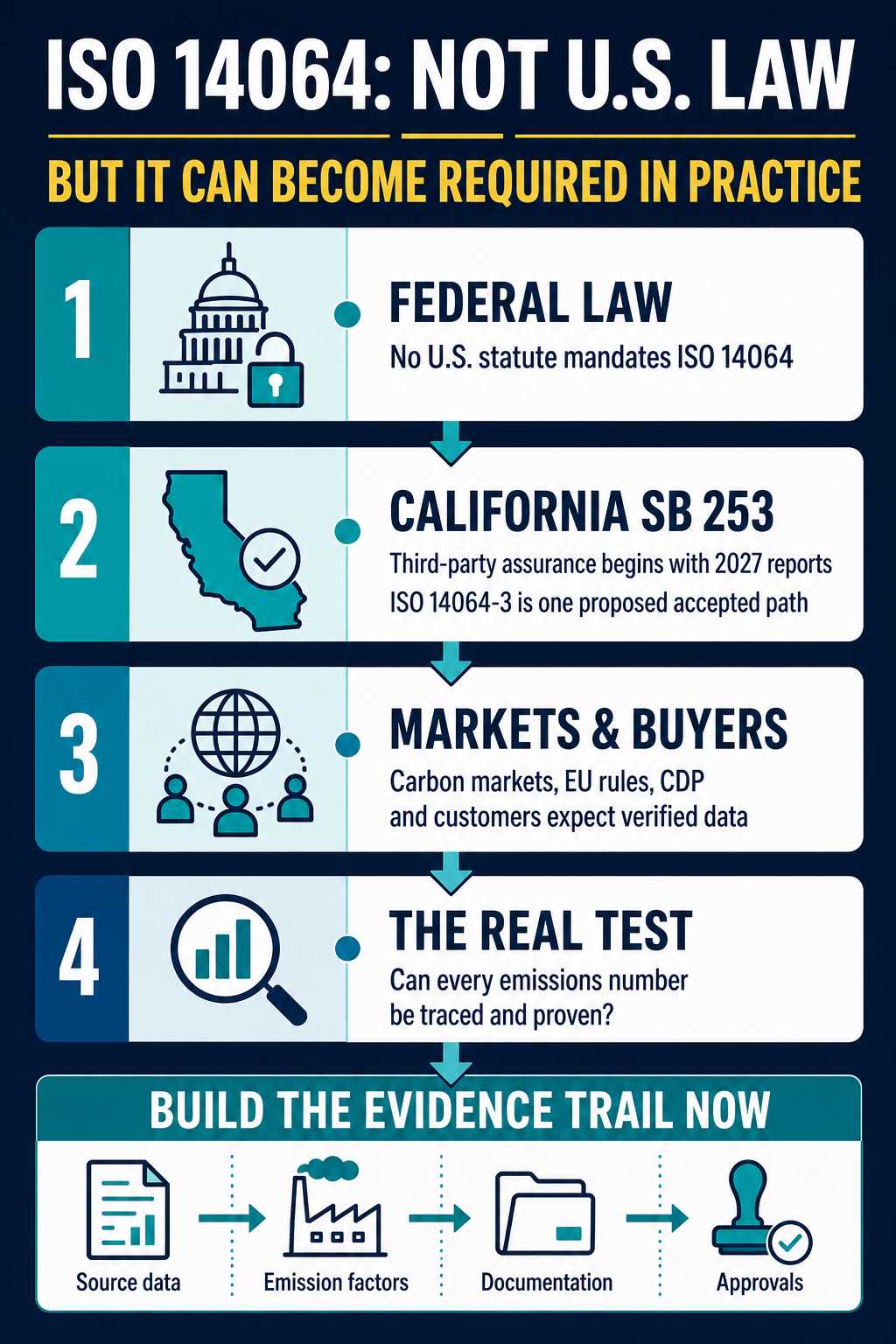
- Federal law: not mandatory. No US statute names ISO 14064. The SEC's 2024 climate disclosure rule, which would have been the closest thing to a federal trigger, was stayed within weeks of adoption, never enforced, and the SEC formally proposed rescinding it in 2026.
- California SB 253: not named as mandatory, but built into the assurance framework. Starting with reports submitted in 2027, companies must obtain third-party assurance for Scope 1 and 2 emissions, and the California Air Resources Board (CARB) has proposed ISO 14064-3:2019 as one of five acceptable standards a verifier can use.
- Cap-and-trade and carbon markets: effectively required. If you participate in California's Cap-and-Trade program, the EU Emissions Trading System, or CBAM reporting, ISO 14064-1-based verification is close to a hard prerequisite.
- CDP and investor scoring: functionally required at the top tiers. Leadership-level CDP disclosure and serious investor due diligence increasingly expect third-party-verified data, and ISO 14064 is the most common standard used to get there.
- EU CSRD: mandatory for companies it covers, including some US subsidiaries above the relevant thresholds — and ISO 14064-3 is one of the recognized assurance frameworks.
Net effect: no single US law forces you to adopt ISO 14064. But it keeps showing up as the accepted answer inside the rules that are mandatory — which is a different, and in some ways more demanding, problem.
What ISO 14064 Actually Is
ISO 14064 is a three-part international standard for greenhouse gas accounting, split by what it covers:
- ISO 14064-1 — how an organization builds a GHG inventory: boundaries, Scope 1/2/3 categories, quantification, reporting.
- ISO 14064-2 — the same, but for individual projects (like a carbon-reduction or offset project).
- ISO 14064-3 — how someone else validates or verifies that inventory. This is the part regulators keep citing, because it's a standard for the audit, not just the number.
It's not a law. It's a technical specification — closer to an accounting standard than a regulation. That distinction matters, because it's exactly why it can be "not mandatory" and "the thing your auditor will use" at the same time.
So Why Does It Keep Coming Up in US Compliance Conversations?
California SB 253 is the main driver
SB 253, the Climate Corporate Data Accountability Act, applies to companies with more than $1 billion in annual revenue doing business in California — a threshold that pulls in plenty of mid-size manufacturers through their supply chains, even if they're not the ones filing directly.
Here's where it stands:
- Scope 1 and 2 disclosure was originally due August 10, 2026; CARB has moved that first deadline to November 10, 2026.
- Scope 3 reporting begins in 2027, initially expected to cover a subset of categories rather than all fifteen.
- No third-party assurance is required for 2026 reports — CARB has granted enforcement relief for that first cycle.
- Starting with reports submitted in 2027, companies must obtain limited assurance for Scope 1 and 2 data from an independent third party.
- CARB's July 2026 workshop confirmed the list of acceptable assurance standards: AA1000AS v3, AICPA AT-C Section 210, ISAE 3410 with ISAE 3000 (for engagements before December 2026), ISSA 5000 (for engagements after), and ISO 14064-3:2019, with additional accreditation requirements under ISO 14065 and 14066.
- Reasonable assurance — a higher bar than limited assurance — is required by statute starting in 2030.
So ISO 14064-3 isn't singled out as the only path. It's one of five doors into the same room. But it's the one most GHG verifiers, auditors, and carbon-accounting consultants already know how to walk through, which is why it tends to become the default choice in practice.
Five more states are building similar patchworks
Colorado, Illinois, New Jersey, New York, and Oregon are each moving through their own versions of GHG reporting requirements. None of them create one clean national ISO 14064 mandate — they create five more sets of dates, thresholds, and formats to track, on top of California's.
The federal picture is shrinking, not disappearing
Two things are true at once in 2026:
- The EPA has proposed eliminating Greenhouse Gas Reporting Program (GHGRP) requirements for 46 of its 47 source categories, and separately extended the 2025 reporting-year deadline for the roughly 8,200 facilities still in scope to October 30, 2026.
- The SEC's climate disclosure rule — adopted in 2024, stayed almost immediately, and never enforced — is now formally headed toward rescission.
Read together, that looks like less federal pressure. But it doesn't remove the underlying demand for verifiable data — it just moves that demand out of Washington and into California, the EU, and your customers' procurement teams.
Buyers, lenders, and carbon markets don't wait for a mandate
If you sell into the EU, participate in a carbon market, or respond to CDP or investor due-diligence requests, you've probably already been asked to have your numbers checked against something. ISO 14064-1 and -3 are the most widely recognized way to answer that ask, mandate or no mandate.
Why "Not Mandatory" Doesn't Mean "Not Urgent"
This is the part that trips manufacturers up. The legal answer is genuinely "no, you don't have to." But the practical position most sustainability and EHS leads are in looks more like this:
- Your customer's procurement scorecard doesn't care whether ISO 14064 is a federal requirement — it just asks if your data is verified.
- CARB's 2027 assurance deadline is closer than it looks once you account for the time it takes to get audit-ready data in place.
- A standard that's voluntary today can become the default tomorrow — regulators rarely invent a new assurance framework from scratch when a widely used one already exists.
Waiting for a mandate to force your hand means starting the real work — building a defensible inventory — under time pressure, right when a deadline or a customer request lands on your desk.
The Real Problem Isn't the Standard. It's the Data.
Whether or not ISO 14064 ever becomes a hard US requirement, the underlying test is the same one every framework eventually applies: can you show where a number came from, and prove it?
For most manufacturers, that's the hard part. Emissions numbers get built from utility bills, fuel invoices, meter readings, procurement records, supplier files, and a rotating cast of spreadsheets — often owned by different people, in different formats, with no shared history. When a verifier, a customer, or an auditor asks "how was this calculated, and what backs it up," someone has to reconstruct the answer after the fact, often under deadline pressure.
That reconstruction is where credibility breaks down — not because the emissions activity is wrong, but because the evidence trail was never built as the data was collected in the first place.
How OCEANS Helps
OCEANS — Operational Climate, Evidence & Assurance Network System — exists to close exactly that gap. Instead of assembling evidence after the fact, every number carries its own trail from the moment it's entered:
- Traceable source data. Every figure links back to the original utility bill, fuel receipt, or meter reading — not a static cell in a spreadsheet.
- Versioned emission factors. As factors and methodologies update, the version used for each calculation stays attached to the number, so you can show exactly how it was derived.
- Evidence at the source. Supporting documentation is attached when data is collected, not tracked down later when a verifier asks.
- A visible approval trail. Sign-off is part of the record, not buried in an email thread from eighteen months ago.
The practical result: whether your team ends up assured against ISO 14064-3, ISSA 5000, AICPA standards, or whatever CARB finalizes, the underlying evidence doesn't need to be rebuilt for each one. You collect it once, structured, and reuse it — for CARB, for a customer questionnaire, for CDP, for whatever comes next.
What Manufacturers Should Do Now
- Check applicability. Do you sell into California, the EU, or to a buyer likely to be caught by SB 253's revenue threshold? That determines how directly this touches you.
- Structure your inventory now, not in 2027. Organize Scope 1, 2, and (eventually) 3 data along the same boundaries and categories ISO 14064-1 and the GHG Protocol both expect — the two frameworks are closely aligned, so this work isn't wasted either way.
- Build the evidence trail as you go. Attach source documents and emission-factor versions at the point of data entry, not months later when someone asks for them.
- Treat 2026 as prep time. With no assurance required for this year's SB 253 reports, this is the window to get audit-ready before it's mandatory.
Frequently Asked Questions
Is ISO 14064 legally required in the United States?
No. There is no US federal or state law that mandates ISO 14064 certification by name. It functions as a recognized technical standard, not a legal requirement.
Is ISO 14064 required for California SB 253 compliance?
Not exclusively. Starting with reports submitted in 2027, SB 253 requires third-party limited assurance of Scope 1 and 2 emissions, and CARB has proposed ISO 14064-3:2019 as one of five acceptable assurance standards. Companies can use ISO 14064-3 or an alternative from CARB's approved list.
What's the difference between ISO 14064-1 and ISO 14064-3?
ISO 14064-1 covers how an organization builds and reports its GHG inventory. ISO 14064-3 covers how a third party validates or verifies that inventory. Most US compliance discussions around "mandatory" are really about 14064-3, the verification standard.
Do small and mid-size manufacturers need to worry about ISO 14064?
Directly, only if you meet a specific threshold — like SB 253's $1 billion revenue trigger. Indirectly, many smaller manufacturers get pulled in anyway, as suppliers to companies that do have to report and verify their Scope 3 data.
How is ISO 14064 different from the GHG Protocol?
The GHG Protocol is the most widely used voluntary framework for calculating emissions and is not certifiable. ISO 14064 is a formal, certifiable international standard built to align closely with it — many organizations use the GHG Protocol to calculate and ISO 14064 to structure and verify.
Trying to figure out where your emissions data actually stands — before a customer, a verifier, or CARB asks? Talk to the OCEANS™ team about building an evidence trail that holds up, no matter which assurance standard ends up on the other side of it.
Mail me at -> praneeth@oceansplatform.com
Sai Praneeth, Sustainability Expert
OCEANS™ Sustainability
OCEANS™ Sustainability is carbon-accounting software for growing US manufacturers, a product of TheEvenity Pvt Limited. The Founding Design Partner Program is now open.