
You didn't ask for this. Someone in procurement at GM, Ford, Stellantis, or Toyota sent your company a sustainability questionnaire, and now it's sitting in your inbox with a deadline attached. Maybe it landed on the EHS manager's desk because "emissions" sounds environmental. Maybe it went to the VP of Ops because it touches production data. Maybe — if your company is lean enough — it ended up with the CFO, because anything with "reporting" in the name eventually becomes a finance problem.
Wherever it landed, the person who opened it is now staring at a request for something like per-part carbon footprint data, backed by primary production numbers, not industry averages. And the honest answer is: nobody at the company has that. What exists is a shared drive full of utility bills, a few ERP exports, some email threads with a steel supplier from eighteen months ago, and a spreadsheet someone started and never finished.
If that's where you are, you're not behind. You're normal. Here's why Scope 3 is genuinely hard — not in theory, but in the specific way it shows up for a mid-sized manufacturer — and what actually fixes it.
It's Not a Math Problem. It's an Ownership Problem.
Scope 1 and Scope 2 emissions are relatively contained. They come from your fuel, your electricity, your fleet — data one facilities or EHS person can usually pull together.
Scope 3 doesn't respect org charts. It touches purchased steel and aluminum from procurement, transportation data from logistics, energy use across every plant from facilities, waste data from operations, and product-use data that might live with engineering. A 250–2,500 employee manufacturer with two or three plants and multiple OEM customers has this data scattered across departments that don't normally talk to each other about carbon — because until recently, they didn't have to.
That's the first reason Scope 3 is hard: there's no single owner, so there's no single source of truth. When the questionnaire arrives, someone has to become a data detective for a few weeks, chase down five departments, and stitch together numbers that were never designed to connect.
OEMs Don't Want Estimates Anymore. They Want Proof.
For years, the accepted shortcut for Scope 3 was spend-based estimation: take your spend on steel, multiply by an industry-average emissions factor, and call it a footprint. That shortcut is closing fast.
Ford, General Motors, Honda, Denso, and Toyota North America — working through the Suppliers Partnership for the Environment — jointly released a standardized Automotive Climate Action Questionnaire specifically because OEMs were tired of getting inconsistent, low-quality supplier data through a dozen different formats. Separately, GM's Supplier Carbon Neutral Program, Ford's carbon disclosure process, and Stellantis's own Scope 3 surveys are all converging on the same underlying ask: primary, per-part data, tied to actual production and material sourcing — not a generic multiplier pulled from a public database.
That's a much harder bar to clear with a spreadsheet. Primary data means someone has to connect machine hours, material purchase records, and site-level energy data down to the part number — and be able to show their work if an OEM auditor asks how the number was calculated.
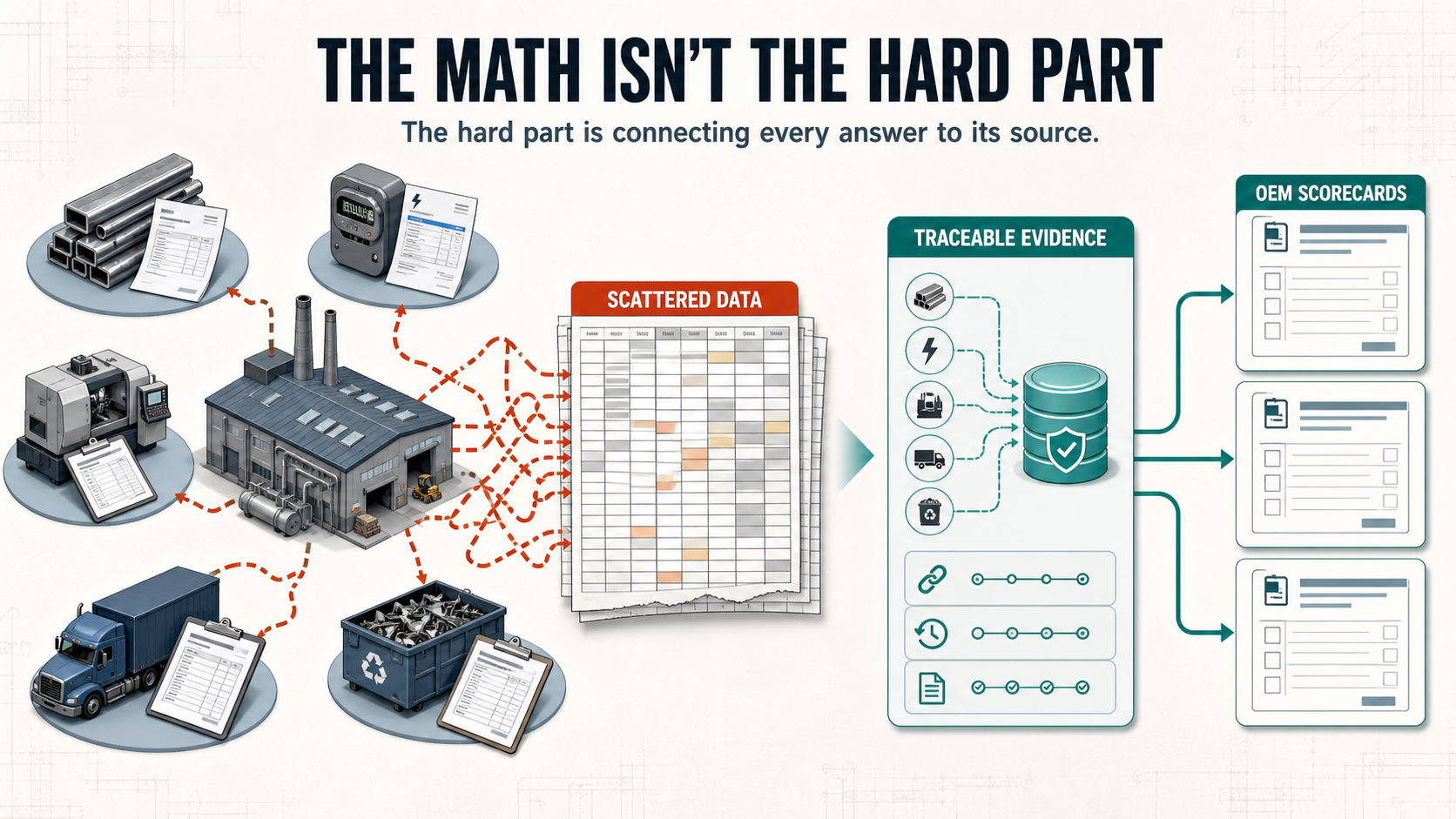
Spreadsheets Don't Have an Audit Trail. Regulators and OEMs Increasingly Require One.
This is the part that quietly wrecks most first attempts at Scope 3 reporting: even when the number gets produced, nobody can defend it six months later.
If your emissions data lives in a spreadsheet that gets copied, edited, and re-copied across three people's laptops, you have no record of which emission factor version was used, who changed which cell, or where a given number originally came from. That's fine right up until an OEM pushes back on a figure, or a customer preparing their own SEC-adjacent climate disclosure asks you to stand behind your data with some level of assurance. A number without a traceable source isn't evidence — it's a guess with good formatting, and increasingly, that gap is what disqualifies suppliers rather than the emissions figure itself.
The Regulatory Picture Is Getting More Confusing, Not Less
If you've been waiting for the rules to settle down before building a real system, here's the uncomfortable update as of late 2026: they're not settling down. They're fragmenting.
At the federal level, the EPA has moved to roll back most of the Greenhouse Gas Reporting Program, with the 2025 reporting deadline pushed to October 30, 2026 while the agency works through eliminating obligations for dozens of source categories. The federal center of gravity on GHG reporting is genuinely receding.
But states are filling the vacuum, not backing off it. California's SB 253 survived CARB's February 2026 rulemaking and now requires Scope 1 and 2 disclosure from large companies by November 10, 2026, with Scope 3 reporting phasing in for 2027. New York has a mandatory facility-level GHG program (Part 253) with monitoring plans due September 1, 2026, plus a proposed corporate-level Climate Corporate Data Accountability Act modeled directly on California's law moving through Albany. Most mid-market suppliers won't cross the $1 billion revenue threshold that triggers these laws directly — but your OEM customers almost certainly will, and they're already pushing the resulting data burden down their supply chains contractually, questionnaire by questionnaire. That's why the scorecard in your inbox matters more, day to day, than the statute itself.
Layer on top of that: seven states now have live packaging EPR laws (California, Colorado, Oregon, Maine, Minnesota, Maryland, Washington), with reporting deadlines that hit in a synchronized wave in May 2026 for the first time. If your products ship in packaging, that data — material types, weights, recyclability — overlaps directly with the material and logistics data feeding your Scope 3 inventory. Companies that build one evidence layer for both are moving faster than companies treating them as separate fire drills.
Net effect: the regulatory environment isn't giving you a stable target to build toward. It's giving you more inputs, from more directions, on more overlapping timelines. A spreadsheet that barely survives one questionnaire cycle won't survive a year of this.
What "Solved" Actually Looks Like
The fix isn't a bigger spreadsheet, a sustainability hire you can't justify yet, or an enterprise platform built for companies ten times your size. It's a data layer that does three things a spreadsheet structurally can't:
- Traces every number to its source — machine data, meter reading, invoice, or log sheet — so when an OEM or auditor asks "where did this come from," there's an answer instead of a shrug.
- Versions its emission factors, so a number calculated in March and a number calculated in October are both defensible, and you can show which methodology and factor set produced each one.
- Answers every questionnaire from the same underlying evidence, instead of starting over each time a different OEM sends a differently worded form. GM's ask, Ford's ask, and Stellantis's ask draw from the same production reality — your system should reflect that, even if their forms don't look alike.
That's the difference between chasing Scope 3 every quarter and having Scope 3 sitting there, ready, the next time the email arrives.
FAQ
Why is Scope 3 harder than Scope 1 and Scope 2? Scope 1 and 2 come from sources you directly control — fuel and electricity. Scope 3 spans your entire value chain: suppliers, logistics, purchased materials, and product use. It crosses departments that don't traditionally coordinate on emissions data, which is why it's an organizational problem as much as a technical one.
Do I have to report Scope 3 if my company doesn't hit California's or New York's revenue thresholds? Not directly under SB 253 or the proposed NY CCDAA. But if you supply a company that does — including any major automaker — you'll likely be asked to provide it anyway, through their supplier questionnaire process, regardless of what the law technically requires of you.
What's the difference between spend-based and primary Scope 3 data? Spend-based data estimates emissions from dollars spent using industry-average factors. Primary data ties emissions to actual production volumes, material sourcing, and site-level energy use. OEMs are increasingly requiring the latter, especially for high-impact categories like purchased steel and aluminum.
How often should I expect to answer these questionnaires? Multiple times a year, from multiple customers, in slightly different formats — which is exactly why rebuilding the answer from scratch each time is the most expensive part of the process.
OCEANS builds the audit-grade evidence layer behind Scope 3 reporting for manufacturers — versioned emission factors, traceable data from source to report, and one system that answers every OEM's questionnaire without starting over. If your team is fielding these requests with spreadsheets and email chains, get in touch.
Sai Praneeth — Founder, OCEANS Sustainability
OCEANS™ Sustainability
OCEANS™ Sustainability is carbon-accounting software for growing US manufacturers, a product of TheEvenity Pvt Limited. The Founding Design Partner Program is now open.