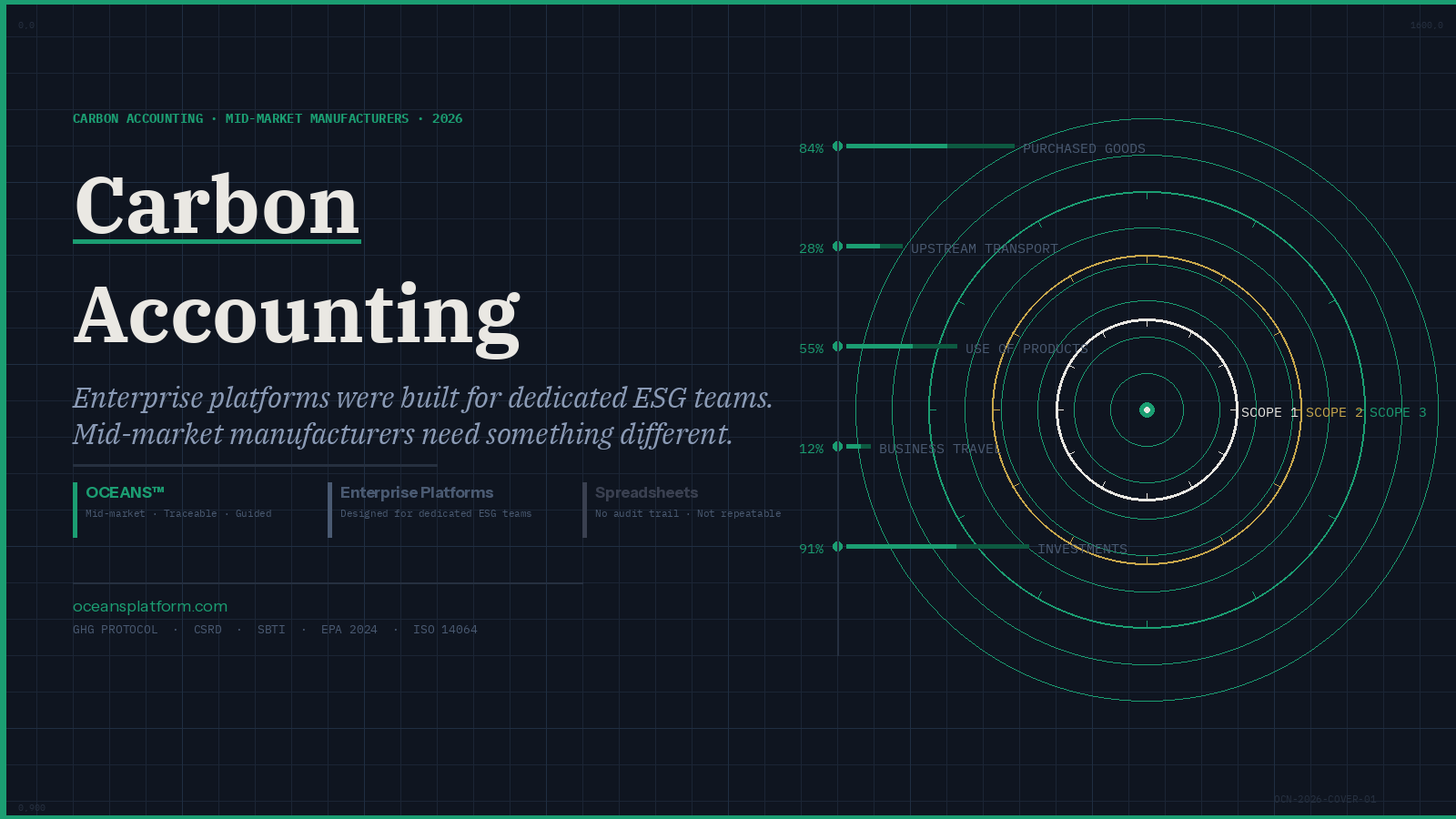
Enterprise platforms were built for dedicated ESG teams with six-figure budgets. Spreadsheets were built for simpler times. Here's how US mid-market manufacturers can find the right fit — and why the right choice might surprise you.
The Mid-Market Carbon Accounting Problem No One Talks About
Here is the reality for most US manufacturers in 2026: your customers are asking for your emissions data. Your OEM is asking. Maybe your bank is asking. And you have a sustainability manager — or more likely, a finance or operations person who drew the short straw — staring at a spreadsheet that took three months to build and still does not feel auditable.
You are not a Fortune 500 with a dedicated ESG function. You are a real company, with real operational data scattered across utility portals, fuel receipts, logistics invoices, and supplier questionnaires. And you need a process that works.
The problem is not that mid-market manufacturers do not care about this. It is that the software market was built around two extremes: enterprise platforms priced for global corporations with dedicated climate teams, and lightweight tools that generate a number but cannot explain where it came from. Neither solves the actual problem.
Here are the four failure modes we see most often.
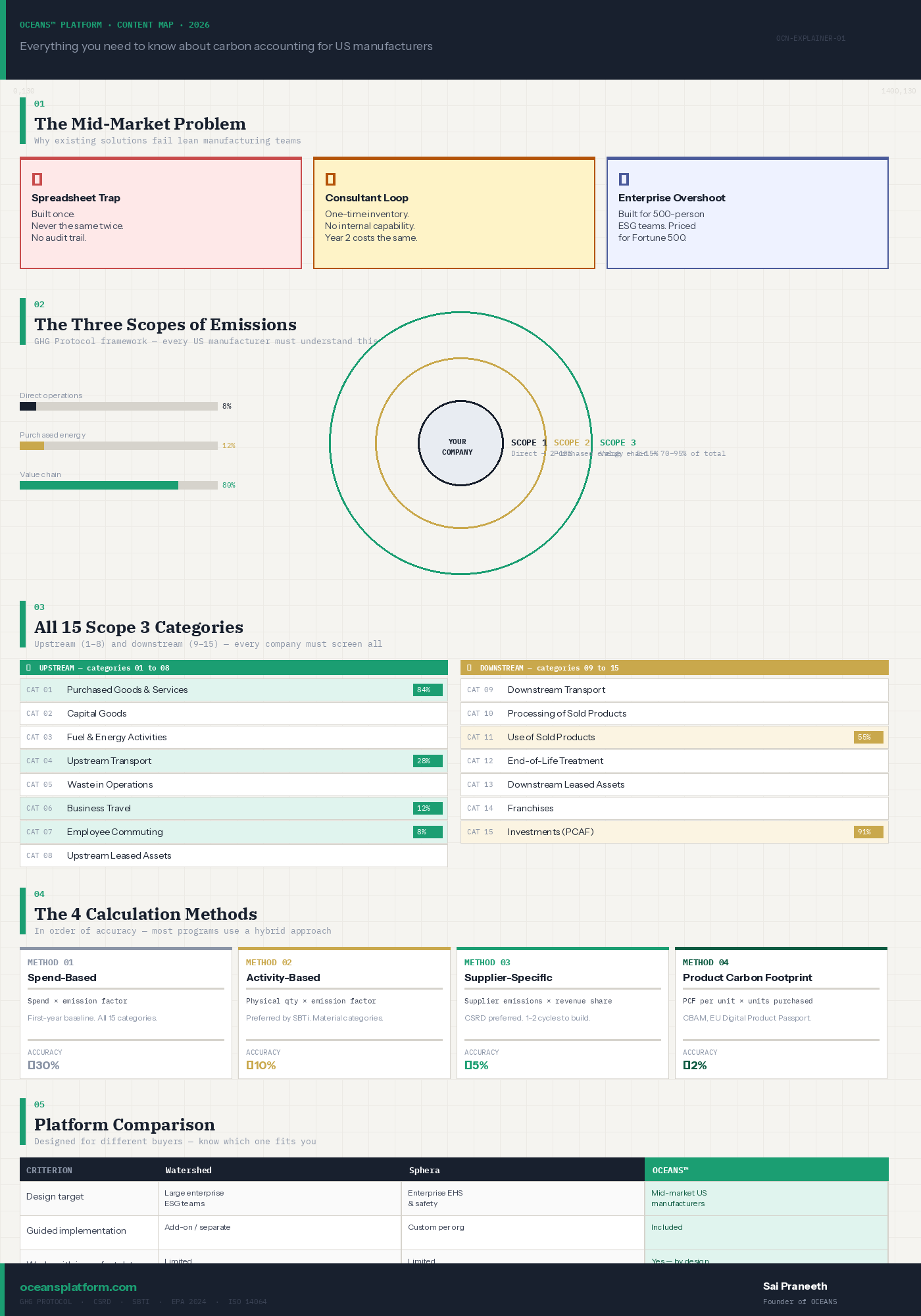
The Spreadsheet Trap. Built in a heroic three-week sprint, never updated the same way twice, impossible to hand to a new hire or an auditor without a full debrief.
The Consultant Loop. Engaging a firm for a one-time inventory builds no internal capability. Year two costs the same. You own a report, not a process.
The Enterprise Overshoot. Signing up for a platform built for 500-person ESG departments means paying for modules you will never use and waiting months for onboarding support.
The Deadline Scramble. An OEM gives you 30 days to complete a sustainability scorecard. With no established process, you are building a methodology from scratch under pressure.
8 Things to Look For in Carbon Accounting Software — If You're in Manufacturing
Before you book a demo with any platform, run through this checklist. These are not generic software-buying criteria — they are specific to the reality of a mid-market manufacturer trying to build a defensible, repeatable carbon inventory.
1. Traceable calculations — every number links back to its source
If you cannot show a customer, auditor, or OEM exactly which utility bill, emission factor, and methodology produced a given number, the number is not defensible. Ask the vendor: can I trace any output emission figure back to its raw input data?
2. GHG Protocol alignment — Scope 1, 2, and 3
The GHG Protocol Corporate Standard is the methodology your OEMs and customers will reference. Make sure the platform's calculation logic is built around it — not a proprietary framework that will be harder to explain.
3. Guided implementation — not just a self-serve tool
Most mid-market teams have never set organizational boundaries, chosen a consolidation approach, or documented a base year. The platform you choose should have a guided process or implementation support that walks you through these decisions — not assume you already know them.
4. Works with imperfect data — not just idealized data
Your first inventory will have gaps. Some utility accounts will be missing three months of data. Some suppliers will not respond. The platform needs to handle partial data, document gaps, and let you improve over time — not require complete data before you can publish anything.
5. Repeatable annual process — not a one-time project
The value of a carbon inventory compounds over years. The second year should take a fraction of the first year's effort. Look for version history, locked reporting periods, and a workflow designed to be repeated — not rebuilt from scratch annually.
6. Stakeholder-ready exports — not just internal dashboards
You will need to share data with OEM sustainability portals, respond to CDP questionnaires, and satisfy investor due diligence requests. The output format matters as much as the calculation engine behind it.
7. Documented emission factors — EPA, IPCC, GHG Protocol
Know which emission factor databases the platform uses and whether they are updated. An outdated emission factor library silently distorts your results. Ask specifically: are you using EPA 2024 factors? Ecoinvent? DEFRA?
8. Pricing that fits mid-market — not enterprise contracts
A platform whose starting contract requires a six-figure annual commitment is designed for companies with a business case already established. If you are building your first inventory, the ROI is not proven yet. Look for pricing transparency and a starting point sized for your actual team and footprint.
How the Main Platforms Stack Up for Mid-Market Manufacturers
This is an honest, research-based comparison of how the leading carbon accounting platforms are designed and positioned. Every statement below reflects each platform's stated target market and documented design priorities.
Editorial note: "Not designed for mid-market" is not the same as "bad." It means the platform was optimized for a different buyer. We recommend evaluating all options directly before making a purchasing decision.
Watershed is designed for large enterprises with a dedicated ESG function. It is a powerful platform once your company has an established baseline and a team that can make methodology decisions independently. Expert guidance is a separate engagement, not bundled. For companies without dedicated sustainability staff building their first inventory, the implementation assumption gap is real.
Sphera is designed for industrial companies where environmental compliance, operational safety, and EHS management are core operations. Its strength is integrating safety and sustainability data across complex industrial environments. For companies whose primary need is a defensible carbon inventory rather than EHS process management, it is oriented toward a different problem.
OCEANS was purpose-built for the gap between these two: lean US manufacturing teams building their first Scope 1, 2, and 3 inventory, without a consultant on retainer or an enterprise ESG department. Every claim OCEANS makes — traceable calculations, guided implementation, imperfect-data tolerance — addresses the specific failure modes that mid-market teams hit in practice.
The key point is not that Watershed and Sphera are inferior products. They are excellent platforms for the buyers they were built for. The question is whether you are that buyer.
| Criterion | Watershed | Sphera | OCEANS |
|---|---|---|---|
| Design target | Large enterprise, dedicated ESG function | Enterprise EHS, operational risk and compliance | Mid-market US manufacturers, lean teams |
| Guided implementation | Add-on / separate engagement | Custom per-org engagement | Included |
| Works with imperfect data | Limited | Limited | Yes — by design |
| Calculation traceability | Dashboard-level | Dashboard-level | Source → factor → result |
| GHG Protocol Scope 1–3 | Yes | Yes | Yes |
| Primary strength | AI-powered decarbonization, enterprise reporting | EHS, operational safety, product lifecycle | First-inventory build, repeatable annual process |
| Methodology support | Assumes team expertise; expert guidance is separate | Requires custom implementation per org | Covers boundary-setting, assumptions, documentation |
| Best for | Company with existing data and dedicated climate team | Industrial company prioritizing EHS and safety | Manufacturer building first credible inventory with lean team |
Why OCEANS Was Built for This Specific Problem
OCEANS was designed around a reality that most platform vendors prefer not to acknowledge: software alone does not solve a sustainability data problem. The data is scattered. The team is lean. The methodology is unfamiliar. And the first carbon inventory needs to be defensible enough to hand to an OEM, an auditor, or a bank — not just directionally correct.
Three differentiators stand out for manufacturing companies specifically.
Calculation traceability — not just a final number.
Every emission figure in the OCEANS platform links back through the chain: which data input it came from, which emission factor was applied, which version of that factor, and why. When your OEM asks how you calculated this, you can show your work — not point to a dashboard and hope they trust it.
Built for imperfect data — because first inventories always are.
Most platforms are designed for companies with clean, complete data. Real manufacturers building their first inventory do not have that. OCEANS is designed to let you start with the data you have, document what is missing, and improve data quality across reporting cycles — rather than waiting until everything is perfect before you can publish anything.
A repeatable process — not a one-time project.
The OCEANS workflow is structured to be repeated annually with decreasing effort. Reporting periods are locked. Version history is maintained. The decisions made in year one — boundaries, assumptions, base year — are documented and carried forward, so year two is refinement, not reconstruction.
How OCEANS Works: The Three-Step Process
Step 1 — Collect
Consolidate utility bills, fuel receipts, travel bookings, procurement records, waste data, and supplier files into one structured workspace. No more emailing spreadsheets between departments or losing the context of where a number came from.
Step 2 — Calculate
Convert your operational data into Scope 1, 2, and 3 emissions using documented emission factors — EPA 2024, GHG Protocol, and others — with every calculation step visible and traceable. The platform shows you which categories are material and where data gaps exist.
Step 3 — Communicate
Generate stakeholder-ready exports when your OEM sends a sustainability questionnaire, when a customer asks for your carbon footprint, or when an investor requests ESG due diligence data. Not a raw data dump — a formatted, explainable output.
Is OCEANS Right for Your Company?
OCEANS is a strong fit if you are:
- Building your first Scope 1, 2, and 3 inventory
- Running a sustainability function of 1–3 people, or sharing it with finance or operations
- Receiving emissions data requests from customers or OEMs
- Looking for a process you can repeat and improve annually
- Working without a large consulting budget on retainer
- Starting with real but scattered operational data
Consider other options if you:
- Have a dedicated ESG team of 5 or more people
- Need complex decarbonization scenario modelling
- Have EHS operational safety compliance as your primary need
- Are managing a global footprint across 50 or more sites
- Need CDP investor questionnaire automation at scale
Frequently Asked Questions
Do I need carbon accounting software if I am not legally required to report yet?
Increasingly yes — but not for regulatory reasons. The requirement is coming from your value chain. OEMs, retailers, and institutional investors are asking their suppliers for emissions data before any law requires it. If you do not have a defensible number, you are either guessing on questionnaires or losing procurement opportunities to suppliers who can answer the question credibly.
How long does it take to build a first carbon inventory?
With a structured platform and guided support, most mid-market manufacturers complete a first Scope 1 and 2 inventory in six to ten weeks. Adding Scope 3 Category 1 takes longer — typically one to two full reporting cycles to build meaningful supplier data coverage. The key is starting with a solid Scope 1 and 2 foundation, then layering Scope 3 systematically.
What is the difference between a carbon inventory and a carbon footprint report?
A carbon inventory is the underlying data and calculations — the documented record of what you measured, how, and why. A carbon footprint report is a formatted communication of that inventory for a specific audience. You need the inventory first. The report is derived from it. Software that only produces a report without maintaining the underlying inventory creates a one-time artefact, not a repeatable process.
What if my supplier data is incomplete?
It will be — for virtually every company in the first one to two years. A well-designed platform handles this by letting you document gaps explicitly, use spend-based proxies for missing categories, and improve data quality incrementally. The important thing is that the gaps are visible and documented, not hidden inside an averaged estimate.
What regulations should US manufacturers be watching in 2026?
Three matter most right now. California SB 253 requires mandatory Scope 1, 2, and 3 disclosure for large companies doing business in California. The SEC climate disclosure rule continues to apply Scope 1 and 2 requirements for large accelerated filers. CSRD is relevant if you supply into EU companies with CSRD obligations — their supply chain disclosure requirements flow upstream to you as a US supplier. Building a defensible carbon inventory now means you are prepared for whichever of these lands first.
CMS Fields — Paste These Into Your Blog Platform
URL SLUG /carbon-accounting-software-manufacturers
CATEGORY How-To
EXCERPT Enterprise platforms were built for dedicated ESG teams. Spreadsheets create defensibility problems. Mid-market US manufacturers need a third option — software with guided implementation, traceable calculations, and a process they can hand to an OEM or auditor. Here's how to evaluate your choices.
TAGS Carbon Accounting Software, Manufacturing, Mid-Market, Buyer's Guide, Scope 1 2 3, GHG Inventory, OEM Sustainability, Carbon Reporting, OCEANS
AUTHOR OCEANS Editorial Team
META DESCRIPTION (158 characters) Comparing carbon accounting software for mid-market US manufacturers in 2026. What Watershed and Sphera don't offer — and what lean teams actually need.
KEYWORDS carbon accounting software manufacturers, mid-market carbon software, GHG inventory manufacturing, scope 3 software mid-market, carbon reporting manufacturing US, sustainability software comparison 2026
INTERNAL LINKS TO ADD
- Link "OEM sustainability scorecard" → https://oceansplatform.com/blog/the-30-day-clock-what-answering-an-oem-sustainability-scorecard-actually-costs-at-u-s
- Link "ISO 14064" → https://oceansplatform.com/blog/is-iso-14064-mandatory-in-the-us-what-manufacturers-need-to-know-in-2026
- Link "all 15 Scope 3 categories" → https://oceansplatform.com/blog/the-15-categories-of-scope-3-emissions-explained-simply-2026-guide
- Link "California SB 253" → https://oceansplatform.com/blog/epa-ghg-rollback-manufacturers-still-must-report
Sai Praneeth, Founder of OCEANS
OCEANS™ Platform