The 15 Categories of Scope 3 Emissions
Here's an uncomfortable number: for most companies, 70 to 95% of their total carbon footprint isn't even created by them.
It's created by their suppliers. Their shippers. The factory that makes the steel that goes into the machine they buy. The customer who plugs in the product they sold. Even the commute their employees make every morning.
That's Scope 3. And if you've ever sat down to "just calculate our Scope 3 emissions" and ended up three weeks deep in supplier emails and mismatched spreadsheets, you already know why it has a reputation as the most painful part of ESG reporting.
The good news is that Scope 3 isn't actually a mystery. The GHG Protocol — the global standard nearly every framework (CDP, the SEC's climate disclosure rule, California's SB 253/261) is built on — breaks it down into exactly 15 categories. Once you know what they are, Scope 3 stops being a fog and starts being a checklist.
This guide walks through all 15, in plain language, with real examples. At the end, we'll talk about the part nobody likes to admit: knowing the categories is the easy part. Collecting the data is where most teams quietly give up — and where a platform like Oceans is built to take the weight off your shoulders.
Quick refresher: what are Scope 1, 2, and 3?
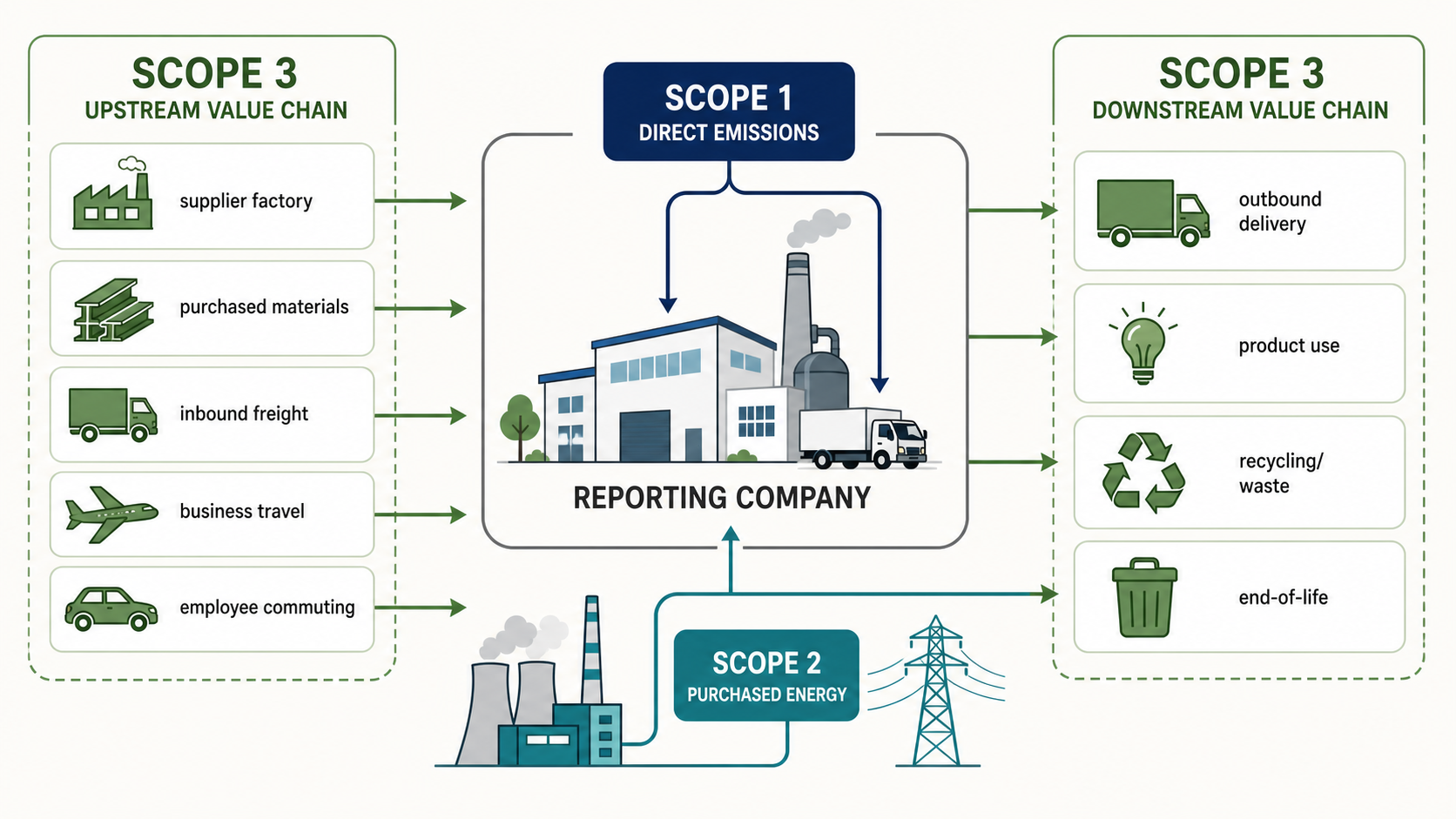
- Scope 1 — Emissions you create directly. Your company vehicles, your factory furnaces, your on-site generators.
- Scope 2 — Emissions from the energy you buy. The electricity powering your office lights and servers.
- Scope 3 — Everything else. Every emission tied to your business that happens before it reaches you or after it leaves you.
Scope 3 is split into two directions:
- Upstream (Categories 1–8): everything that happens to get your product or service ready — your suppliers, your logistics, your employees getting to work.
- Downstream (Categories 9–15): everything that happens after you've sold it — how it's shipped, used, and eventually thrown away.
Now let's go through each one.
Upstream categories (1–8): everything before your product exists
1. Purchased goods and services
The emissions baked into everything you buy to run your business — raw materials, packaging, office supplies, even software licenses. For most companies, this is the single biggest Scope 3 category, simply because it covers so much ground. A clothing brand's biggest Category 1 driver might be cotton and dye; a software company's might be the cloud servers it rents.
2. Capital goods
Similar to Category 1, but for the big-ticket, long-life stuff: machinery, buildings, vehicles, IT equipment. If you bought it and it's still on your balance sheet in five years, it probably belongs here.
3. Fuel- and energy-related activities
The emissions from getting fuel and electricity to you — extraction, refining, transmission losses — that aren't already counted in Scope 1 or 2. It's the "emissions behind the emissions."
4. Upstream transportation and distribution
The freight and logistics that move goods to you — from your supplier's factory to your warehouse, in trucks, ships, or planes you don't own or operate.
5. Waste generated in operations
What happens to the waste your operations produce, once it leaves your building. Landfill, incineration, recycling — all of it carries an emissions footprint.
6. Business travel
Flights, hotel stays, rental cars for work trips. It's usually one of the more visible categories because the data (travel bookings) already exists somewhere in your systems.
7. Employee commuting
The emissions from employees getting to and from work — by car, train, or bus. Hybrid and remote work policies genuinely move this number.
8. Upstream leased assets
Emissions from operating assets you lease from someone else — a warehouse, a piece of equipment, a fleet vehicle that isn't yours but that you run day to day.
Downstream categories (9–15): everything after you sell it
9. Downstream transportation and distribution
The logistics that happen after the sale — moving your product from your warehouse to a retailer or straight to a customer's door.
10. Processing of sold products
If you sell something that another business turns into a different product, the emissions from that further processing count here. A steel producer selling to a car manufacturer is a classic example.
11. Use of sold products
For a huge range of companies, this is the biggest number on the whole list. It's the emissions created every time a customer uses what you sold them — every mile a car you made is driven, every hour a laptop you built stays plugged in.
12. End-of-life treatment of sold products
What happens when your product is finally thrown away or recycled, once the customer is done with it.
13. Downstream leased assets
The mirror image of Category 8 — emissions from assets you own but lease out to someone else, like a property you rent to a tenant.
14. Franchises
If you run a franchise model, this covers the operational emissions of your franchisees — restaurants, retail locations, service outlets operating under your brand.
15. Investments
Often called "financed emissions." If your company holds equity or debt investments, the emissions of the companies you've invested in count toward your own footprint. This one matters enormously for banks, private equity, and holding companies.
A quick honesty note: you're expected to screen all 15 categories for relevance, but you don't need deep, granular data on every single one. If a category genuinely doesn't apply to your business, you're allowed to explain why and move on. The skill isn't measuring everything perfectly — it's knowing where your real exposure sits.
Why Scope 3 breaks most teams (even good ones)
None of the 15 categories above is conceptually hard. What's hard is this:
- The data doesn't live in one place. Fuel receipts sit with facilities. Travel data sits with finance. Supplier data sits with procurement — if it exists at all.
- Suppliers won't always give you clean numbers. So teams fall back on spend-based estimates (multiplying a dollar amount by an industry-average emissions factor), which are fast but rough — two companies spending the same amount on very different products get treated the same.
- It's manual, every single reporting cycle. Someone, somewhere, is copying numbers from an invoice PDF into a spreadsheet, right now.
- The reporting bar keeps rising. The SEC's climate disclosure rule, California's SB 253 and SB 261, and CDP questionnaires are all pushing companies toward more granular, more auditable Scope 3 data — not less.
That combination — scattered data, manual effort, and rising expectations — is exactly why so many sustainability teams end up spending more time wrangling data than actually reducing emissions. The categories were never the bottleneck. The pipeline was.
This is where Oceans comes in
We built OCEANS Sustainability Platform around one belief: a company shouldn't need a small army of analysts and a maze of spreadsheets just to answer "what's our Scope 3 footprint?"
Here's how OCEANS Sustainability Platform Platform takes the pain out of the 15 categories above:
- Upload raw data, not reformatted data. Feed in the messy Excel files, invoices, and utility bills you already have. Oceans maps them into the right Scope 3 categories automatically — no manual reclassification required.
- One system instead of five. Procurement spend, travel logs, facility data, and supplier disclosures live in a single pipeline, so nothing falls through the cracks between departments.
- Dashboards built for the room, not just the report. Whether you're presenting to your board, a regulator, or a client asking about your supply chain, Oceans turns raw numbers into a dashboard people actually understand at a glance.
- Built for evolving compliance. As frameworks like the SEC's climate rule, California's SB 253/261, and CDP shift their requirements, your underlying data stays structured and ready — instead of needing to be rebuilt from scratch each cycle.
- Less chasing, more deciding. The goal isn't just measurement for its own sake. It's giving your team the time back to actually act on what the data shows — which suppliers to work with, where to invest in reduction, what's actually material to your business.
If Category 1 (purchased goods) or Category 11 (use of sold products) is where your real exposure lives — and for most companies, it is — Oceans is built to make that visible in days, not quarters.
FAQ
What's the difference between Scope 1, 2, and 3 emissions? Scope 1 is emissions you create directly. Scope 2 is emissions from the energy you purchase. Scope 3 is every other emission connected to your value chain, both upstream (suppliers, travel, commuting) and downstream (product use, distribution, disposal).
Which Scope 3 category is usually the biggest? It depends on the business, but Category 1 (purchased goods and services) and Category 11 (use of sold products) are the two most common heavyweights — the first for manufacturers and retailers, the second for anyone selling a product that runs on energy.
Do companies have to report on all 15 categories? Companies are expected to screen all 15 for relevance, but only need to report in depth on the ones that are material to their business. Categories judged irrelevant can be excluded, with a stated reason.
How do you actually calculate Scope 3 emissions? Most companies use a mix of methods: spend-based (dollars spent × an industry emissions factor) for a fast starting estimate, and activity-based (actual quantities — distance travelled, kilowatt-hours used, tons shipped) for greater accuracy where the data is available. Platforms like Oceans are built to layer both, tightening your estimates over time as better data comes in.
Sai Praneeth B, Sustainability expert
OCEANS™ Sustainability
OCEANS™ Sustainability is carbon-accounting software for growing US manufacturers, a product of TheEvenity Pvt Limited. The Founding Design Partner Program is now open.