
One person gets the email. Three departments have the data. No system connects them.
That's not a description of a broken process. It's the default state at almost every mid-sized automotive supplier in the country, and it repeats every time GM, Ford, Stellantis, or Toyota sends a sustainability scorecard down the chain. If you've lived through it, the next few paragraphs will feel less like an article and more like a transcript.
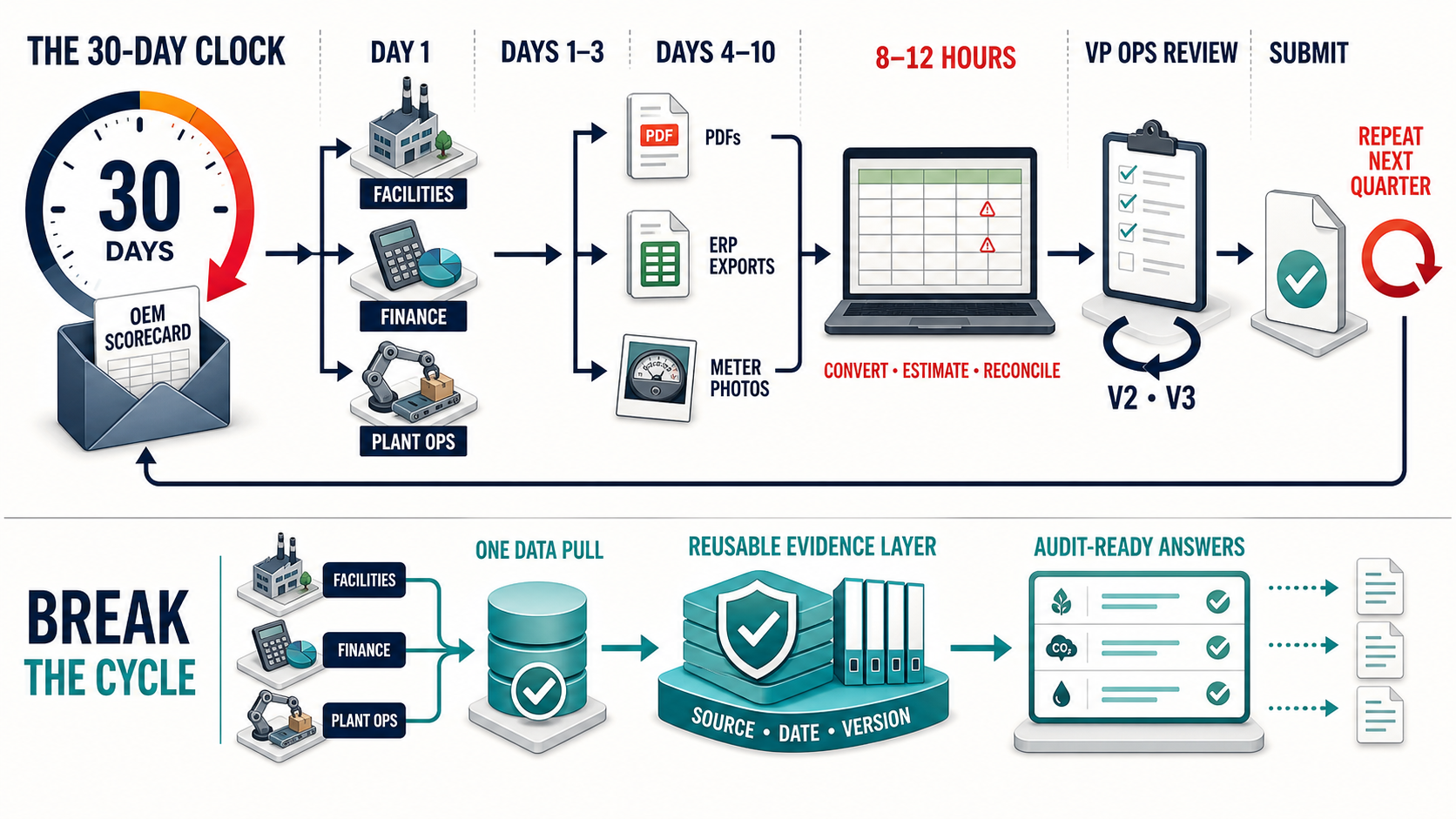
Day 1: The Clock Starts
The scorecard lands in one inbox — usually the EHS manager's, sometimes the environmental lead's. There's no ESG system to route it to, no shared data layer to pull from. Just the email and a 30-day deadline.
There's no meeting to kick this off, because there's no team to kick it off with. It's one person, and now it's their problem.
Days 1–3: Three Emails Go Out
The EHS manager can't produce this data alone, because they don't have it. So three emails go out:
- To Facilities: utility bills, by site, by month.
- To Finance: ERP cost data — what was purchased, from whom, how much.
- To Plant Ops: fuel logs and meter readings, often still recorded by hand.
Each of these departments has a piece of the answer. None of them has ever been asked to format it for a carbon calculation before.
Days 4–10: The Wait, and the Mess That Arrives
Responses trickle in over three to seven days, and they don't match. Facilities sends PDFs. Finance sends a cost-center export with SKUs that don't map cleanly to anything. Plant Ops sends a photo of a meter reading from a supervisor's phone. Units are inconsistent — some in kWh, some in dollars, some in gallons. Date ranges don't line up: one department reports by calendar month, another by fiscal quarter.
Nobody did anything wrong. Nobody was ever asked to keep this data in a form another department, let alone an OEM, could use.
The 8–12 Hour Spreadsheet
This is where the real cost hides. Someone — almost always the EHS manager, on top of their actual job — spends eight to twelve hours converting units, filling gaps with estimates, reconciling date ranges, and building a spreadsheet that will not exist in this exact form ever again. There isn't time to build something reusable. There's only time to build something that answers this questionnaire, this month.
The file gets emailed to VP Ops for review. Comments come back. Version 2 goes out. Sometimes version 3. Each round trip costs another day against the clock.
It Gets Submitted. Then It Starts Over.
The scorecard goes back to the OEM. Relief lasts until the next questionnaire arrives — from a different customer, in a different format, asking for overlapping but not identical data.
None of the work from last quarter carries forward. There's no reusable data layer underneath any of this, so the 8–12 hours doesn't get shorter. It happens again. And again, every time a new OEM request lands, or an existing one gets updated.
This is the part that's easy to miss if you've never lived it: the problem isn't that Scope 3 is calculated wrong. It's that it never gets to exist as an asset. It gets rebuilt, from scratch, under deadline, every single time.
Who Actually Has to Say Yes
The EHS manager feels this pain daily, but they usually can't fix it alone — because fixing it means buying something, and they're not the one who signs off.
That decision sits with VP Operations or the CFO. And here's what actually triggers a yes: not a pitch about ESG maturity, not a sustainability roadmap. It's the moment the EHS manager says, plainly, "I cannot do this without a tool" — and the cost fits inside an existing operational line, not a new software budget nobody planned for. There's rarely a sustainability analyst in the room for that conversation. It's an operations decision, made in operational language.
IT and finance tend to stay quiet at this stage too, as long as the pilot is read-only and doesn't touch the ERP directly. Security and data-handling questions come later, once the pilot proves the workflow — not before.
What Actually Breaks the Cycle
If you recognize this workflow, the fix isn't a bigger spreadsheet template or a sustainability hire you can't justify yet. It's a system that does the three things a spreadsheet structurally cannot:
- Pulls from Facilities, Finance, and Plant Ops once, into one place — instead of three inboxes and three formats every quarter.
- Keeps the data alive between questionnaires, so the next OEM request pulls from an existing evidence base instead of starting the 8–12 hour build over again.
- Shows its work — source, date, version — so when VP Ops asks for the third review round, the answer is a traceable number, not a new spreadsheet tab.
That's the difference between a 30-day scramble every quarter and a system that already has the answer sitting there when the email arrives.
If you're the one who just opened the scorecard: you're not behind, and this isn't a you-problem. OCEANS builds the evidence layer underneath exactly this workflow — one data pull, versioned and audit-ready, that answers GM's, Ford's, Stellantis's, and Toyota's questionnaires from the same underlying numbers. If it's time to make the case to whoever signs off on this, see how it works.
Sai Praneeth — Founder, OCEANS Sustainability
OCEANS™ Sustainability
OCEANS™ Sustainability is carbon-accounting software for growing US manufacturers, a product of TheEvenity Pvt Limited. The Founding Design Partner Program is now open.