OCEANS™ PRACTICAL GUIDES
Practical guidance for building credible climate data
Step-by-step guides, checklists, templates, and examples for collecting sustainability data, calculating emissions, improving Scope 3 information, and preparing stakeholder-ready reports.
Written for growing companies with lean sustainability teams.
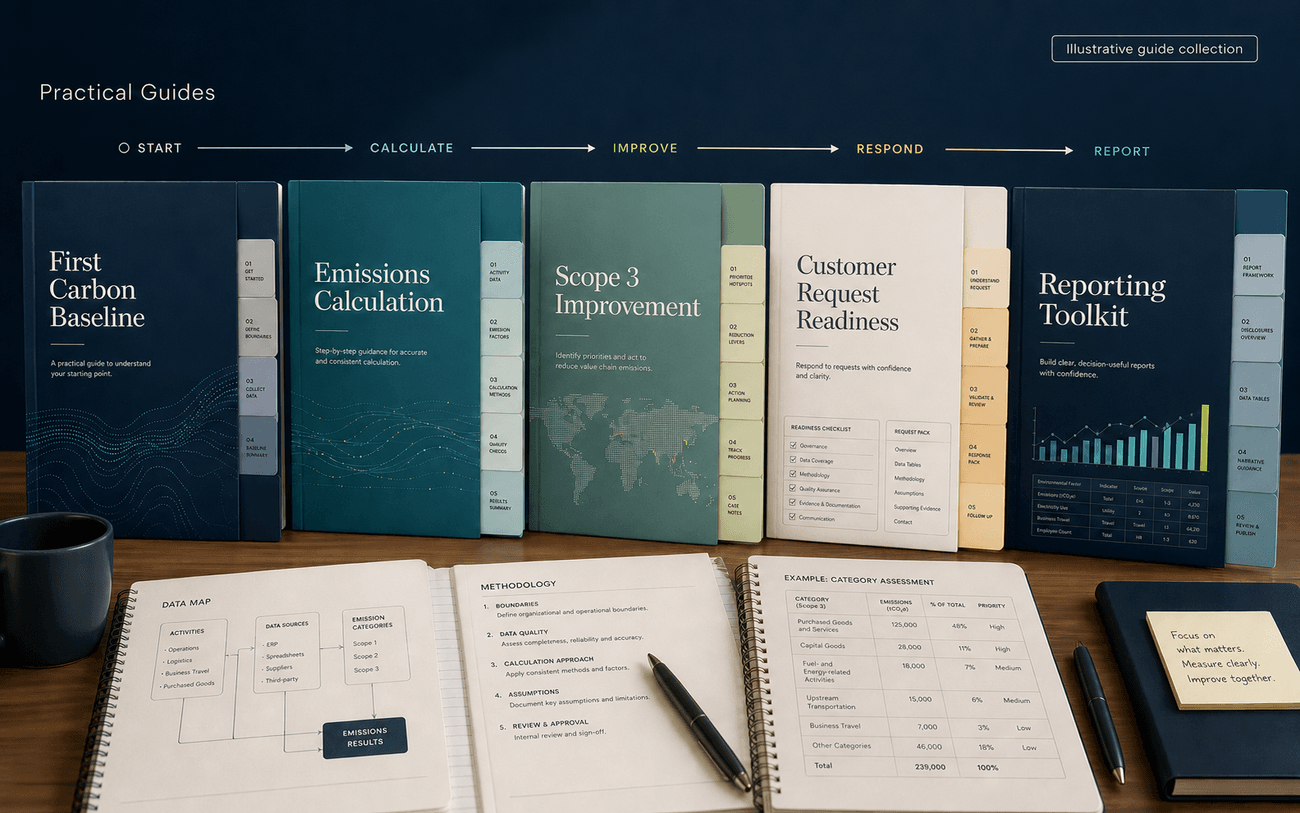
- Start
- Calculate
- Improve
- Respond
- Report
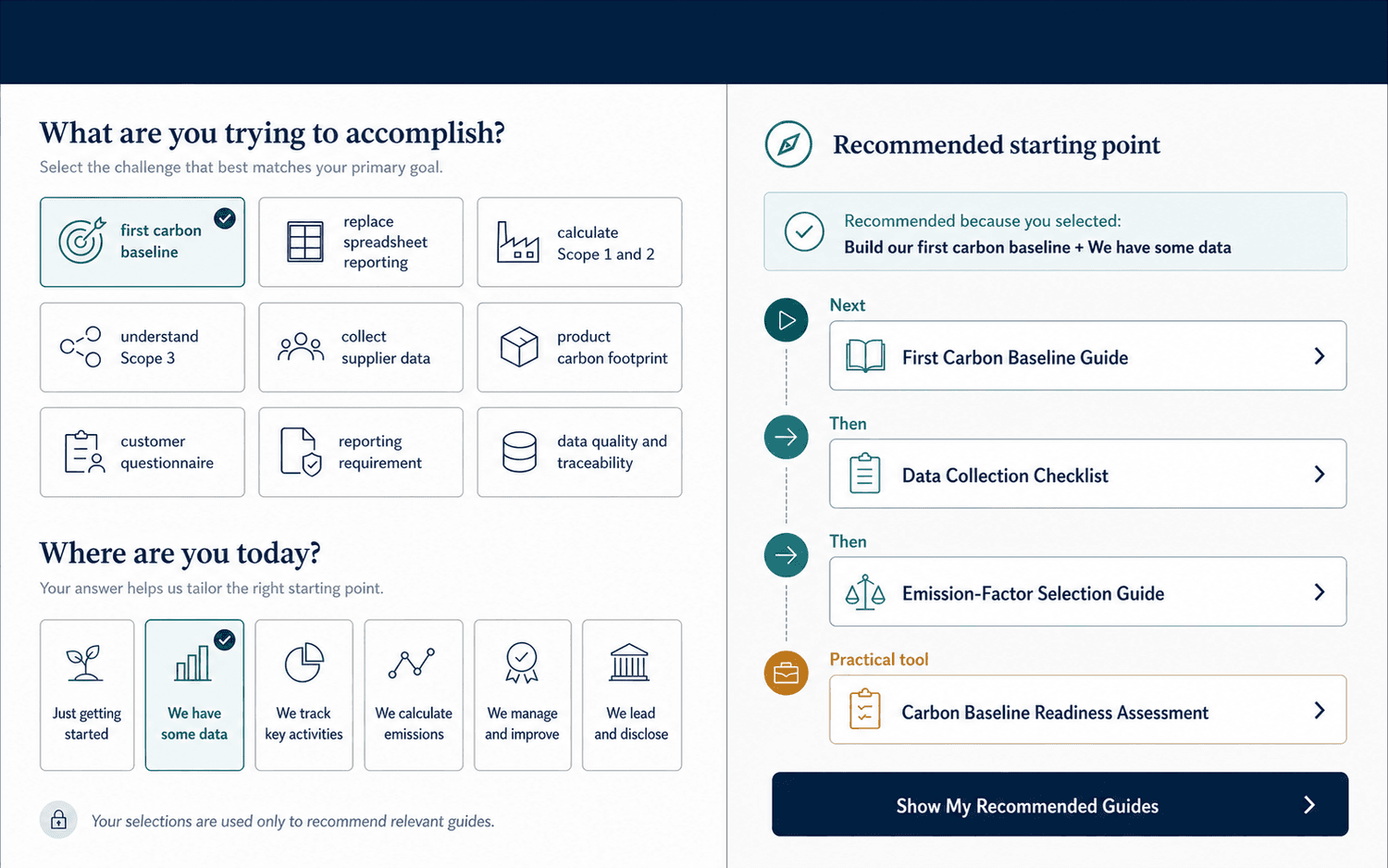
GUIDE FINDER
What are you trying to accomplish?
Choose your current challenge and receive a recommended learning path.
TRY IT NOW
Get an immediate preparation summary
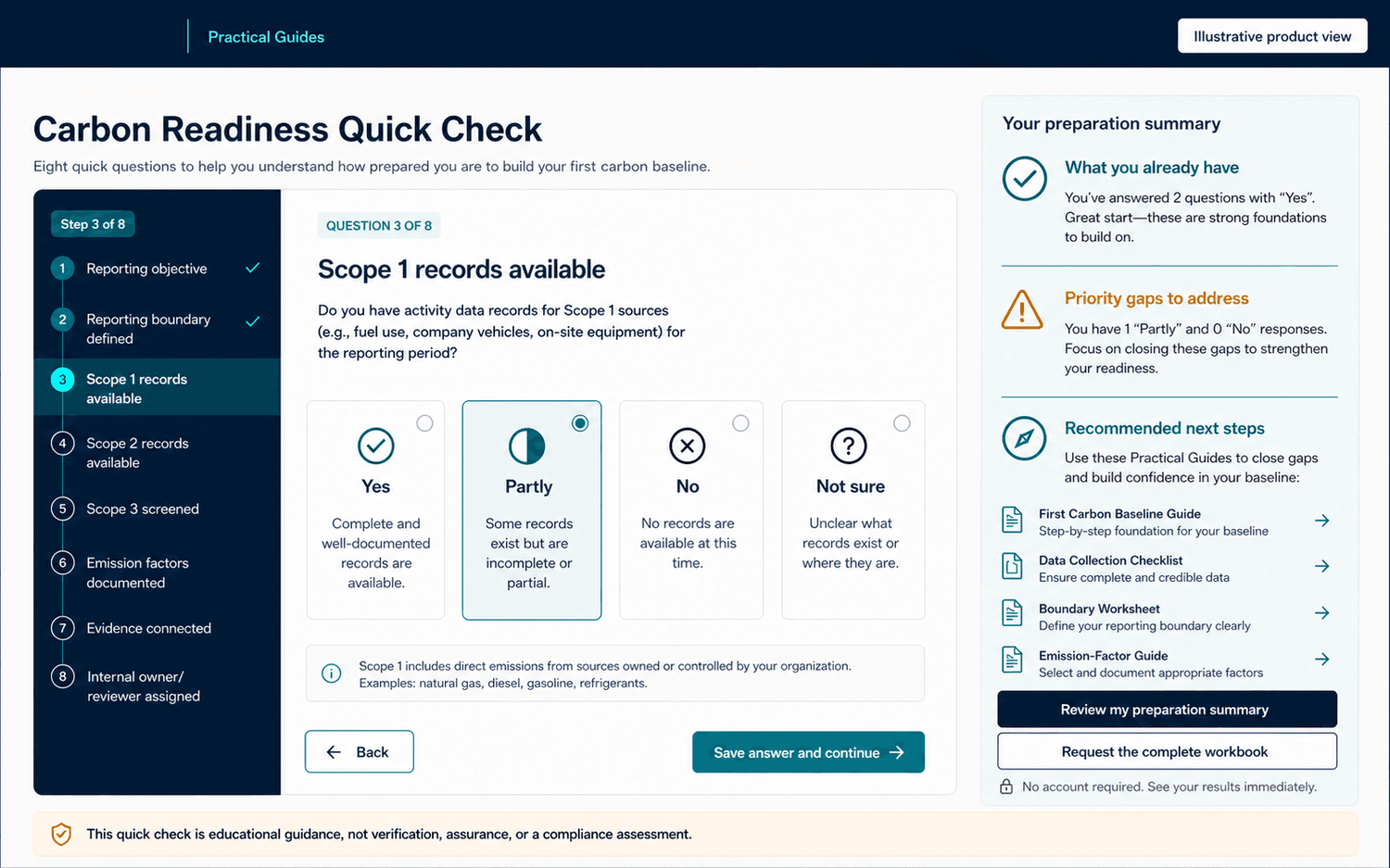
Answer eight concise questions about your reporting boundary, activity data, factors, evidence, and ownership. See what you already have and your priority gaps immediately — no login or email required.
Take the Carbon Readiness Quick CheckFEATURED GUIDE
The practical guide to building your first carbon baseline
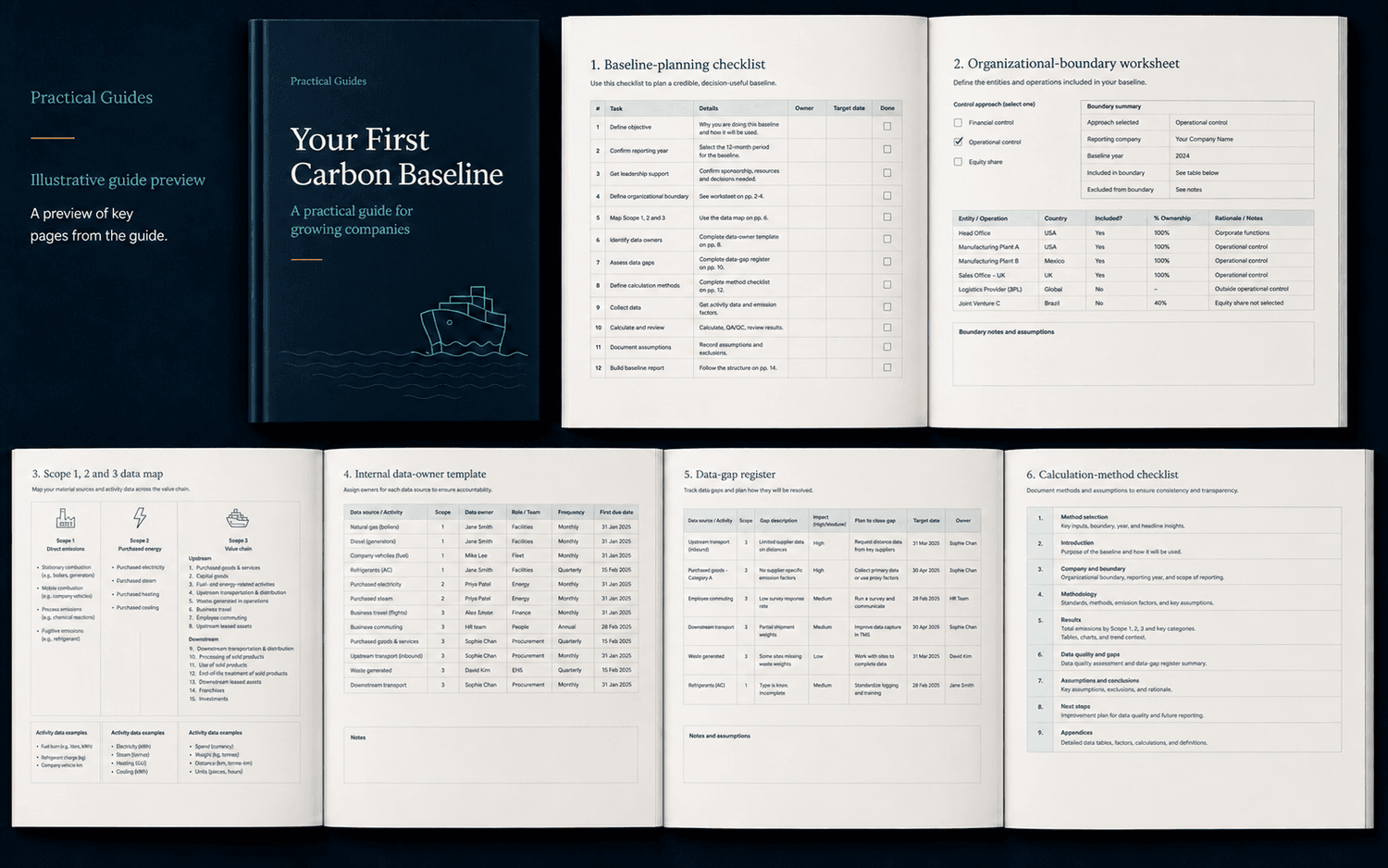
Learn how to define reporting boundaries, identify emissions sources, collect available business data, select calculation methods, document estimates, and prepare your first organizational emissions inventory.
What the guide includes
- Baseline-planning checklist
- Organizational-boundary worksheet
- Scope 1, 2, and 3 data map
- Internal data-owner template
- Data-gap register
- Calculation-method checklist
- Baseline-report structure
Start with the outcome you need
Establish your first baseline
Understand boundaries, emissions scopes, data requirements, calculation methods, and reporting outputs.
- Build Your First Carbon Baseline
- Scope 1, 2, and 3 Data Collection Checklist
- How to Select and Document Emission Factors
- Carbon Accounting Readiness Checklist (Planned)
- How to Define Organizational Boundaries (Planned)
Replace spreadsheet reporting
Move from disconnected workbooks to a structured and repeatable carbon-accounting process.
- Moving Carbon Accounting Beyond Spreadsheets
- Reporting Toolkit
- Spreadsheet Migration Checklist (Planned)
- Carbon Data Model Template (Planned)
- Calculation-Control Checklist (Planned)
Improve Scope 3 data
Identify relevant categories, organize procurement information, engage suppliers, and improve estimates progressively.
- Scope 3 Screening and Supplier Prioritization
- Scope 3 Toolkit
- The 15 Scope 3 Categories Explained (Planned)
- Spend-Based Versus Activity-Based Methods (Planned)
- Supplier Data Quality Checklist (Planned)
Respond to customers
Prepare reusable, reviewed sustainability information for RFPs, procurement requests, and questionnaires.
- Customer Sustainability Request Readiness Guide
- Customer Request Toolkit
- How to Explain Your Carbon Footprint (Planned)
- Evidence Checklist for Customer Responses (Planned)
Calculate product footprints
Structure materials, supplier, manufacturing, packaging, transportation, use, and end-of-life information.
- Product Footprint Toolkit
- Product Carbon Footprint Starter Guide (Planned)
- Product System Boundary Worksheet (Planned)
- PCF, LCA, and EPD: What Is the Difference? (Planned)
Prepare reports
Turn reviewed emissions information into consistent disclosures and stakeholder-ready outputs.
- Reporting Toolkit
- Carbon Inventory Reporting Checklist (Planned)
- How to Write a Calculation Methodology (Planned)
- Estimates and Exclusions Register (Planned)
GUIDANCE FOR YOUR ROLE
Find the information relevant to your responsibilities
Sustainability teams
Build inventories, manage Scope 3, improve data quality, and coordinate reporting.
Finance teams
Connect financial records with carbon data, establish controls, and support review.
Procurement teams
Categorize purchases, prioritize suppliers, and collect better value-chain information.
Operations and facilities
Provide energy, fuel, refrigerant, waste, and facility-level records.
Sales and proposal teams
Respond consistently to customer sustainability questions and RFP requirements.
Legal and compliance teams
Understand reporting developments, review external claims, and coordinate responsibilities.
Product teams
Calculate product footprints and investigate emissions hotspots.
GUIDE LIBRARY
Six cornerstone guides to start with
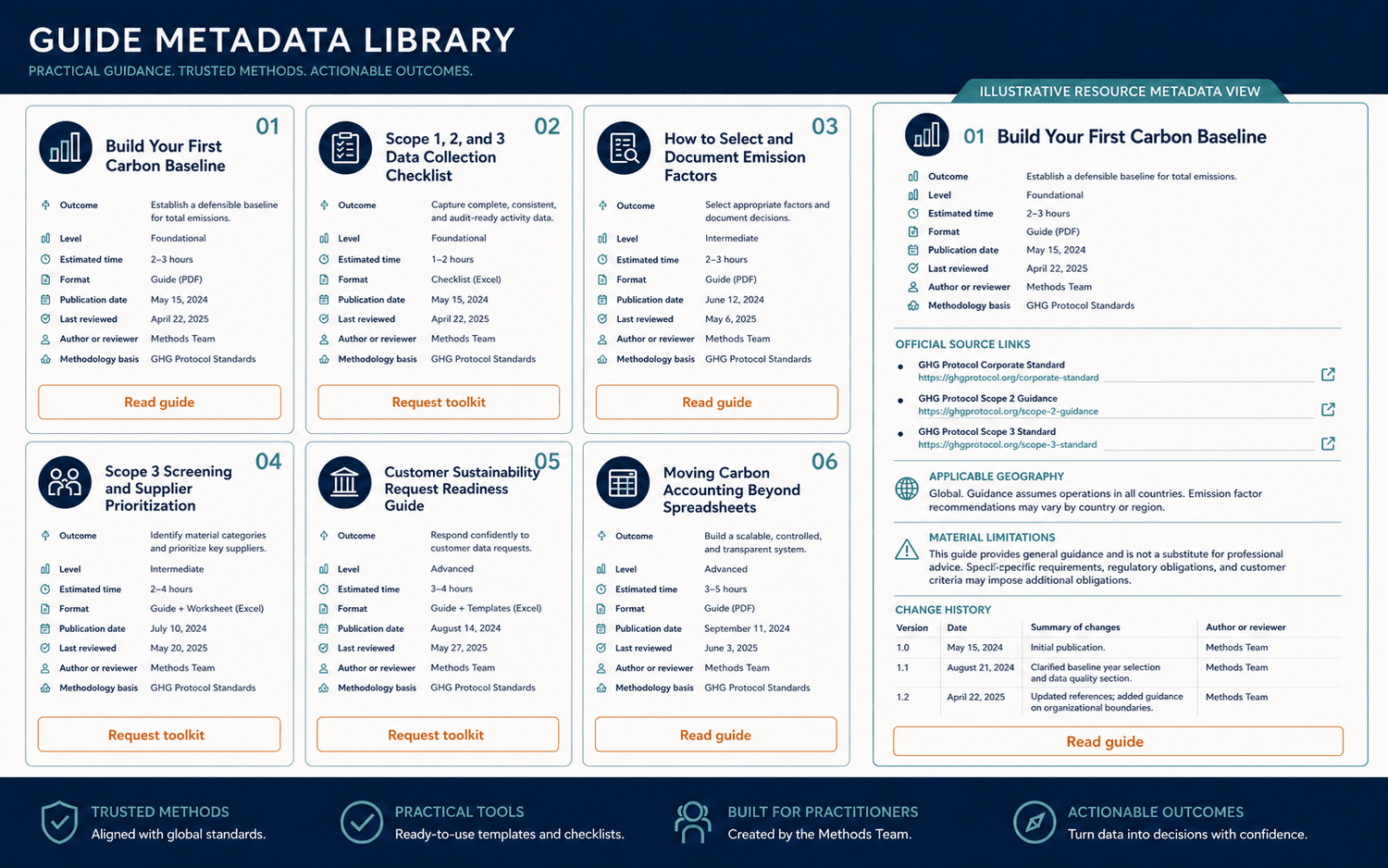
Supplier Data Checklist
Request and review supplier-provided emissions data consistently, field by field.
Last reviewed September 2026
Open checklistMoving Carbon Accounting Beyond Spreadsheets
Assess your current spreadsheet process and plan a phased migration to a structured system.
Last reviewed August 2026
Read guideCustomer Sustainability Request Readiness Guide
Prepare approved answers and evidence before a customer questionnaire or RFP arrives.
Last reviewed August 2026
Read guideScope 3 Screening and Supplier Prioritization
Identify which of the fifteen Scope 3 categories are relevant, and which suppliers to engage first.
Last reviewed September 2026
Read guideHow to Select and Document Emission Factors
Understand what makes a factor suitable, and what to record so the choice can be reviewed later.
Last reviewed August 2026
Read guideScope 1, 2, and 3 Data Collection Checklist
Work department by department through the records needed for a complete first inventory.
Last reviewed August 2026
Open checklistBuild Your First Carbon Baseline
Define your reporting boundary, collect available data, and produce a first-year emissions inventory.
Last reviewed August 2026
Read guideTOOLS YOU CAN USE
Move from reading to doing
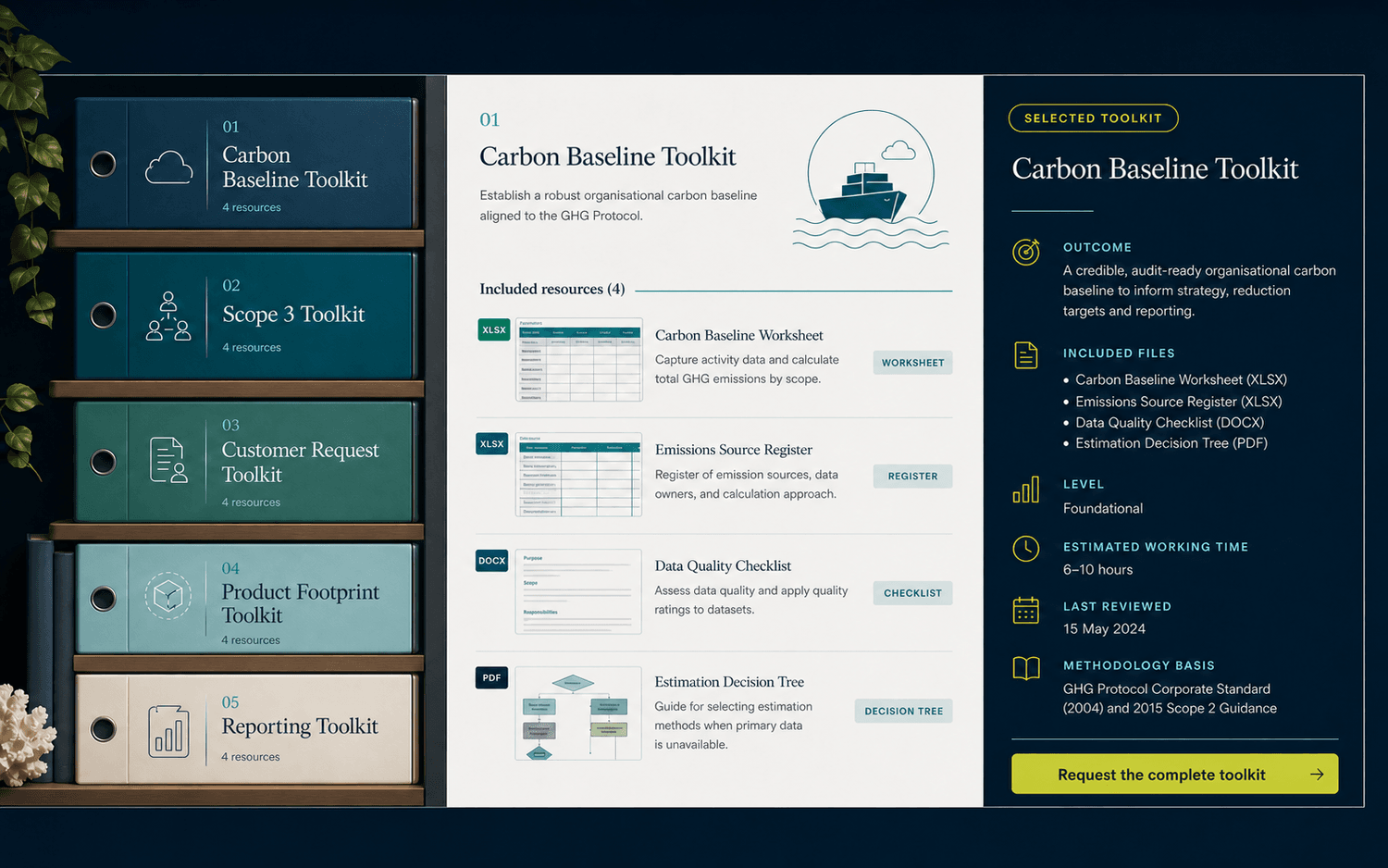
OCEANS™ guides include practical resources that teams can use in their own reporting processes. Toolkits are multi-file working resources, reviewed manually before access is provided.
Reporting Toolkit
Inventory-report outline, methodology-statement template, assumptions register, exclusions register, and internal-approval checklist.
30-minute working session
Request toolkitProduct Footprint Toolkit
Product definition worksheet, system-boundary diagram, product-data template, allocation register, and methodology checklist.
30-minute working session
Request toolkitCustomer Request Toolkit
Request-intake form, approved-answer library, evidence checklist, review workflow, and response-readiness assessment.
30-minute working session
Request toolkitScope 3 Toolkit
Category-screening worksheet, procurement template, supplier-prioritization matrix, supplier-request template, and data-quality checklist.
30-minute working session
Request toolkitCarbon Baseline Toolkit
Boundary worksheet, data-source map, data-owner register, Scope screening checklist, and data-gap tracker.
30-minute working session
Request toolkitFollow a structured path instead of searching randomly
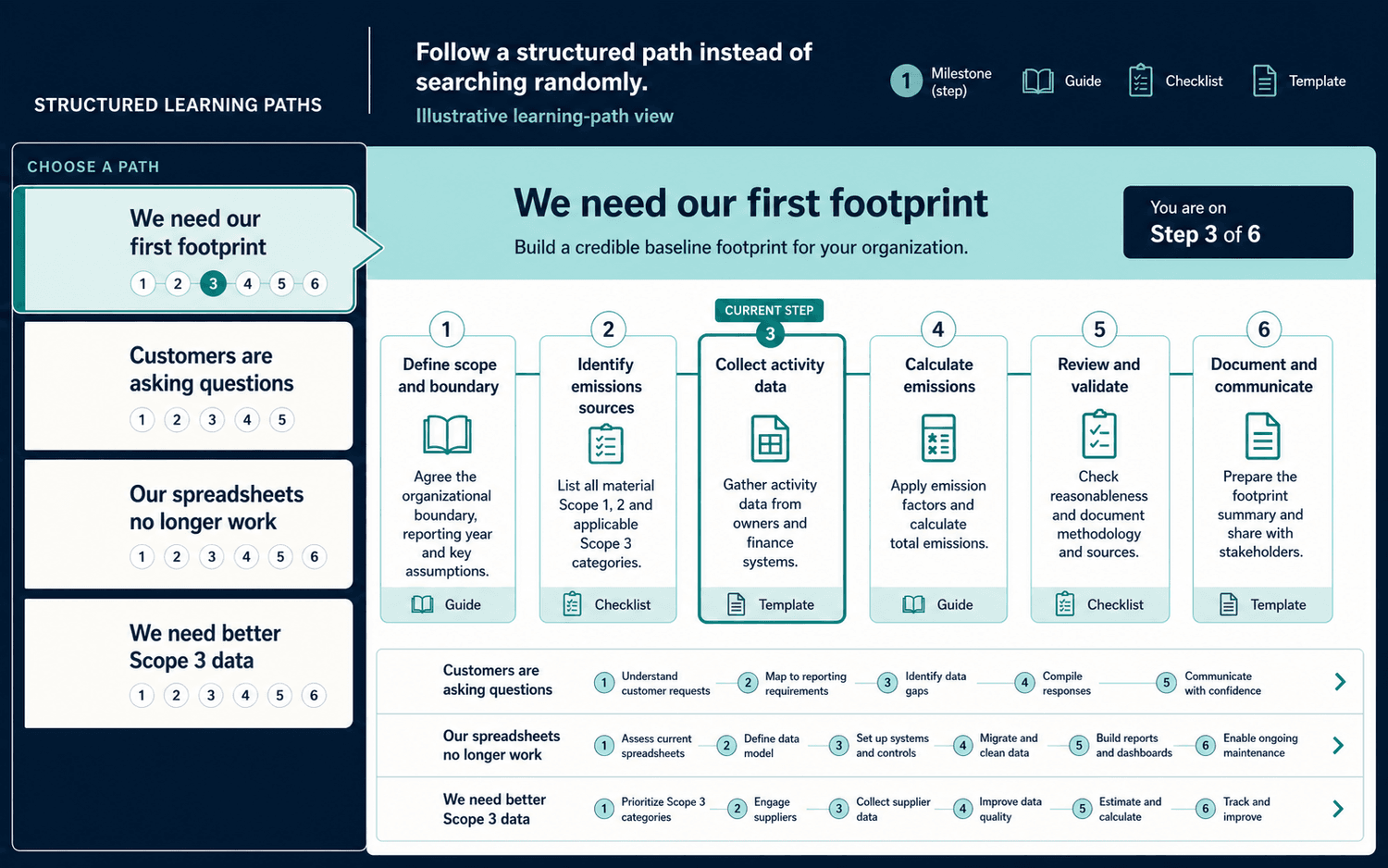
We need our first footprint
- 01Carbon Accounting Fundamentals(Planned)
- 02Build Your First Carbon Baseline(Guide)
- 03Scope 1, 2, and 3 Data Collection Checklist(Checklist)
- 04How to Select and Document Emission Factors(Guide)
- 05Carbon Baseline Toolkit(Toolkit)
Customers are asking questions
- 01Customer Sustainability Request Readiness Guide(Guide)
- 02Build Your First Carbon Baseline(Guide)
- 03Customer Request Toolkit(Toolkit)
Our spreadsheets no longer work
- 01Moving Carbon Accounting Beyond Spreadsheets(Guide)
- 02Scope 1, 2, and 3 Data Collection Checklist(Checklist)
- 03Reporting Toolkit(Toolkit)
We need better Scope 3 data
- 01Scope 3 Screening and Supplier Prioritization(Guide)
- 02Scope 3 Toolkit(Toolkit)
RESEARCH APPROACH
Guidance grounded in recognized methodologies
OCEANS™ guides draw from relevant standards, official regulatory sources, and established greenhouse-gas accounting practices. Every technical or regulatory guide includes an author or technical reviewer, publication date, last-reviewed date, source links, applicable geography, methodology basis, material limitations, and change history where relevant.
Guides provide general educational information. Legal, accounting, assurance, and regulatory decisions should be reviewed with appropriately qualified advisers.
Understand a requirement—and the data behind it
Regulatory guides connect each potential reporting requirement to applicability questions, organizational boundaries, required scopes, activity-data requirements, calculation methods, evidence expectations, timelines, and practical readiness actions.
Explore Regulatory UpdatesPut the guidance into practice with OCEANS™
| Guidance need | OCEANS™ workflow |
|---|---|
| Identify required records | Connect Data |
| Calculate Scope 1, 2, and 3 | Calculate Emissions |
| Document factor selection | Emission Factors |
| Connect results to evidence | Verify Evidence |
| Improve data confidence | Data Quality and Traceability |
| Prepare stakeholder outputs | Prepare Reports |

Guides in practice
Worksheets that assign ownership and close gaps
EHS, sustainability, operations, and finance teams use these worksheets together to assign ownership and close data gaps — not as a solo reading exercise.
Recently published and updated
OCEANS™ PRACTICAL BRIEF
One useful carbon-accounting resource at a time
Receive practical guides, reporting checklists, methodology updates, and regulatory preparation tools designed for lean sustainability teams. No spam, unsubscribe anytime.
Not sure which guide fits your situation?
Tell us where your carbon-accounting process stands and what prompted your current work. We will recommend the most useful starting point.