OCEANS™ REGULATORY IMPACT CENTER
Know what changed—and what your company should prepare next
Track climate-reporting developments, understand their potential business impact, and translate emerging requirements into practical data, calculation, evidence, and reporting actions.
Official sources. Clear explanations. Practical preparation steps.
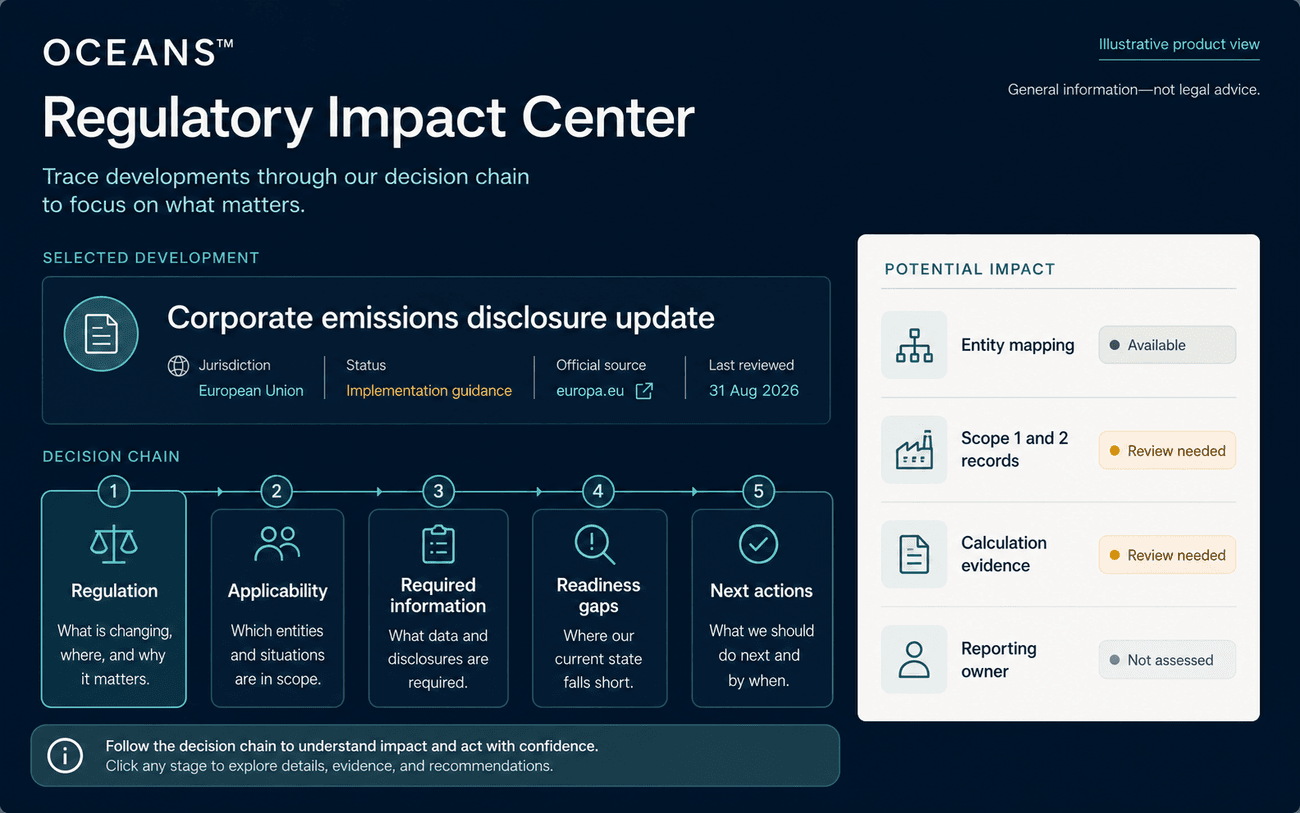
- Regulatory development
- Possible relevance
- Information to examine
- Data/readiness gaps
- Owners and next actions
OCEANS™ provides general regulatory intelligence for preparation and planning. It does not provide legal, accounting, regulatory, or assurance advice.
Regulatory news tells you what happened. OCEANS™ helps you understand what it may mean.
A regulatory announcement
Climate-reporting requirements are changing across states, countries, and international standards — but an announcement alone rarely answers the questions that matter to your team.
The operational questions your team still needs to answer
- Does this potentially apply to our company?
- Which reporting period is affected?
- Which emissions scopes may be required?
- What data should we begin collecting?
- Will assurance or supporting evidence be expected?
- Are our customers likely to request information from us?
- Which parts of our current process are not ready?
REGULATION EXPLORER
Find climate-reporting developments relevant to your operating profile
Filter curated, reviewed regulatory records by jurisdiction, topic, and status. This explorer indicates possible relevance — it does not decide legal applicability.
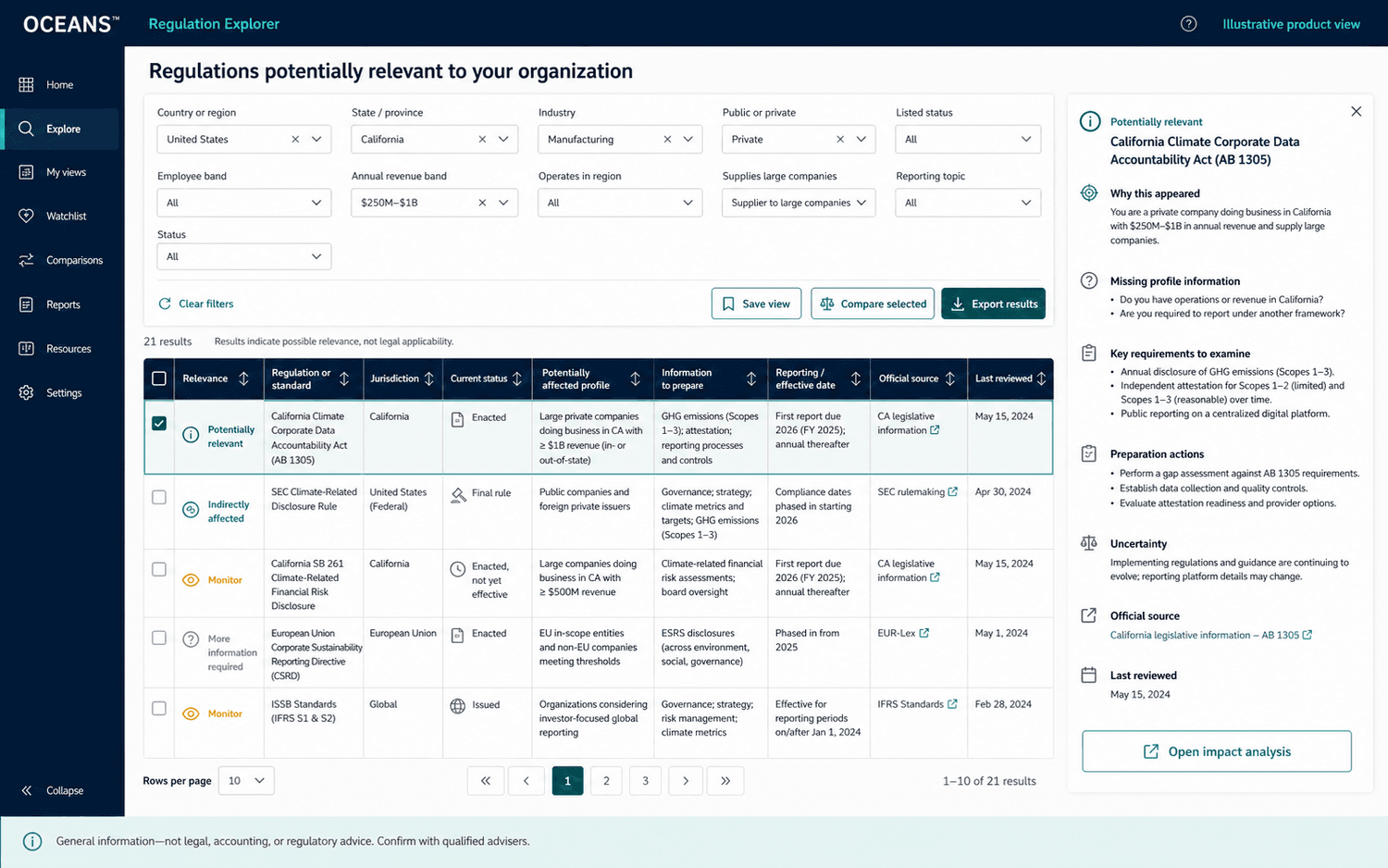
4 results
| Relevance | Jurisdiction | Status | Last reviewed | Open impact analysis | ||
|---|---|---|---|---|---|---|
| Potentially relevant | California climate-reporting laws: what companies should prepare now SB 253 / SB 261 (CARB) | California | Effective | 10 Aug 2026 | 31 Aug 2026 | Open impact analysis |
| Potentially relevant | US federal climate disclosure: what the SEC's proposed rescission means SEC climate-disclosure rescission (proposed) | United States (federal) | Proposed rescission / change | Not yet known | 31 Aug 2026 | Open impact analysis |
| Potentially relevant | European sustainability reporting: what the Omnibus I simplification changed Omnibus I (CSRD / CSDDD / ESRS) | European Union | Effective | 18 Mar 2026 | 31 Aug 2026 | Open impact analysis |
| Potentially relevant | ISSB adoption around the world: how to read the jurisdiction-by-jurisdiction picture ISSB / IFRS S1 & S2 adoption | Global (ISSB / IFRS jurisdictional adoption) | Implementation guidance | Not yet known | 31 Aug 2026 | Open impact analysis |
Potentially relevant
California climate-reporting laws: what companies should prepare now
- Jurisdiction
- California
- Status
- Effective
- Effective / expected
- 10 Aug 2026
- Last reviewed
- 31 Aug 2026
Potentially relevant
US federal climate disclosure: what the SEC's proposed rescission means
- Jurisdiction
- United States (federal)
- Status
- Proposed rescission / change
- Effective / expected
- Not yet known
- Last reviewed
- 31 Aug 2026
Potentially relevant
European sustainability reporting: what the Omnibus I simplification changed
- Jurisdiction
- European Union
- Status
- Effective
- Effective / expected
- 18 Mar 2026
- Last reviewed
- 31 Aug 2026
Potentially relevant
ISSB adoption around the world: how to read the jurisdiction-by-jurisdiction picture
- Jurisdiction
- Global (ISSB / IFRS jurisdictional adoption)
- Status
- Implementation guidance
- Effective / expected
- Not yet known
- Last reviewed
- 31 Aug 2026
Results indicate possible relevance, not legal applicability.
General information — not legal, accounting, or regulatory advice. Confirm applicability with qualified advisers.
REGULATORY IMPACT FINDER
Understand which requirements may deserve detailed review
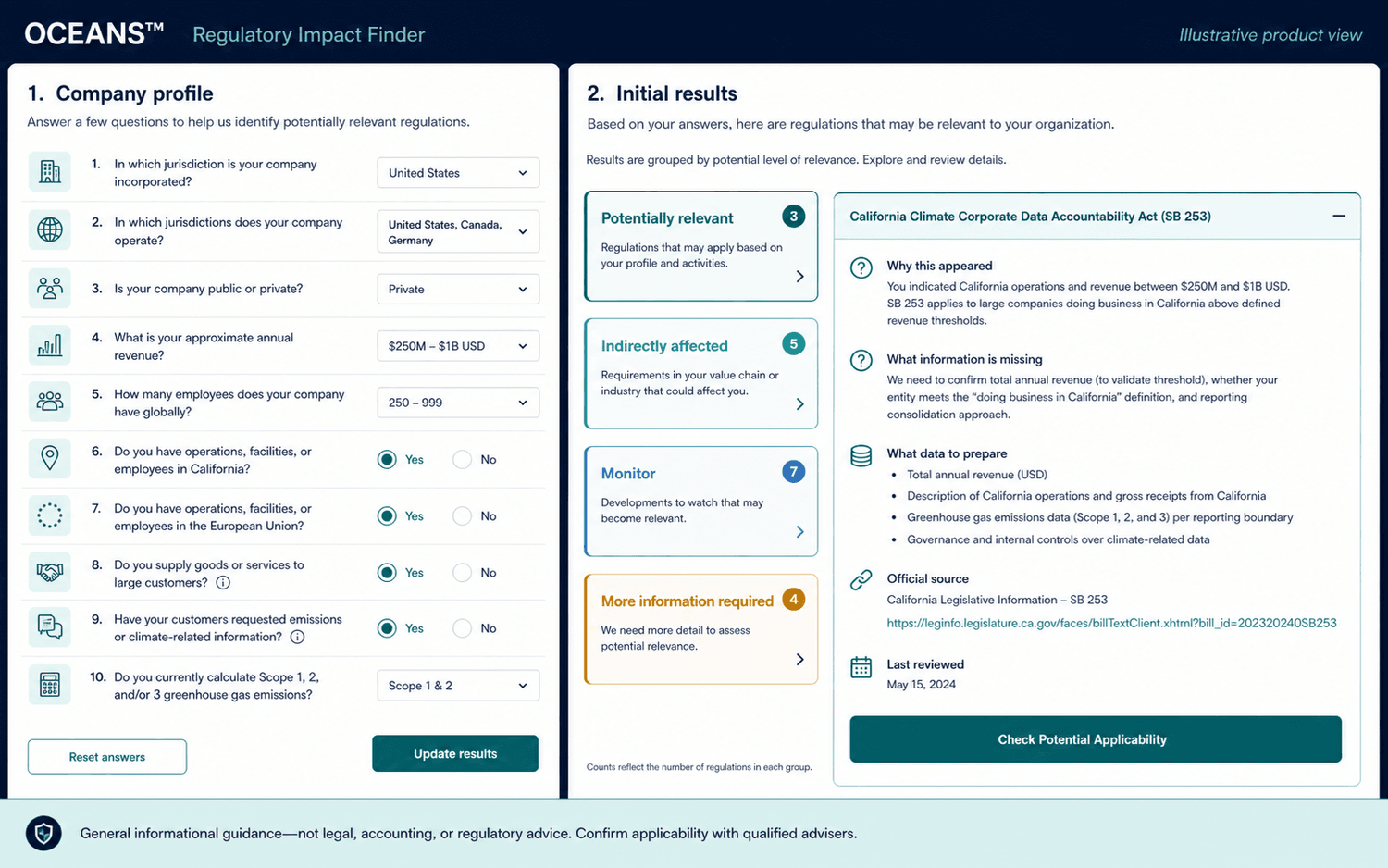
A profile-based finder would ask a short series of questions and return one of four result categories:
Potentially relevant
The available company information indicates this requirement may deserve detailed review.
Indirectly affected
Your company may not report directly, but customers, investors, or supply-chain partners could request supporting data.
Monitor
The requirement is proposed, under review, or not yet sufficiently clear for a firm applicability assessment.
More information required
Additional legal-entity, revenue, jurisdiction, or business-activity information is needed.
This matching experience is not yet enabled. Automated applicability matching is only launched after its rule logic has been professionally reviewed, versioned, tested, and signed off by a qualified reviewer — that review has not yet occurred. Use the Regulation Explorer above to browse curated, reviewed records in the meantime.
CURRENT LANDSCAPE
Follow the requirements shaping corporate climate reporting
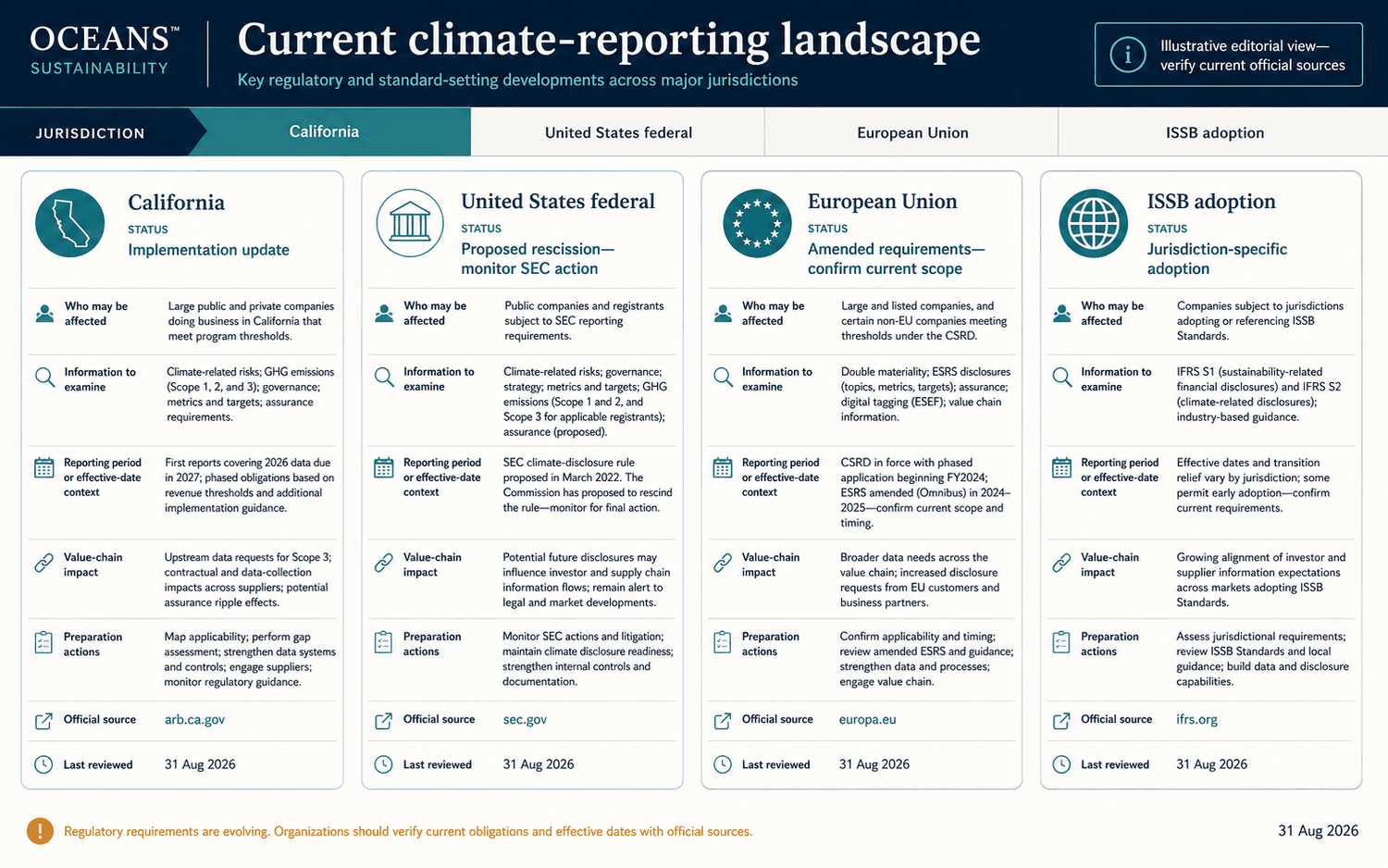
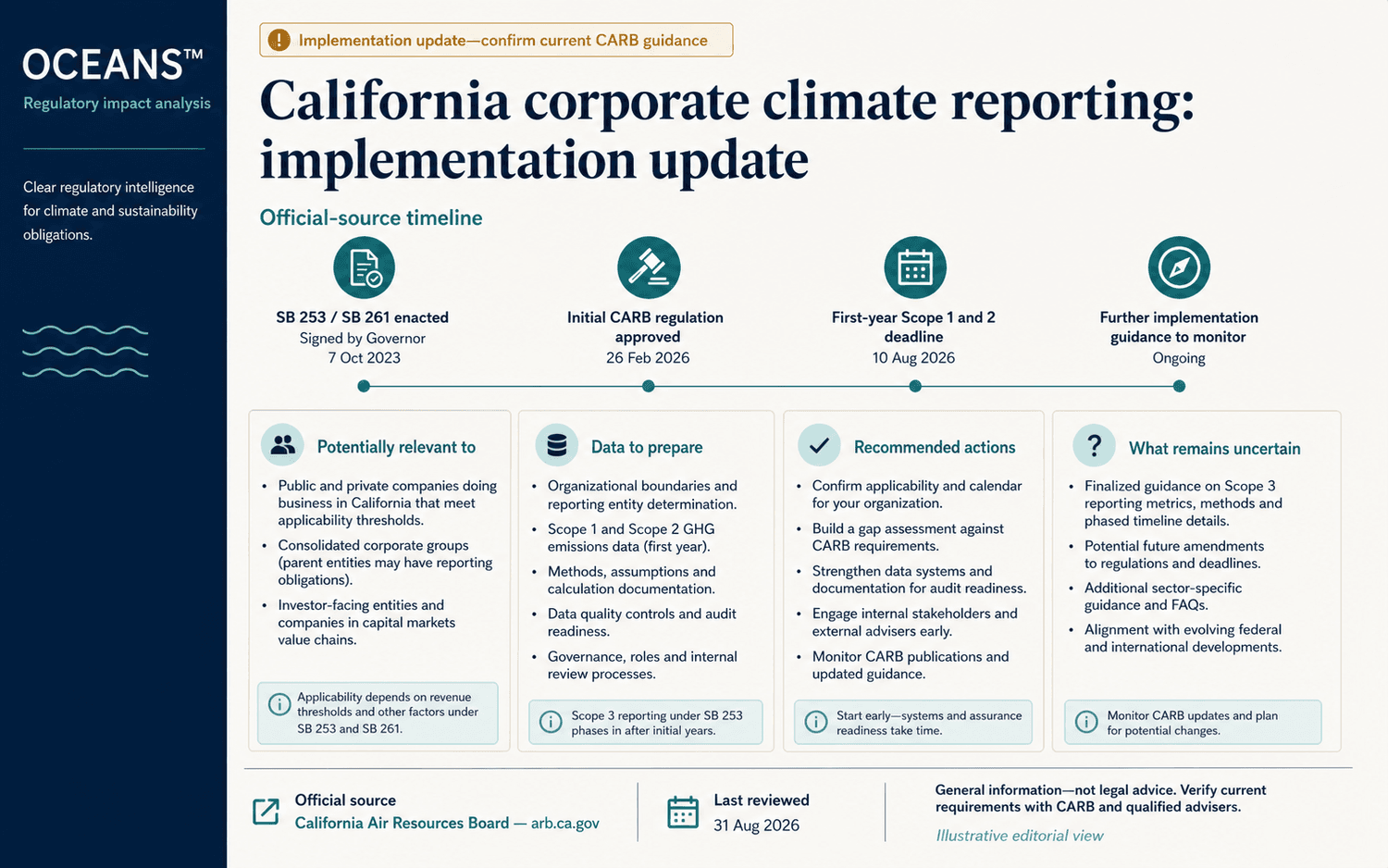
California climate-reporting laws: what companies should prepare now
The California Air Resources Board (CARB) approved the climate-transparency regulation implementing SB 253 (corporate GHG emissions reporting) and SB 261 (climate-related financial risk reporting) on 26 Feb 2026. The first annual Scope 1 and Scope 2 emissions disclosures under SB 253 were due 10 Aug 2026; Scope 3 reporting is expected to begin in 2027. CARB has indicated it will apply enforcement discretion to good-faith initial submissions.
Last reviewed 31 Aug 2026
View SB 253 / SB 261 (CARB)US federal climate disclosure: what the SEC's proposed rescission means
The SEC's March 2024 climate-related disclosure rules were stayed pending litigation and, on 29 May 2026, the Commission proposed rescinding those rules in their entirety. The proposal was published in the Federal Register on 3 June 2026 with a comment period that closed 3 Aug 2026. A final rescission requires a subsequent Commission vote, which has not yet occurred.
Last reviewed 31 Aug 2026
View SEC climate-disclosure rescission (proposed)European sustainability reporting: what the Omnibus I simplification changed
The Council of the EU gave final approval to the Omnibus I Directive simplifying the Corporate Sustainability Reporting Directive (CSRD) and Corporate Sustainability Due Diligence Directive (CSDDD) on 24 Feb 2026; it was published in the Official Journal as Directive (EU) 2026/470 and entered into force 18 Mar 2026. It raises CSRD scope thresholds to more than 1,000 employees and over €450 million net turnover. The European Commission separately adopted a delegated act on simplified ESRS (2026) on 3 Jul 2026, applying from financial years beginning on or after 1 Jan 2027 (with voluntary early adoption for FY2026). CSDDD national transposition compliance applies from 26 Jul 2029, with first reports covering financial years starting on or after 1 Jan 2030.
Last reviewed 31 Aug 2026
View Omnibus I (CSRD / CSDDD / ESRS)ISSB adoption around the world: how to read the jurisdiction-by-jurisdiction picture
The IFRS Foundation maintains an official jurisdictional-adoption resource distinguishing finalized "profiles" from developing "snapshots." As of this review, 26 jurisdictions have finalized profiles (including Australia, Brazil, Japan, and Singapore) and 9 jurisdictions have published snapshots of approaches still in development (including Canada, China, South Korea, and the United Kingdom). Adoption approach, effective dates, entity eligibility, transitional relief, and local modifications vary by jurisdiction — there is no single global ISSB effective date.
Last reviewed 31 Aug 2026
View ISSB / IFRS S1 & S2 adoptionEvery OCEANS™ update answers five practical questions
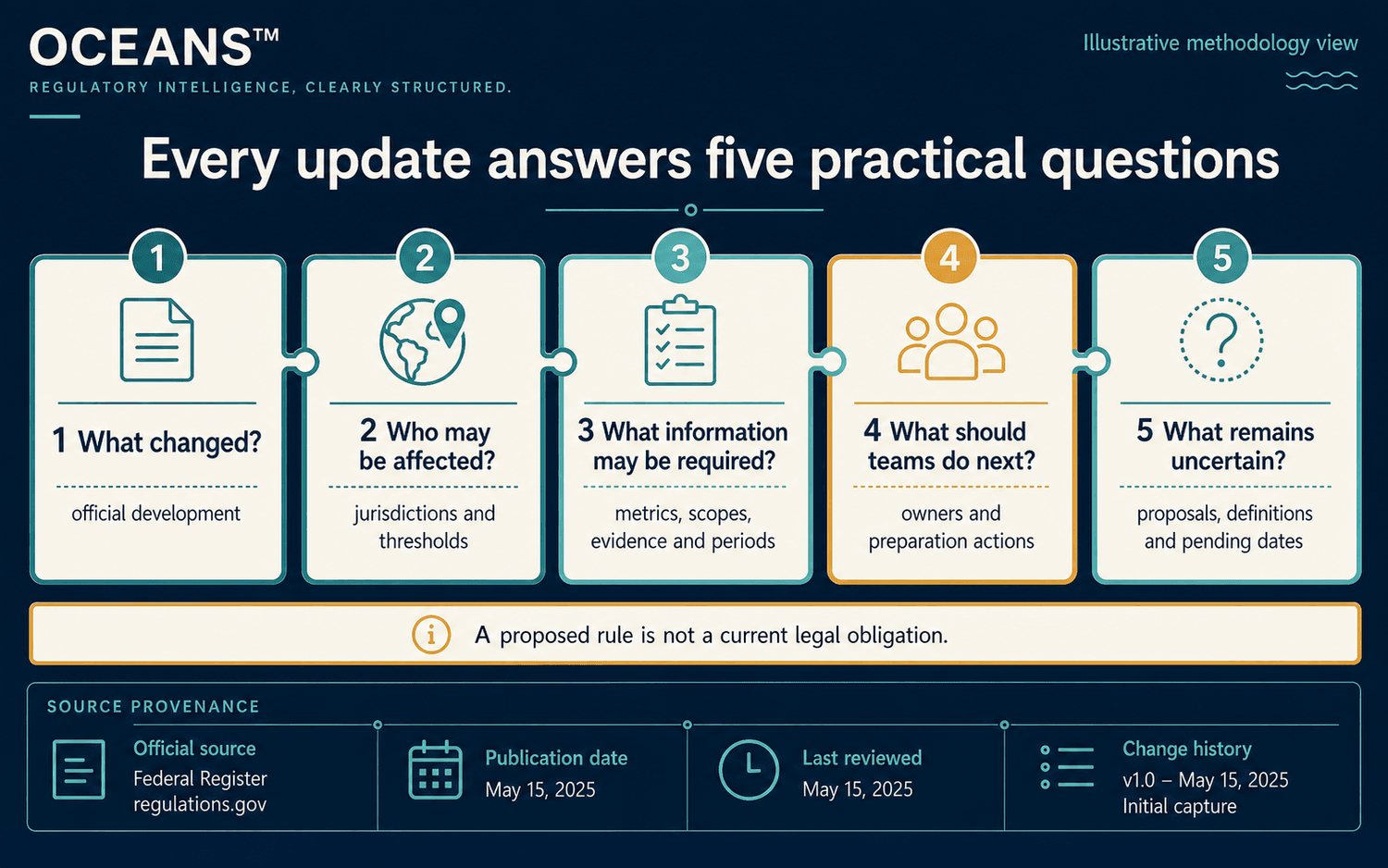
What changed?
A plain-language explanation of the official development.
Who may be affected?
Relevant jurisdictions, company types, thresholds, and business relationships.
What information may be required?
Metrics, disclosures, emissions scopes, evidence, and reporting periods.
What should teams do next?
Specific preparation actions for sustainability, finance, legal, procurement, and operations.
What remains uncertain?
Proposed provisions, unresolved definitions, implementation questions, and pending deadlines.
Every update links to the official regulatory or standard-setting source and shows when OCEANS™ last reviewed it. A proposed rule is not a current legal obligation.
See a dedicated impact-analysis page
FROM REQUIREMENT TO DATA
See which business information each requirement depends on
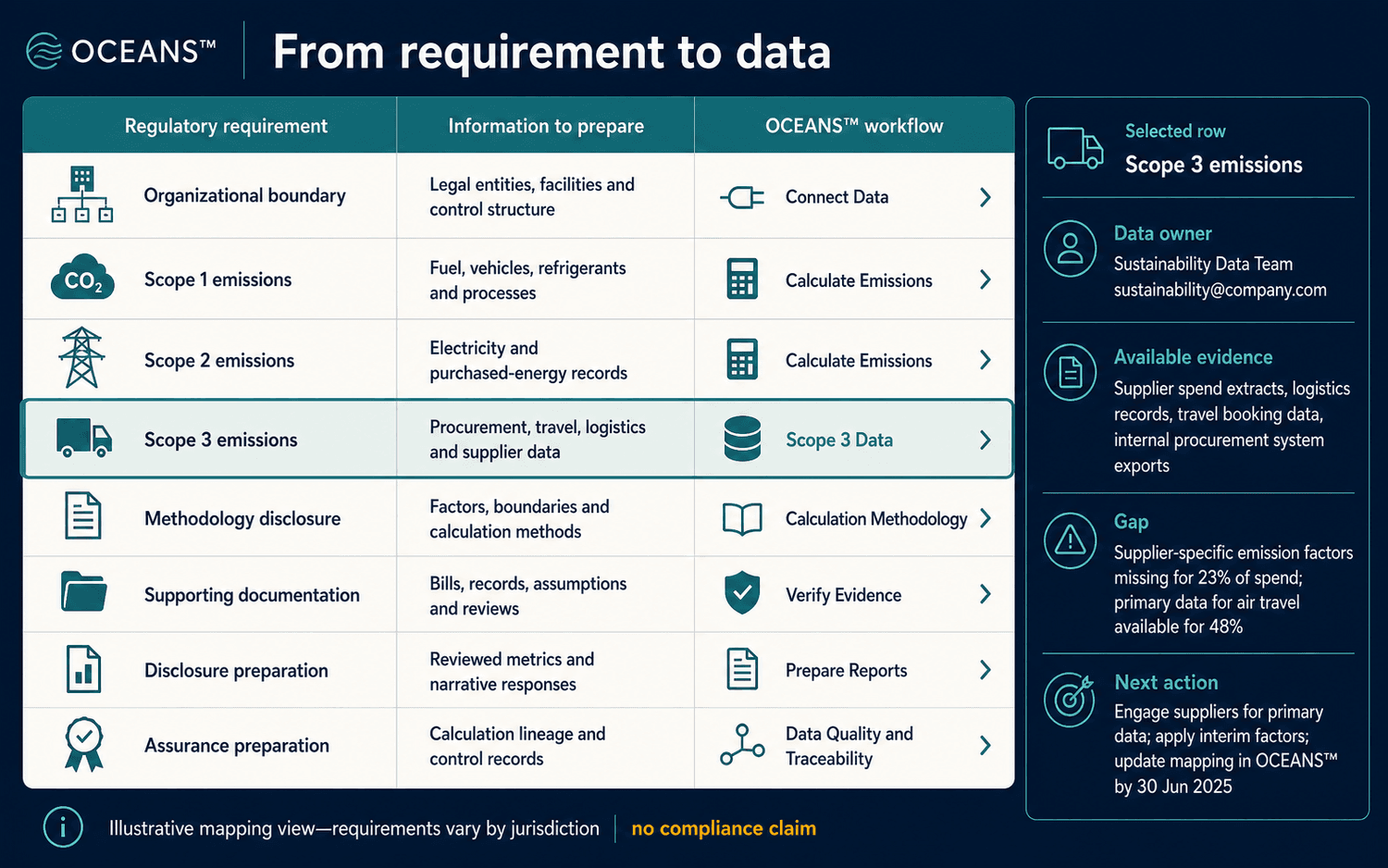
| Regulatory requirement | Information to prepare | OCEANS™ workflow |
|---|---|---|
| Organizational boundary | Legal entities, facilities and control structure | Connect Data |
| Scope 1 emissions | Fuel, vehicles, refrigerants and processes | Calculate Emissions |
| Scope 2 emissions | Electricity and purchased-energy records | Calculate Emissions |
| Scope 3 emissions | Procurement, travel, logistics and supplier data | Scope 3 & Supplier Data |
| Methodology disclosure | Factors, boundaries and calculation methods | Calculation Methodology |
| Supporting documentation | Bills, records, assumptions and reviews | Verify Evidence |
| Disclosure preparation | Reviewed metrics and narrative responses | Prepare Reports |
| Assurance preparation | Calculation lineage and control records (preparation, not assurance delivered by OCEANS™) | Data Quality and Traceability |
READINESS OVERVIEW
Turn requirements into a practical preparation plan
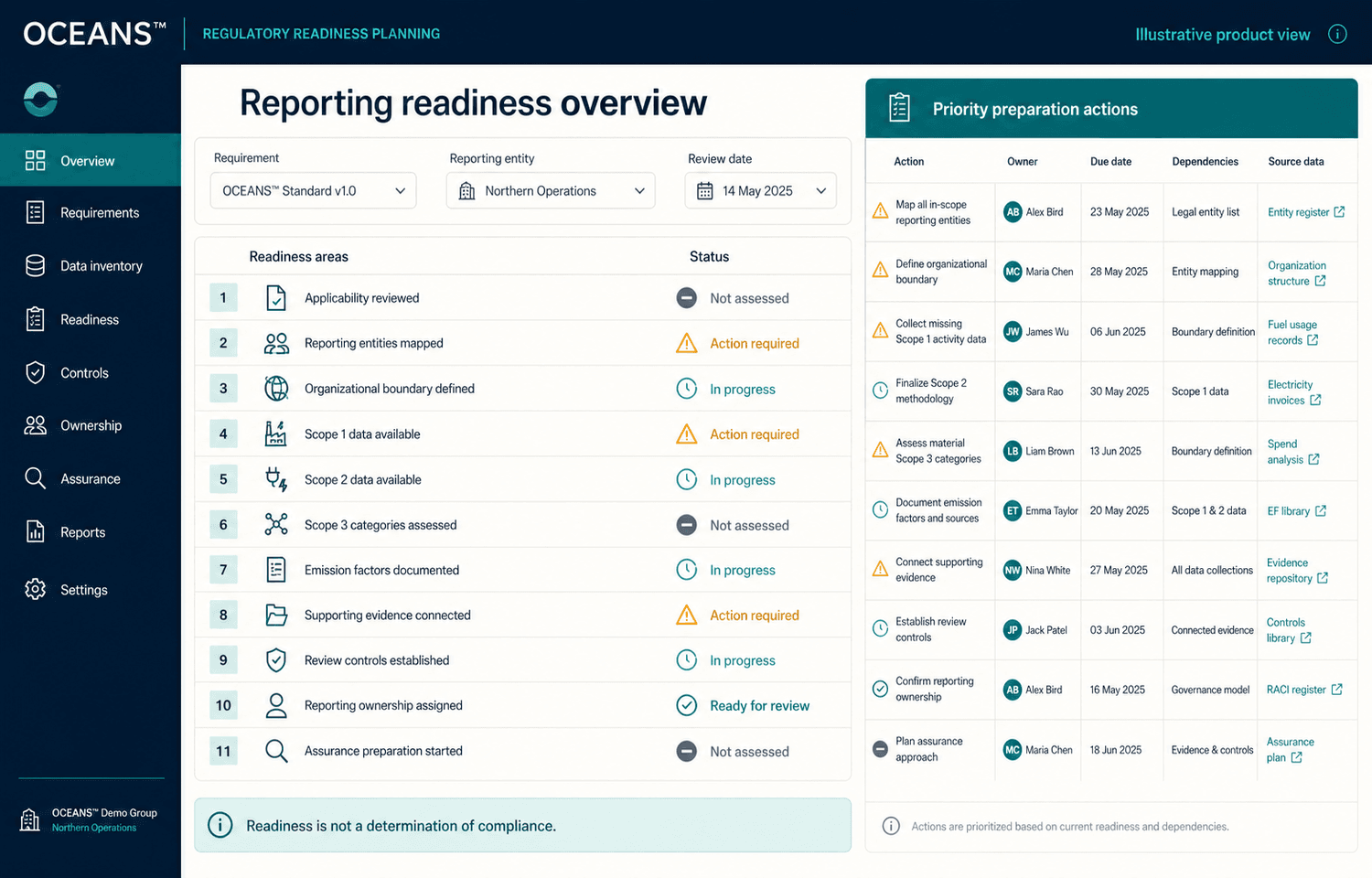
A practical readiness process maps potential reporting requirements to the information and processes your company currently has in place, using statuses such as:
Readiness areas to track
- Applicability reviewed
- Reporting entities mapped
- Organizational boundary defined
- Scope 1 data available
- Scope 2 data available
- Scope 3 categories assessed
- Emission factors documented
- Supporting evidence connected
- Review controls established
- Reporting ownership assigned
- Assurance preparation started
Readiness is not a determination of compliance.
This is a general educational checklist, not a personalized dashboard connected to your organization's data — an interactive per-organization readiness tool is not yet part of OCEANS™ Sustainability.
You may be affected even when you are not directly regulated
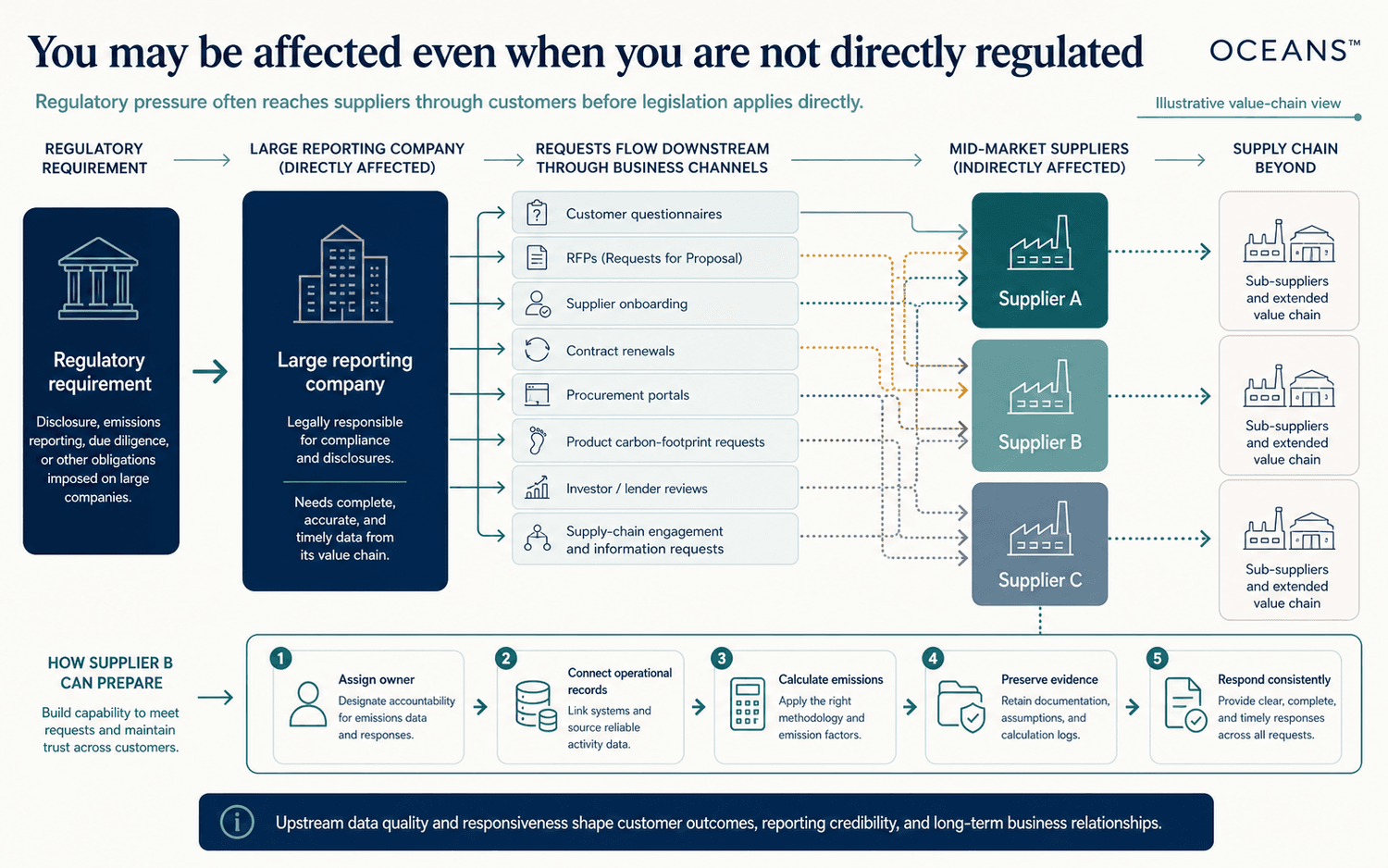
Large reporting companies often depend on suppliers for Scope 3 and product-level emissions information. As a result, growing companies may receive sustainability requests through:
Regulatory pressure frequently reaches mid-market companies through customers before it reaches them directly through legislation.
Prepare for Customer RequestsRegulations change. Your preparation plan should change with them.
OCEANS™ distinguishes between:
A proposed rule should never be presented as a current legal obligation. Where information changes, OCEANS™ updates the status, records the change, and retains the original official source.
OCEANS™ REGULATORY BRIEF
Receive updates based on your reporting profile
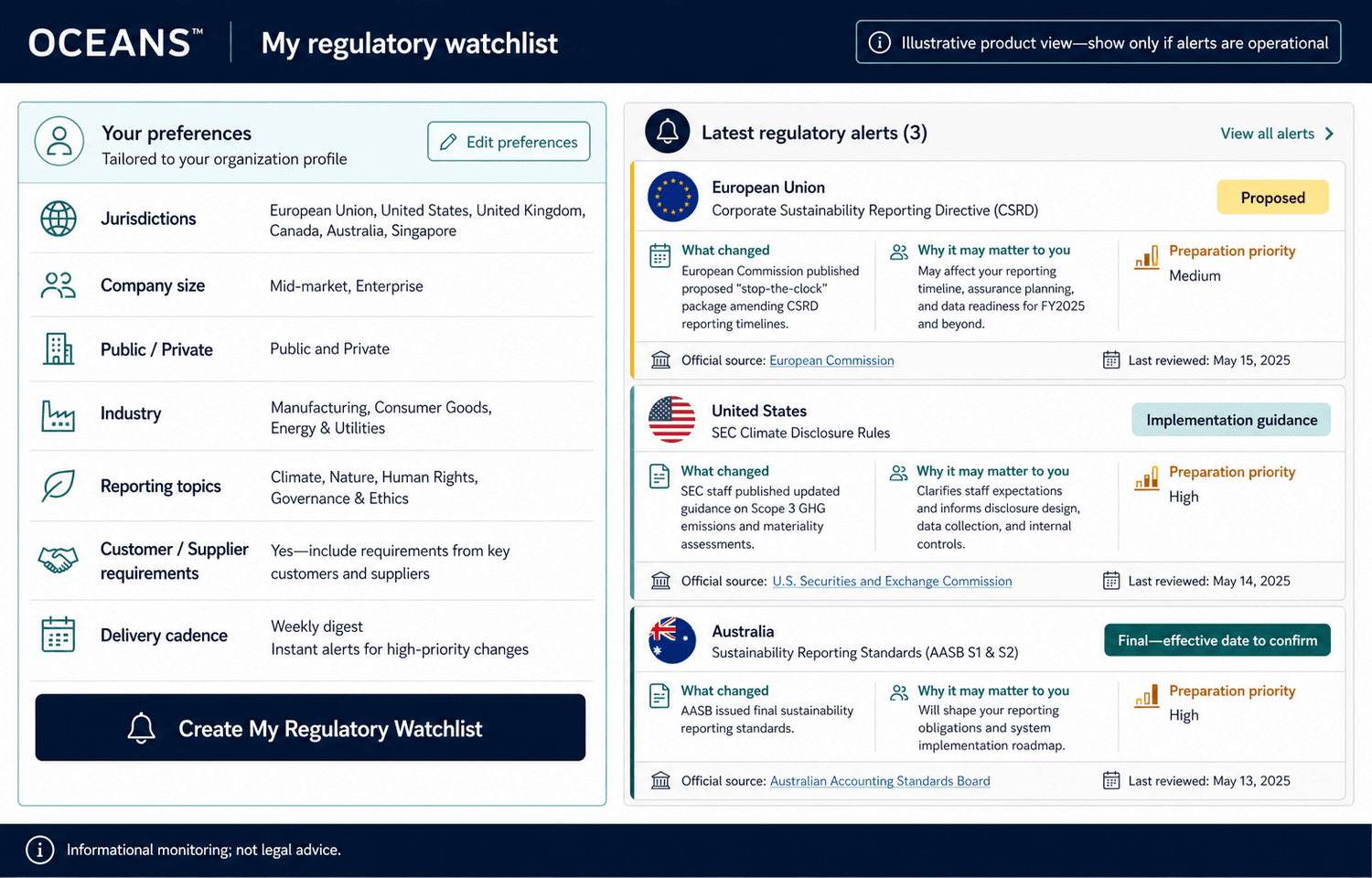
A personalized regulatory watchlist — scoped to your jurisdictions, size, industry, and reporting topics — is not yet available. It requires explicit consent, preference management, and secure account scoping that OCEANS™ Sustainability does not yet operate.
Discuss a regulatory watchlistOfficial sources first. Practical interpretation second.
Every OCEANS™ regulatory update:
- Links directly to the official source
- Distinguishes proposals from final requirements
- States the date last reviewed
- Explains unresolved uncertainty
- Avoids unsupported legal conclusions
- Identifies practical data implications
OCEANS™ provides regulatory intelligence for preparation and planning. It does not provide legal, accounting, or assurance advice.

Regulatory interpretation in practice
Understanding a requirement takes more than one point of view
Sustainability, legal and compliance, finance, operations and data, and procurement typically resolve gaps and interpret methodology together, not as a single reviewer working alone.
Explore regulatory guidance by business need
First-time reporting
Understand foundational boundaries, emissions scopes, data requirements, and responsibilities.
California readiness
Follow implementation developments and prepare the data potentially required under California laws.
Scope 3 readiness
Understand value-chain data requirements and supplier implications.
Customer-request readiness
Prepare for sustainability questions from regulated customers.
Assurance preparation
Organize evidence, methodologies, review controls, and calculation histories.
International reporting
Monitor ISSB adoption, European requirements, and other jurisdictional developments.
Do not wait for a reporting deadline to discover your data gaps
Understand which climate-reporting developments may affect your organization and build a practical plan for collecting, calculating, reviewing, and reporting the required information.