OCEANS™ METHODOLOGY
Use emission factors with clear sources, versions and calculation context
See how emission factors are selected, documented, versioned and connected to business activity data when calculating greenhouse-gas emissions.
Because a carbon calculation is only as credible as the data and factor behind it.
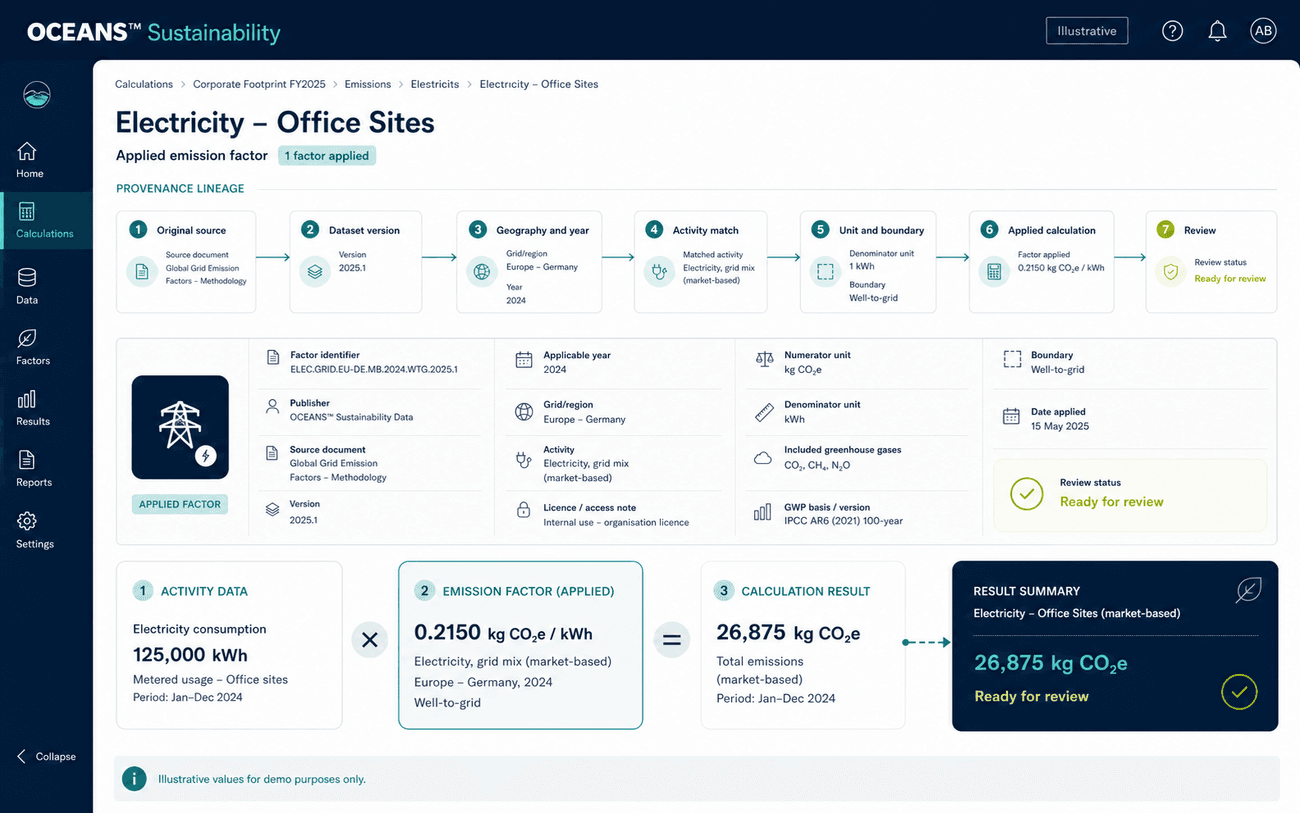
On this page
Connecting business activity to greenhouse-gas emissions
An emission factor represents the greenhouse gases associated with a defined unit of activity, expressed as carbon-dioxide equivalent (CO₂e) — a common unit that expresses the climate effect of different greenhouse gases relative to CO₂. A typical calculation is:
GHG emissions = Activity data × Emission factor
Examples include
The GHG Protocol describes emission factors as values relating greenhouse-gas emissions to a defined amount of business activity — not every source is calculated only by this basic formula. GHG Protocol calculation tools FAQ (opens in a new tab)
The same activity can produce different results with different factors
Emission factors can vary according to:
A technically calculable result may still be unsuitable. OCEANS™ Sustainability is designed to make the selection context visible rather than hiding a single default factor behind the result.
FACTOR SELECTION
Choosing the most appropriate available factor
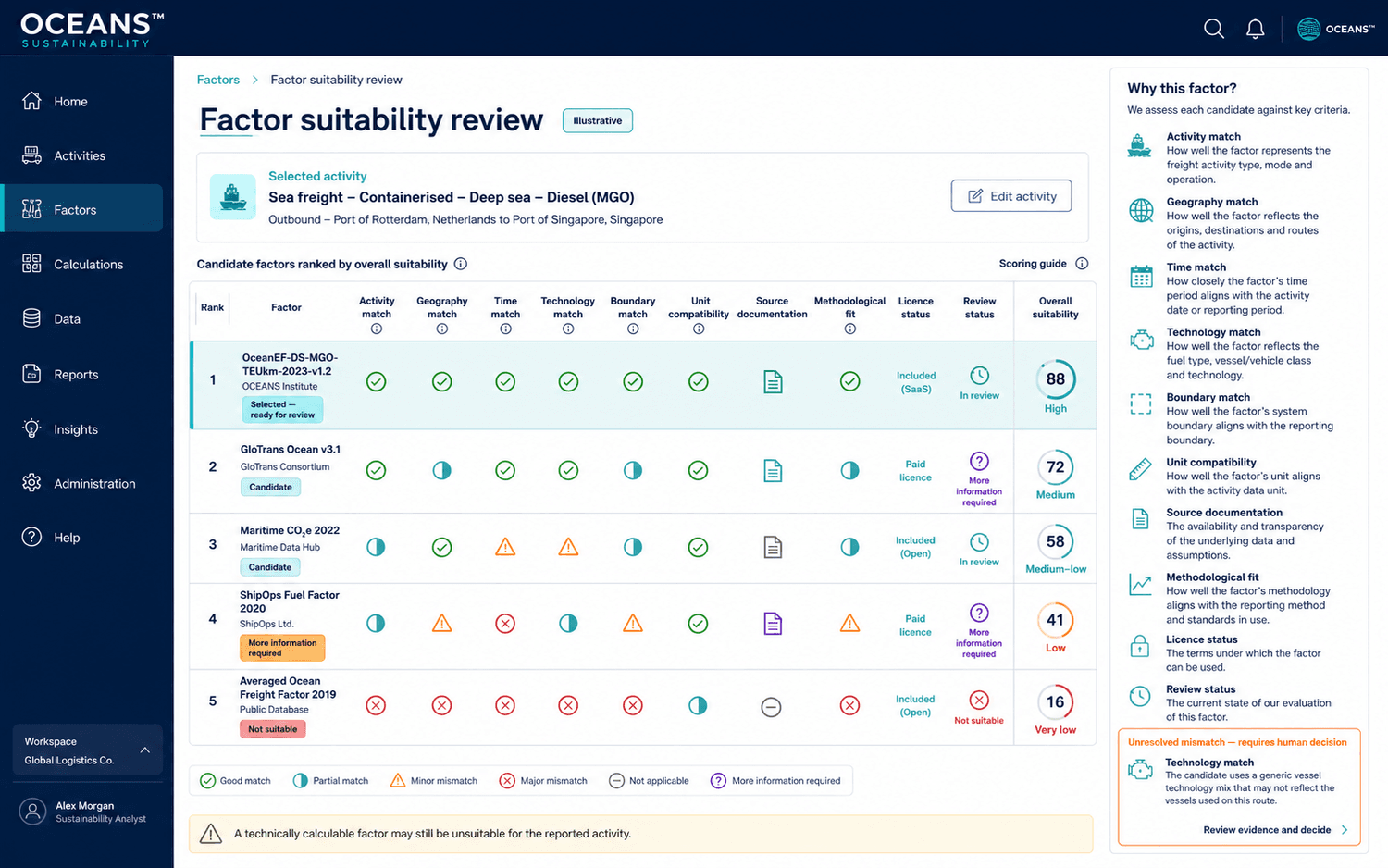
Activity match
Does the factor represent the fuel, material, transport mode, process, or service being calculated?
Geographic match
Does it represent the country, grid, market, supplier, or region where the activity occurred?
Time match
Is it appropriate for the relevant reporting period?
Technology match
Does it reflect the equipment, production method, vehicle, or process involved?
Boundary match
Do the lifecycle stages included in the factor match the intended calculation?
Unit compatibility
Can the activity data and factor be combined without inappropriate assumptions?
Source quality
Is the factor from a credible, documented, and appropriately maintained source?
Methodological fit
Is the factor suitable for the applicable emissions scope, category, and intended use?
The image above illustrates a review framework, not an automated suitability score. An unresolved mismatch remains visible and subject to human decision rather than being silently resolved.
Prefer greater specificity when the data are suitable
- 01
Supplier- or facility-specific, with reviewed context
- 02
Product- or process-specific
- 03
Technology- and region-specific
- 04
National or regional
- 05
Industry average
- 06
Global average
- 07
Spend-based economic
- 08
Documented proxy
A more specific factor is not automatically better. OCEANS™ Sustainability is also intended to consider its methodology, boundary, reporting period, supporting evidence, and suitability for the activity.
DOCUMENTED SOURCES
Use authoritative sources appropriate to the calculation
Depending on geography, activity, intended use, and licensing, potential factor sources may include:
The GHG Protocol provides calculation tools and identifies third-party databases, and notes that most companies need more than one tool to cover their emissions. GHG Protocol calculation tools (opens in a new tab)
Source availability
No third-party emission-factor database is currently licensed by OCEANS™ for product use, customer access, or public representation. A source is named here only once its usage, redistribution, and display rights are confirmed.
Last reviewed 2026-08-31.
Preserve the context behind every factor
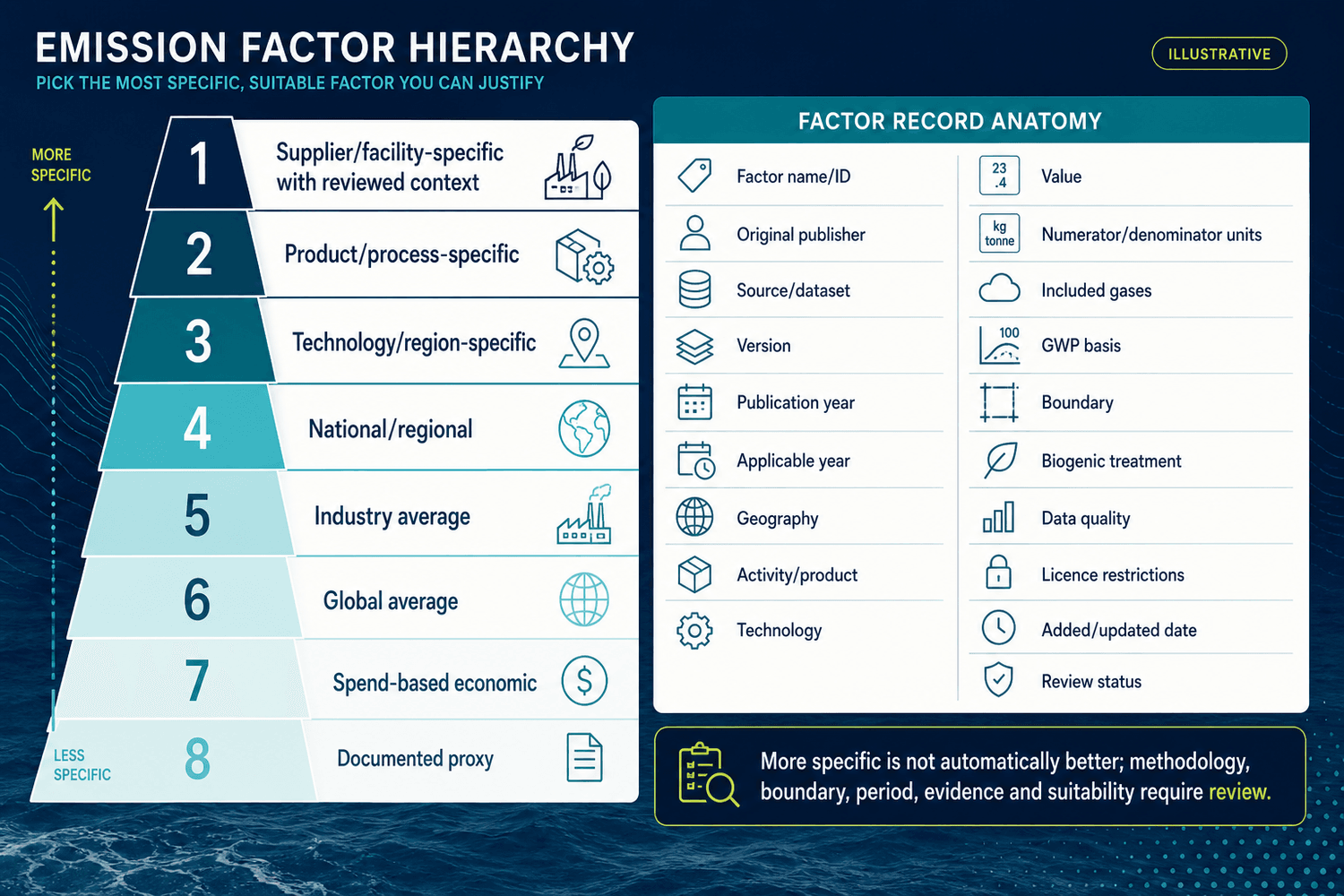
For each factor, OCEANS™ Sustainability is designed to retain
A user should be able to understand what a factor represents without relying on its label alone.
UNIT INTEGRITY
Match activity data and factors correctly
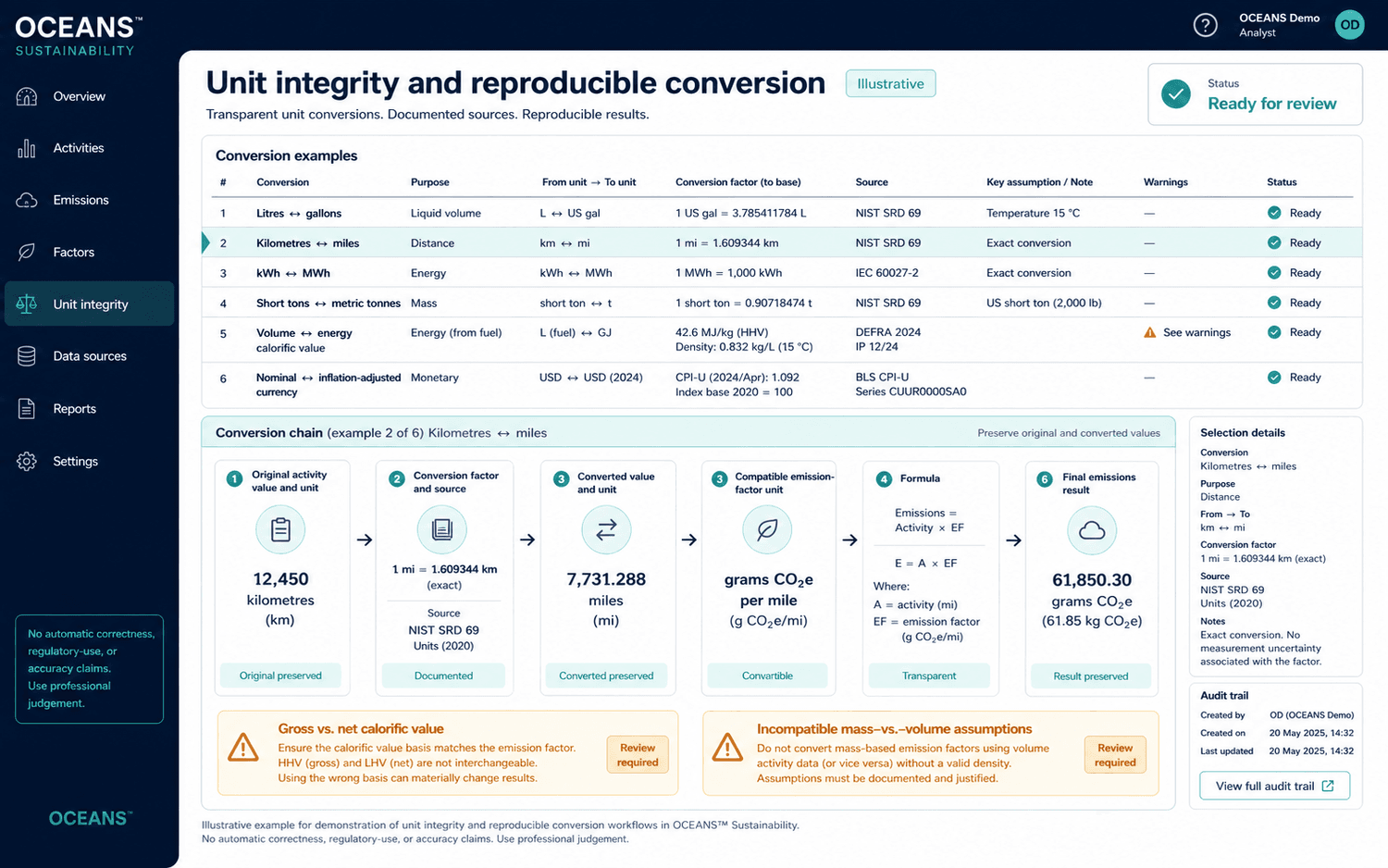
An emission factor can only be applied correctly when its units are compatible with the underlying activity data. OCEANS™ Sustainability is designed to preserve a conversion record for every factor applied:
Examples requiring care
Every conversion should be visible and reproducible. The conversion record above documents how a value was converted — it is not an independent audit of the underlying activity data.
Match purchased-energy calculations to place, period, and method
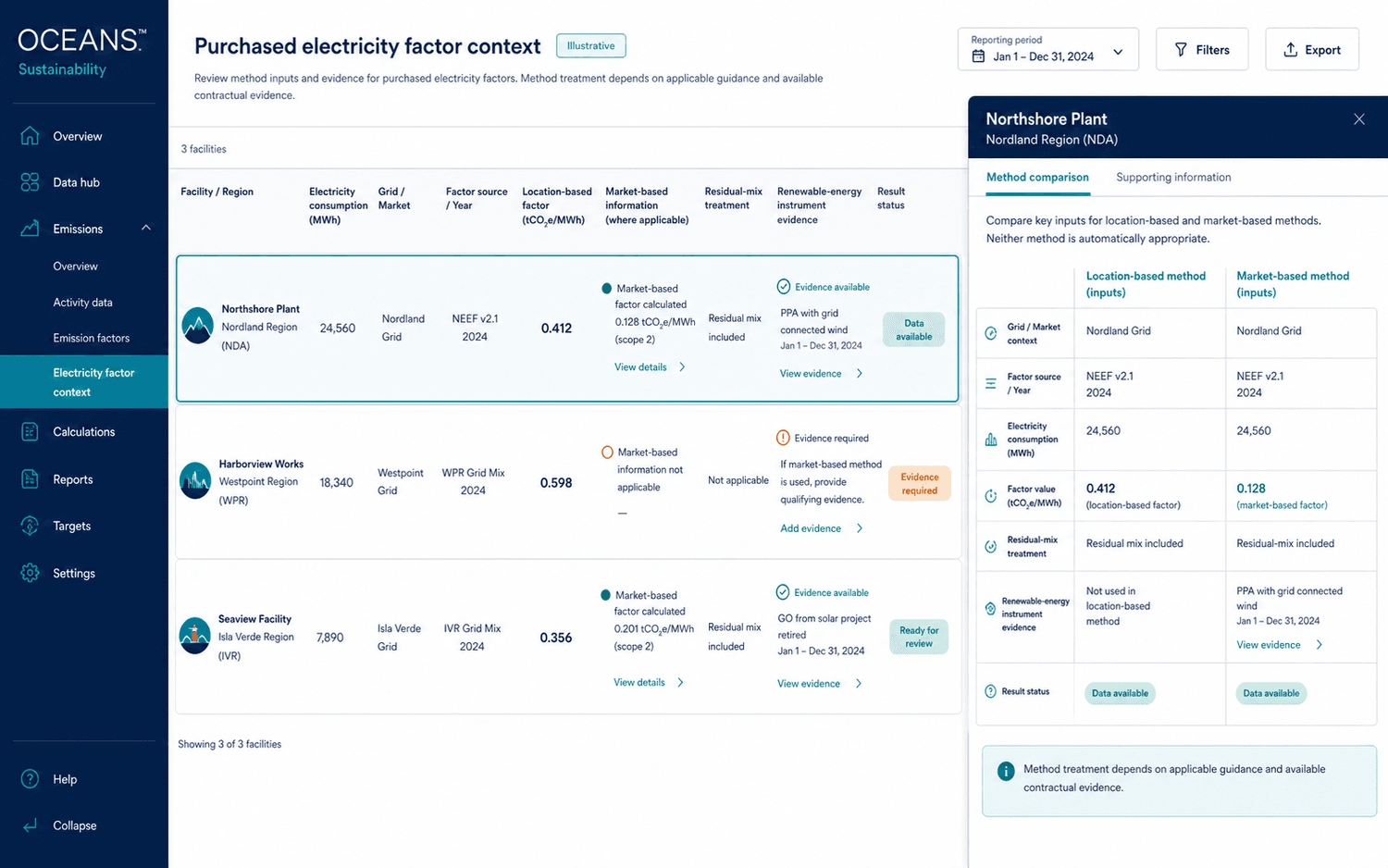
Electricity factors can vary significantly across grids, suppliers, markets, and reporting years. For Scope 2 calculations, OCEANS™ Sustainability is designed to retain:
The current GHG Protocol Scope 2 Guidance distinguishes location-based and market-based accounting approaches. Method treatment depends on applicable guidance and qualifying evidence — an uploaded instrument does not, by itself, establish validity or factor suitability. Scope 2 Guidance (opens in a new tab)
Account for the fuel, mode, and lifecycle boundary
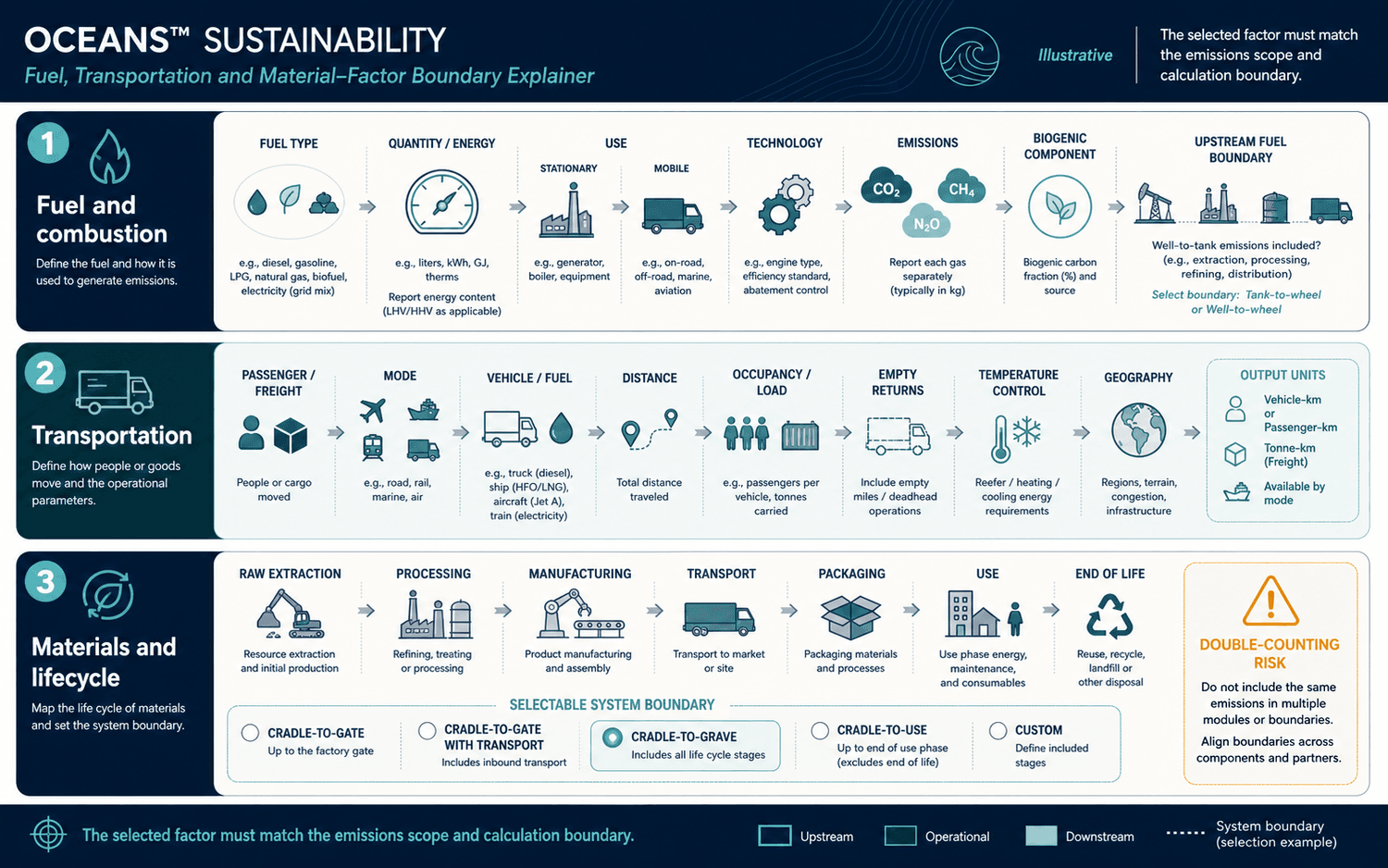
Fuel and combustion
Combustion emissions may be calculated using fuel quantity, energy content, distance, or other appropriate activity data.
Transportation
Transportation factors reflect how people and goods move.
Material and lifecycle
Material and product factors may cover one lifecycle stage or a selected combination.
The selected factor must match the emissions scope and calculation boundary. No single boundary is universally correct — confirming the boundary before applying a factor avoids omissions and double counting, particularly for Scope 3 and product carbon footprints.
ECONOMIC FACTORS
Use spend-based factors as transparent estimates
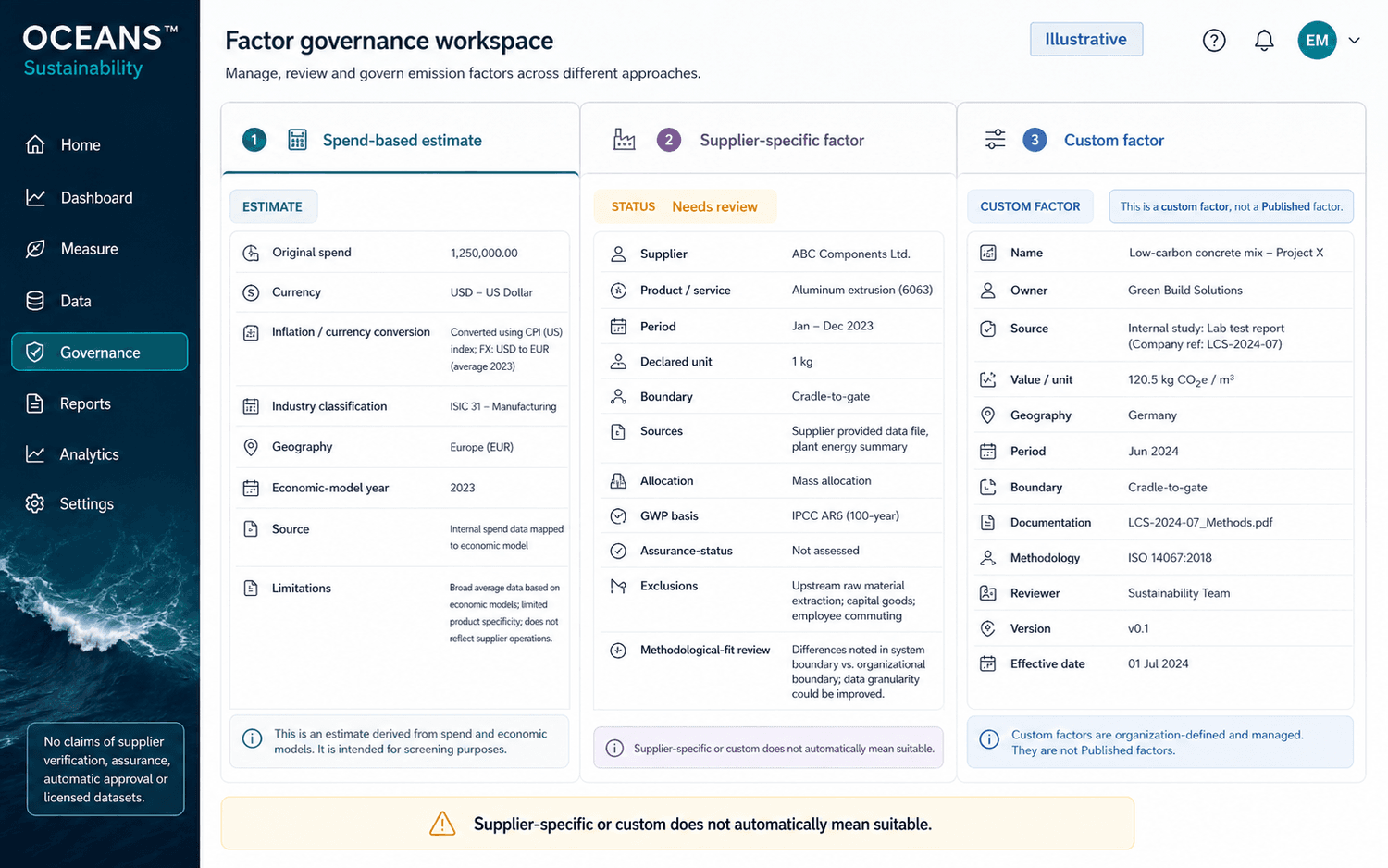
Spend-based calculations combine financial expenditure with environmentally extended economic emission factors. They can support initial Scope 3 screening when physical or supplier-specific information is unavailable. OCEANS™ Sustainability is designed to record:
Spend-based results are presented as estimates — not precise physical measurements.
Review supplier information before applying it
Supplier-specific factors may improve relevance, but only when their methodological context is understood. OCEANS™ Sustainability is designed to document:
Verification or assurance status is a documented field a supplier provides — not an OCEANS™ verification claim. A supplier value does not automatically replace a secondary factor unless it is suitable for the intended calculation.
Support organization-specific factors with appropriate controls
Companies may need custom factors for specific suppliers, facilities, processes, products, or contractual instruments. A custom factor requires:
Supplier-specific or custom does not automatically mean suitable. A custom factor remains labeled and visually distinguishable from a published standard factor throughout review and calculation.
APPLICATION LOGIC
Make factor recommendations explainable
Where a factor might be recommended for an activity, the criteria behind that recommendation should remain visible for review — potential criteria include:
Users would review a recommended factor and its supporting metadata before approving material calculations. OCEANS™ does not publish automatic factor matching as an available capability unless the feature is operational and tested, and never markets it as automatic, optimal, or infallible.
Update factor libraries without rewriting history
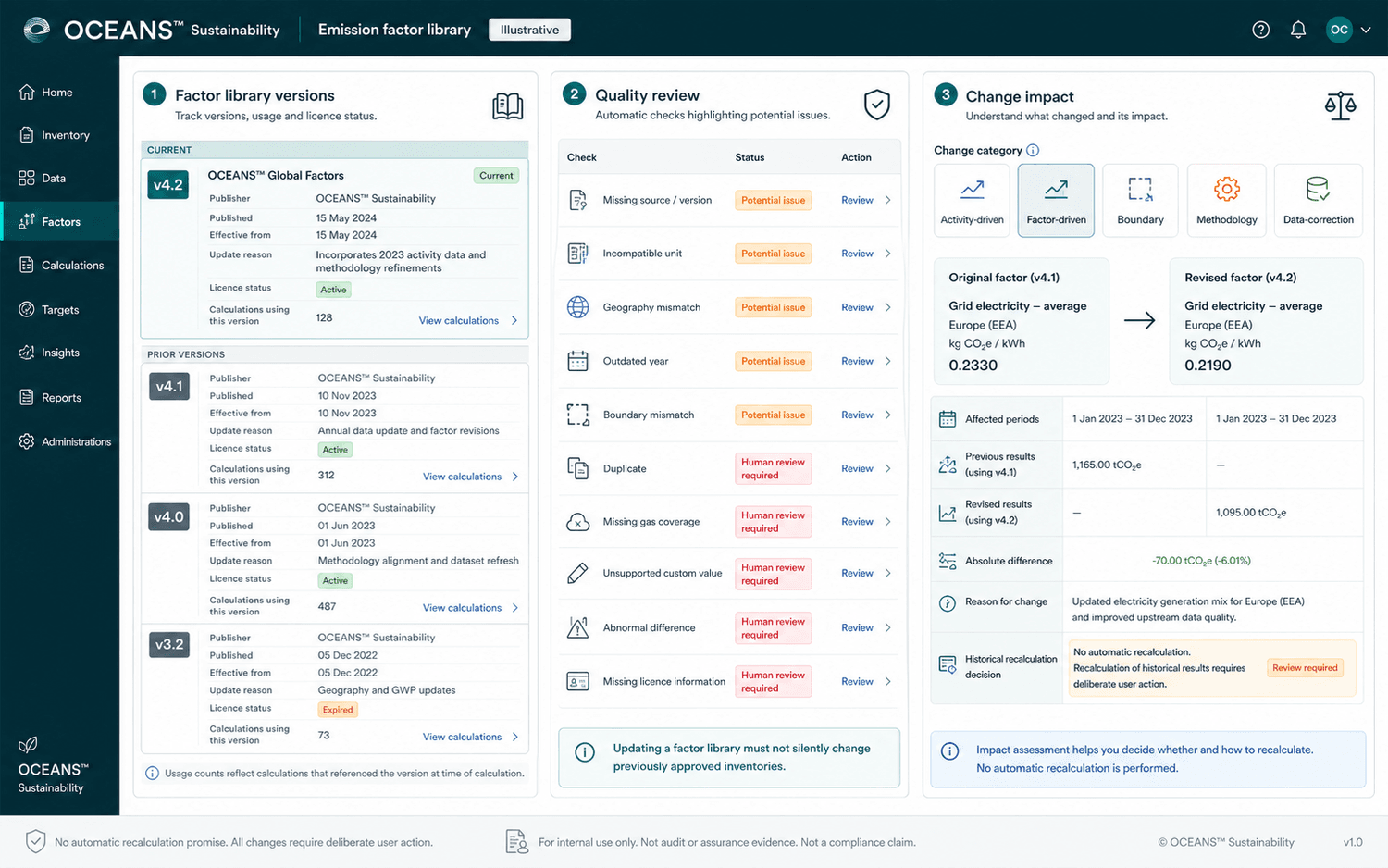
Emission-factor datasets evolve as grids, technologies, scientific values, and reporting guidance change. OCEANS™ Sustainability is designed to maintain:
Updating a factor library does not silently change previously approved inventories. GHG Protocol and ISO are developing a consolidated corporate accounting standard — see the dated standards-development update on the Calculation Methodology page for the current timeline rather than a figure repeated here.
FACTOR GOVERNANCE
Review factors before they influence reported results
Potential quality checks include:
Only checks confirmed in the current implementation are shown above.
Automated checks can identify potential problems; appropriate human review remains necessary.
Make the impact of a factor change visible
A change in emissions does not always reflect a change in business activity. OCEANS™ Sustainability is being designed to distinguish:
Activity-driven
The underlying business activity itself changed.
Factor-driven
An updated grid factor, economic dataset, or scientific value was applied.
Boundary
The calculation or organizational boundary changed.
Methodology
The calculation method or approach changed.
Data correction
A previous input or calculation error was corrected.
Where historical recalculation is required, OCEANS™ Sustainability is designed to document
OCEANS™ Sustainability does not silently recalculate previously approved results. Recalculation is a deliberate, reviewed decision made under the applicable reporting method or program.
Every calculated result should answer these questions
- 01 Which factor was used?
- 02 Who published it?
- 03 Which dataset version applies?
- 04 Which geography and year does it represent?
- 05 What unit and boundary does it use?
- 06 Which greenhouse gases are included?
- 07 Were any unit conversions applied?
- 08 Was the factor recommended, selected, or custom?
- 09 Who reviewed it?
- 10 Has the factor changed since the previous period?
Emission factors estimate emissions — they do not directly measure every source
Most emission factors represent averages, models, or generalized relationships. They may not capture the exact technology, supplier, operating condition, or location associated with an individual activity.
OCEANS™ helps users understand these limitations and progressively introduce more relevant primary or supplier-specific information where appropriate — as an improvement subject to review, not automatic truth.
No emission-factor library can eliminate uncertainty caused by incomplete activity data or unsuitable calculation boundaries.

Factor review in practice
Comparing sources, metadata, and calculation impact together
Sustainability, data owners, and finance and control typically review source documentation, metadata, units, licence terms, and calculation impact together before a factor change is approved.
Frequently asked questions
What is an emission factor?
A documented value that converts a unit of activity into greenhouse-gas emissions — for example, kgCO₂e per kWh of electricity, per litre of fuel, per passenger-kilometre travelled, or per unit of currency spent.
Why does the "right" emission factor vary so much?
Because factors differ by country or region, reporting year, electricity-grid composition, fuel specification, transportation mode, technology, dataset boundary, the greenhouse gases included, and the global-warming-potential basis used — among other variables. The same activity can have several valid factors depending on which of these apply.
What determines whether a factor is suitable for a given calculation?
Eight matching criteria: activity match, geographic match, time match, technology match, boundary match, unit compatibility, source quality, and methodological fit for the applicable emissions scope and category.
What is the difference between location-based and market-based electricity factors?
A location-based factor reflects the facility’s grid or market for the reporting period. A market-based factor incorporates contractual or supplier-specific information, and renewable-energy instruments and supporting evidence, where applicable — the two are recorded as distinct fields, not blended together.
What happens when an emission factor changes or is updated?
A factor change is categorized as activity-driven, factor-driven, boundary, methodology, or a data correction. The reason, affected reporting periods, prior and revised factor and result, reviewer decision, and historical treatment are all recorded alongside the change.
See the factor behind every emissions result
Explore how OCEANS™ Sustainability is designed to connect activity data with documented emission factors, unit conversions, calculation methods, and supporting evidence.