OCEANS™ VERIFY EVIDENCE
Keep every emissions result connected to its source evidence
Connect emissions calculations to source records, factor versions, assumptions and review activity so sustainability teams can understand how each reported result was produced.
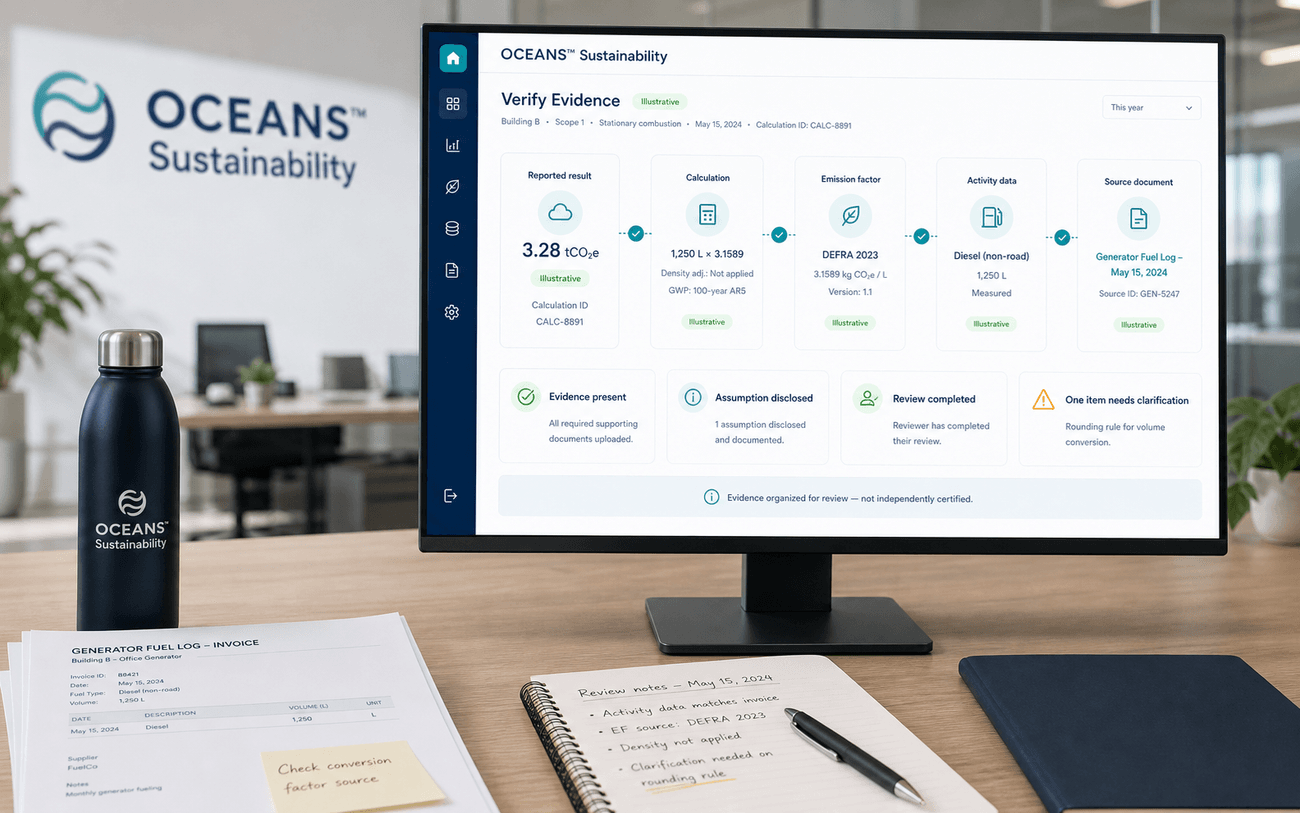
Know where each number came from, how it was calculated, and what still requires review.
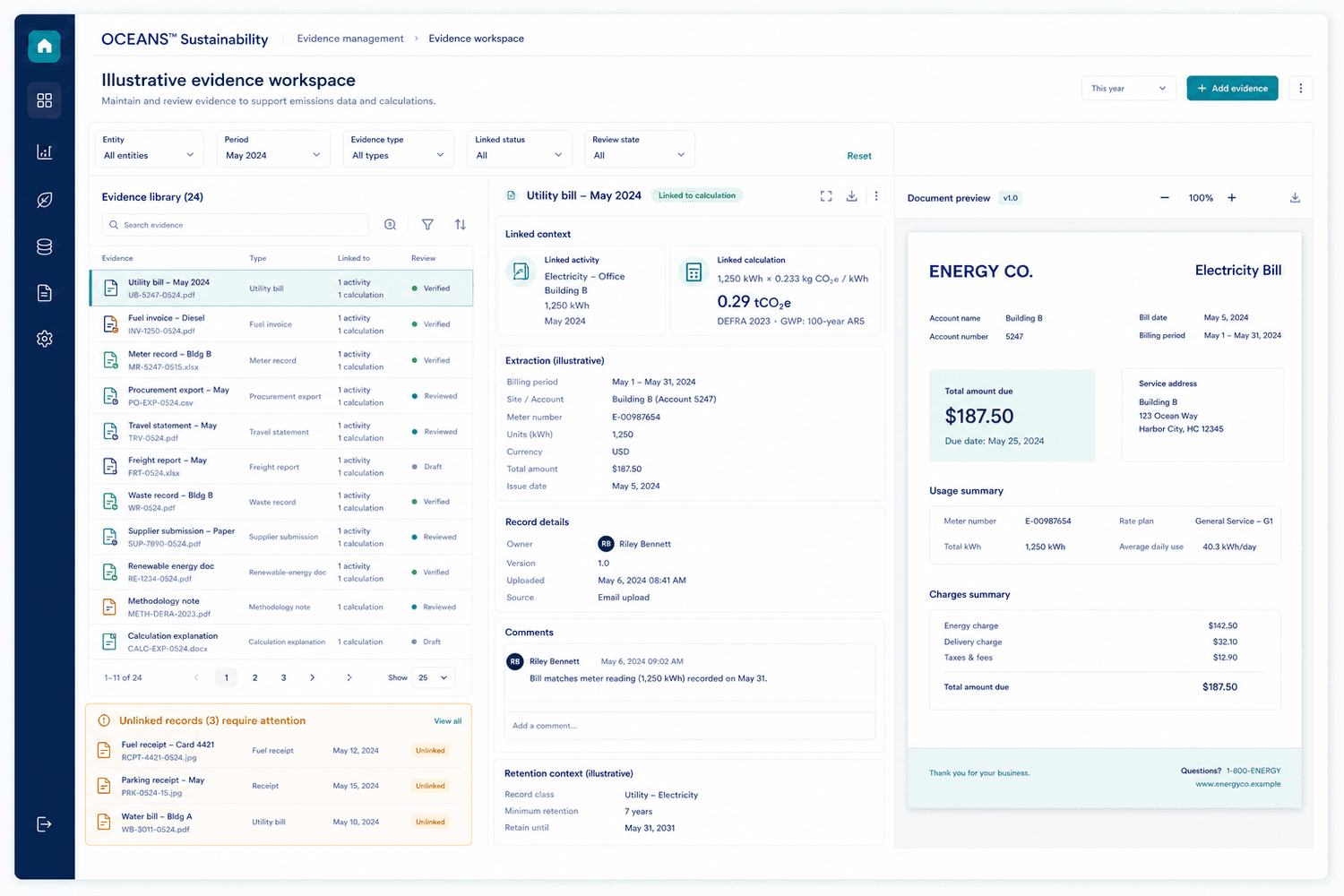
Explore the platformThe image above traces a result back to its source. Read the other direction, the logical order is:
- Reported result
- Calculation
- Emission factor
- Activity data
- Source document
This example demonstrates connection and review readiness—not independent certification.
Reporting a number is easy. Defending it is harder.
Spreadsheet-based work often separates supporting documents and calculation notes from the final reported result. When someone asks a question about a number, the answer lives in someone's inbox instead of with the number itself.
Where did this value come from?
Who submitted and reviewed it?
Which emission factor was used?
Was the result measured or estimated?
What changed from the previous reporting period?
Is supporting documentation available?
OCEANS™ Sustainability is designed to keep these answers connected to the reported information.
Transparent review
Verification begins with a visible evidence trail
Verify Evidence means organizing, tracing, and reviewing the information supporting a result. It helps your team assess whether required records are present, calculations are documented, assumptions are visible, and internal review steps are complete.
OCEANS™ Sustainability supports evidence preparation and traceability. It does not replace independent assurance or certify that customer-submitted information is factually correct.
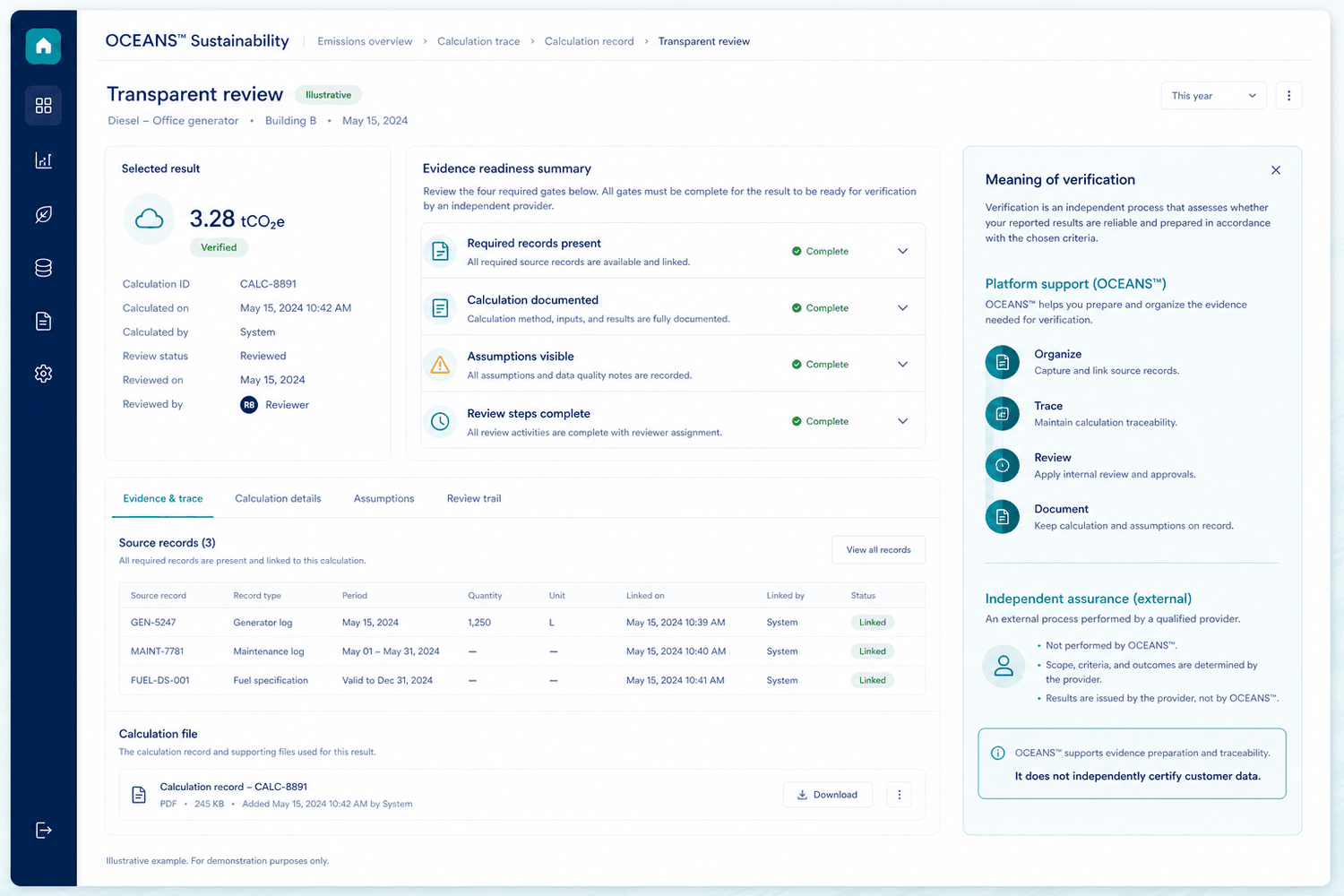
Platform support (OCEANS™)
Organize
Capture and link source records.
Trace
Maintain calculation traceability.
Review
Apply internal review and approvals.
Document
Keep calculation and assumptions on record.
Independent assurance (external)
An external process performed by a qualified provider — not performed by OCEANS™. Its scope, criteria, and outcomes are determined by that provider, and its results are issued by the provider, not by OCEANS™.
Follow every result back to its source
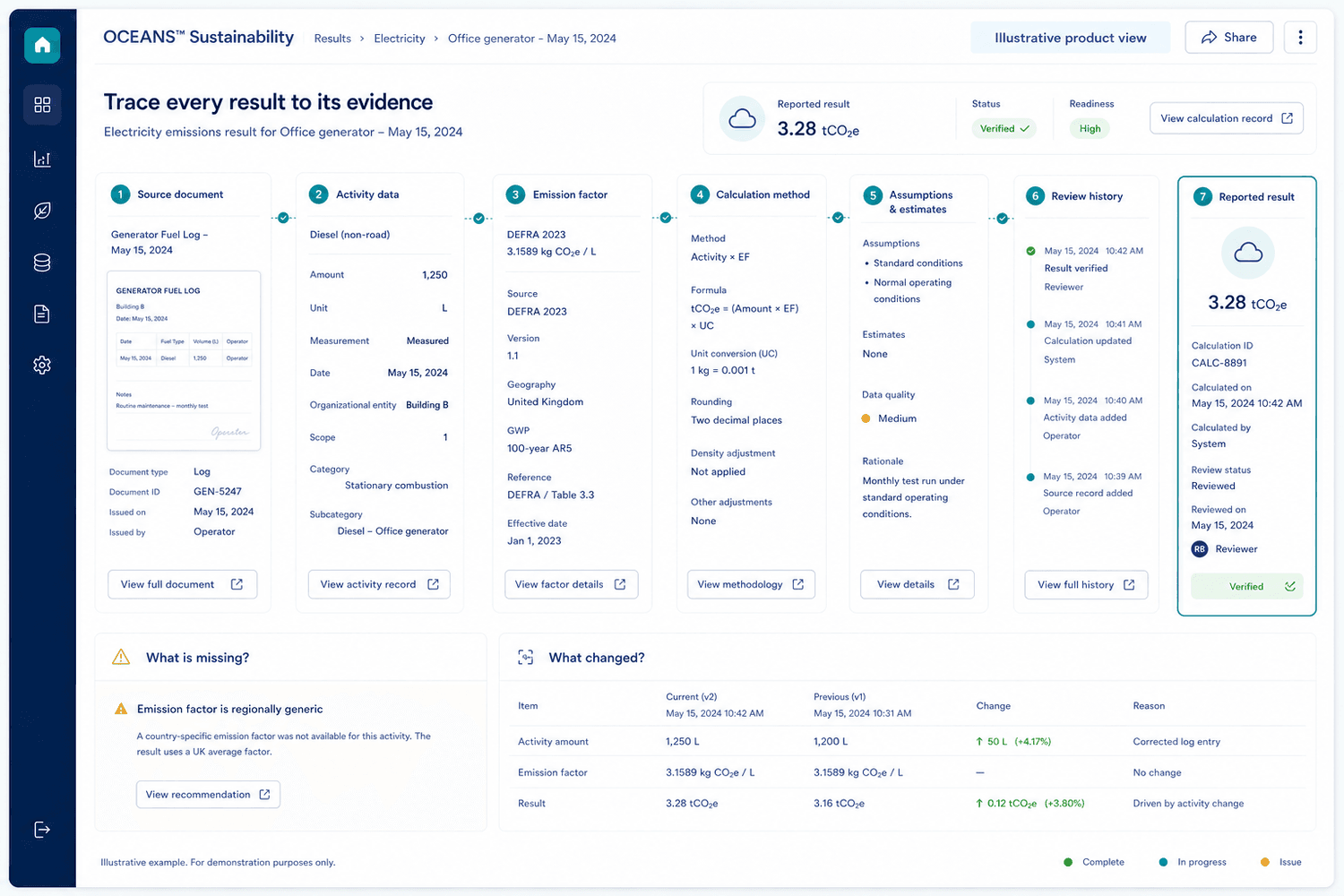
Source record
Invoice, bill, operational record, supplier file, or supporting document.
Activity data
Quantity, distance, spend, energy, mass, or another supported business activity.
Emission factor
Documented factor used to convert activity into emissions.
Calculation method
Formula, unit conversions, classifications, and methodology.
Assumptions and estimates
Exclusions, proxies, extrapolations, or limitations.
Review history
People, comments, states, decisions, and changes.
What is missing?
Gaps in the evidence chain are surfaced directly against the result, instead of being discovered later.
What changed?
When a value is revised, the prior version and the reason for the change stay attached to the result.
How it works
A consistent review process for every reporting period
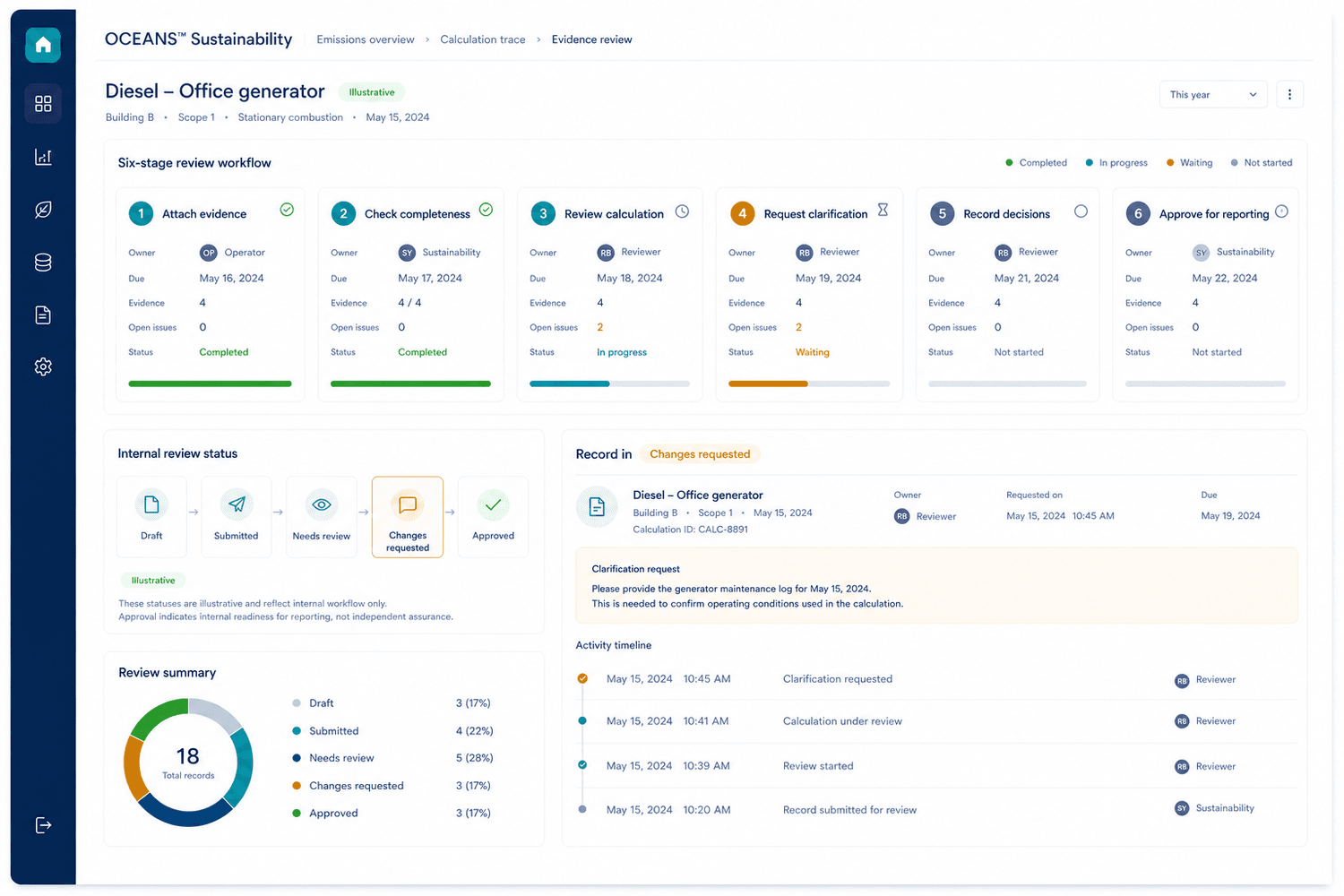
- 01
Attach evidence
Connect supporting records to submitted activity data.
- 02
Check completeness
Review required values, units, periods, entities, and documentation.
- 03
Review the calculation
Inspect category, factor, method, assumptions, and result.
- 04
Request clarification
Return incomplete or inconsistent records to the contributor.
- 05
Record decisions
Preserve review comments, explanations, and approved changes.
- 06
Approve for reporting
Mark internally reviewed information as ready for dashboards and reporting outputs.
Keep supporting records where they belong
Supporting documents stay associated with the relevant activity, calculation, entity, and period — including records such as:
- Utility bills
- Fuel invoices
- Meter records
- Procurement exports
- Travel statements
- Freight reports
- Waste records
- Supplier submissions
- Renewable-energy documents
- Methodology notes
When a stakeholder asks for supporting information, your team can locate the relevant record without reconstructing the calculation process.
Review and accountability
Make ownership and review status visible
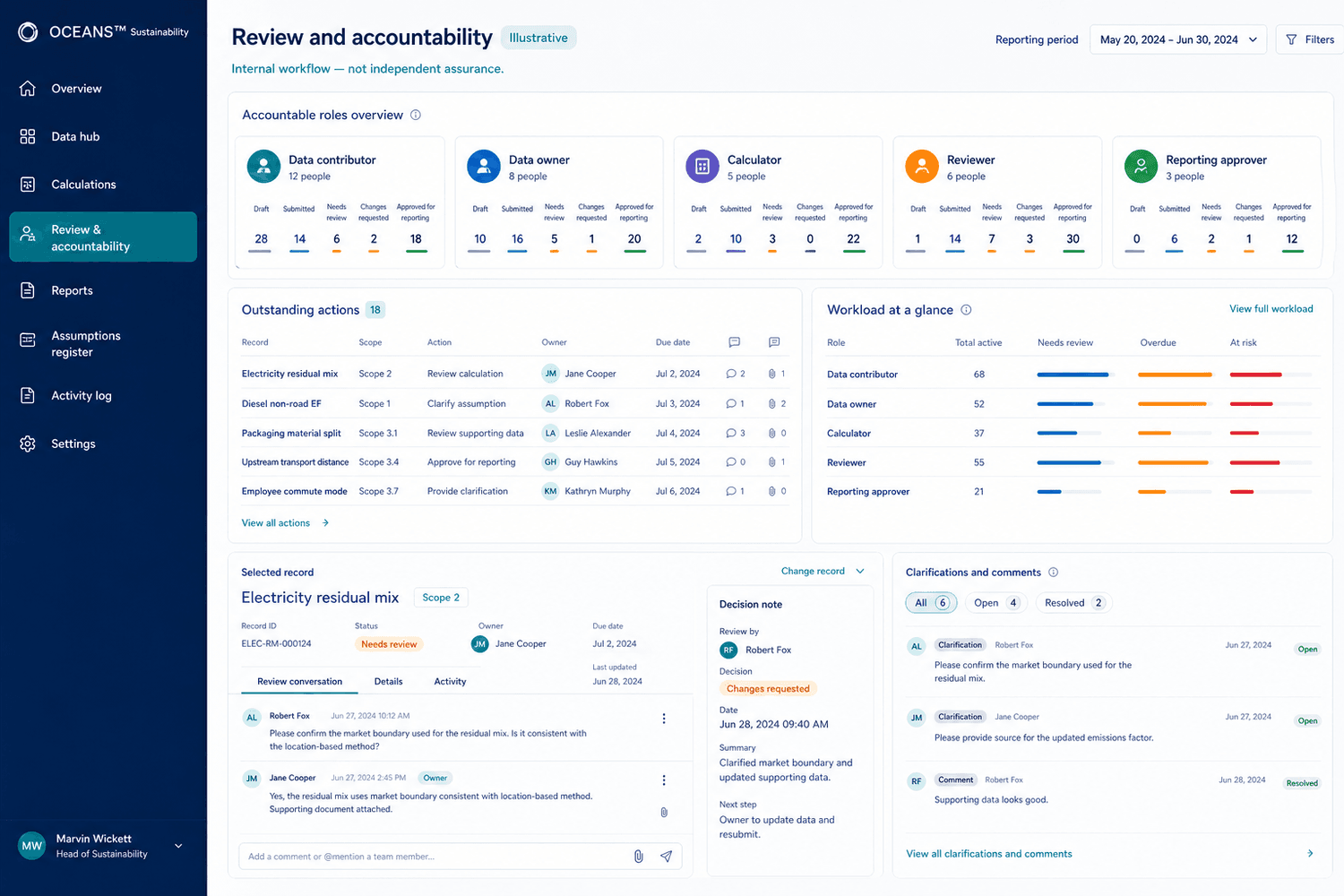
Contributors, data owners, calculators, reviewers, and reporting approvers can each understand responsibility and outstanding work as a reporting period moves toward completion.
- Contributors
- Data owners
- Calculators
- Reviewers
- Reporting approvers
Everyone can understand what requires attention, while the sustainability team retains oversight of the reporting process.
Find issues before information reaches a report
Examples of information a structured review can surface:
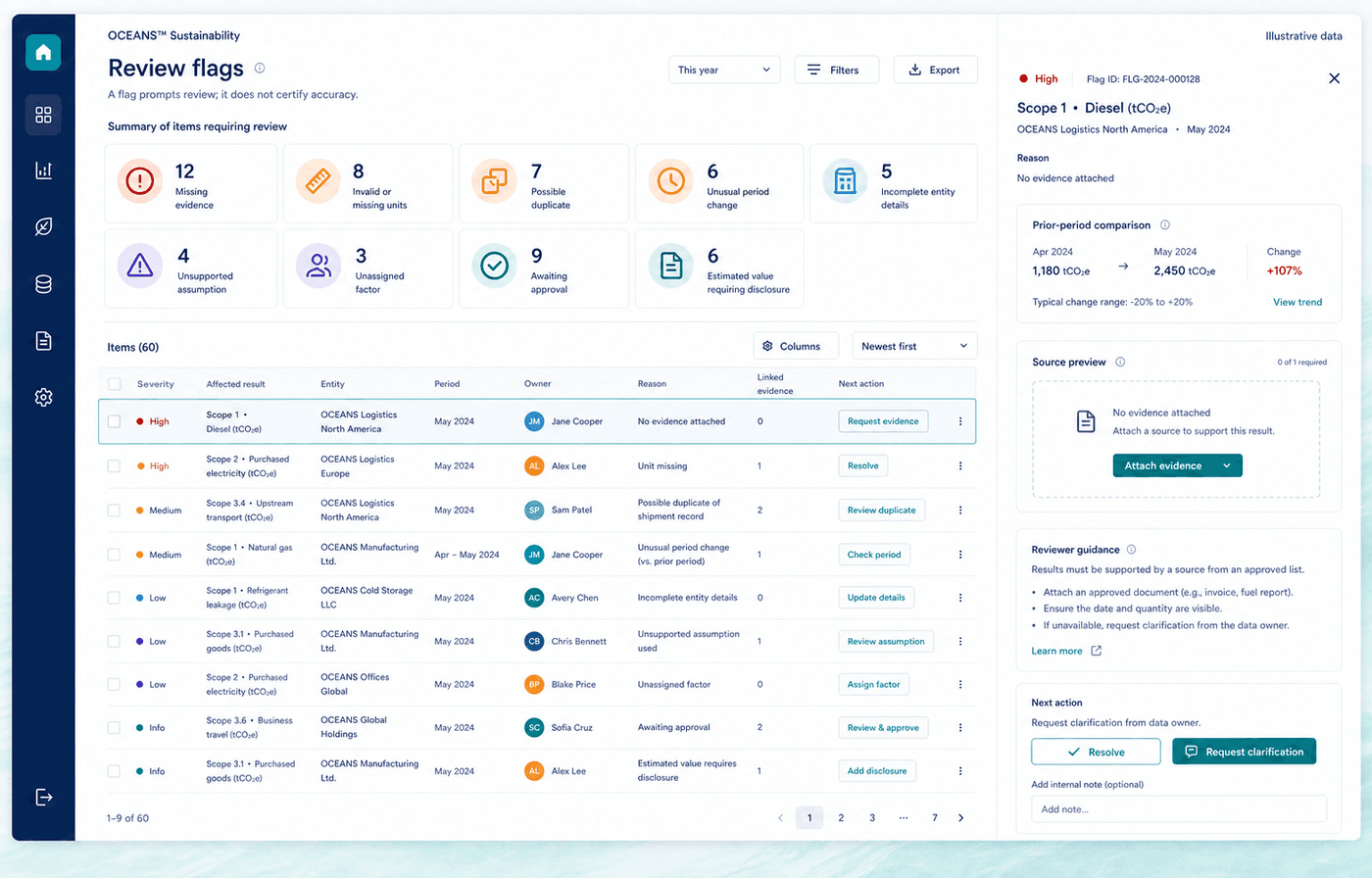
A flag prompts review; it does not certify accuracy.
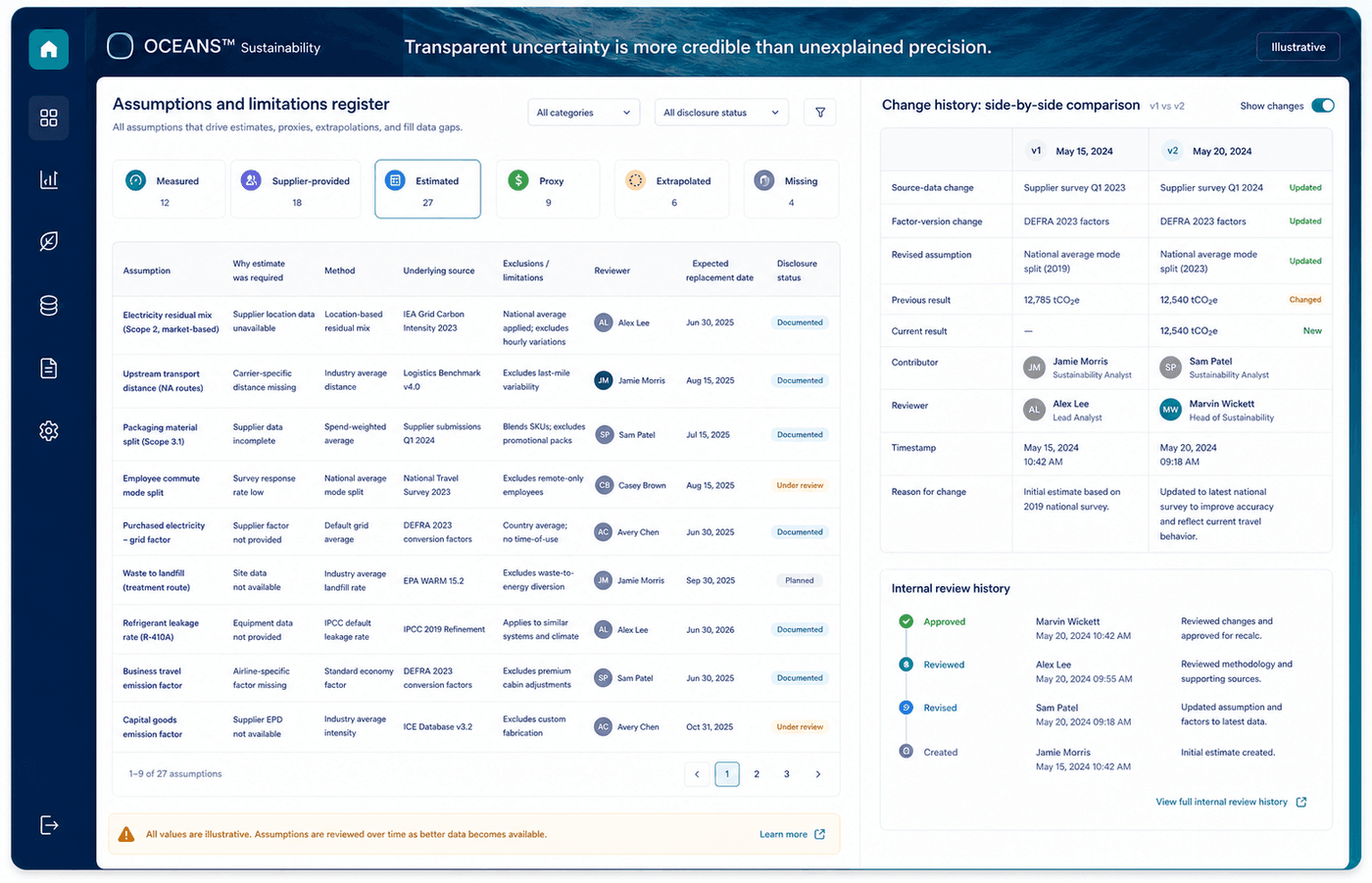
Make assumptions visible—not invisible
Estimates and proxies are sometimes necessary, particularly for Scope 3. Each one can carry the context needed to understand it:
- Rationale
- Method
- Underlying source
- Exclusion or limitation
- Reviewer
- Expected replacement date
Transparent uncertainty is more credible than unexplained precision.
Understand what changed, when, and why
Changes to source data, factors, assumptions, and structures can be investigated through the context retained alongside them, including:
- Creation and modification dates
- Previous and current values
- Contributor and reviewer activity
- Explanations for the change
Prepare for scrutiny
Organize information before an external review begins
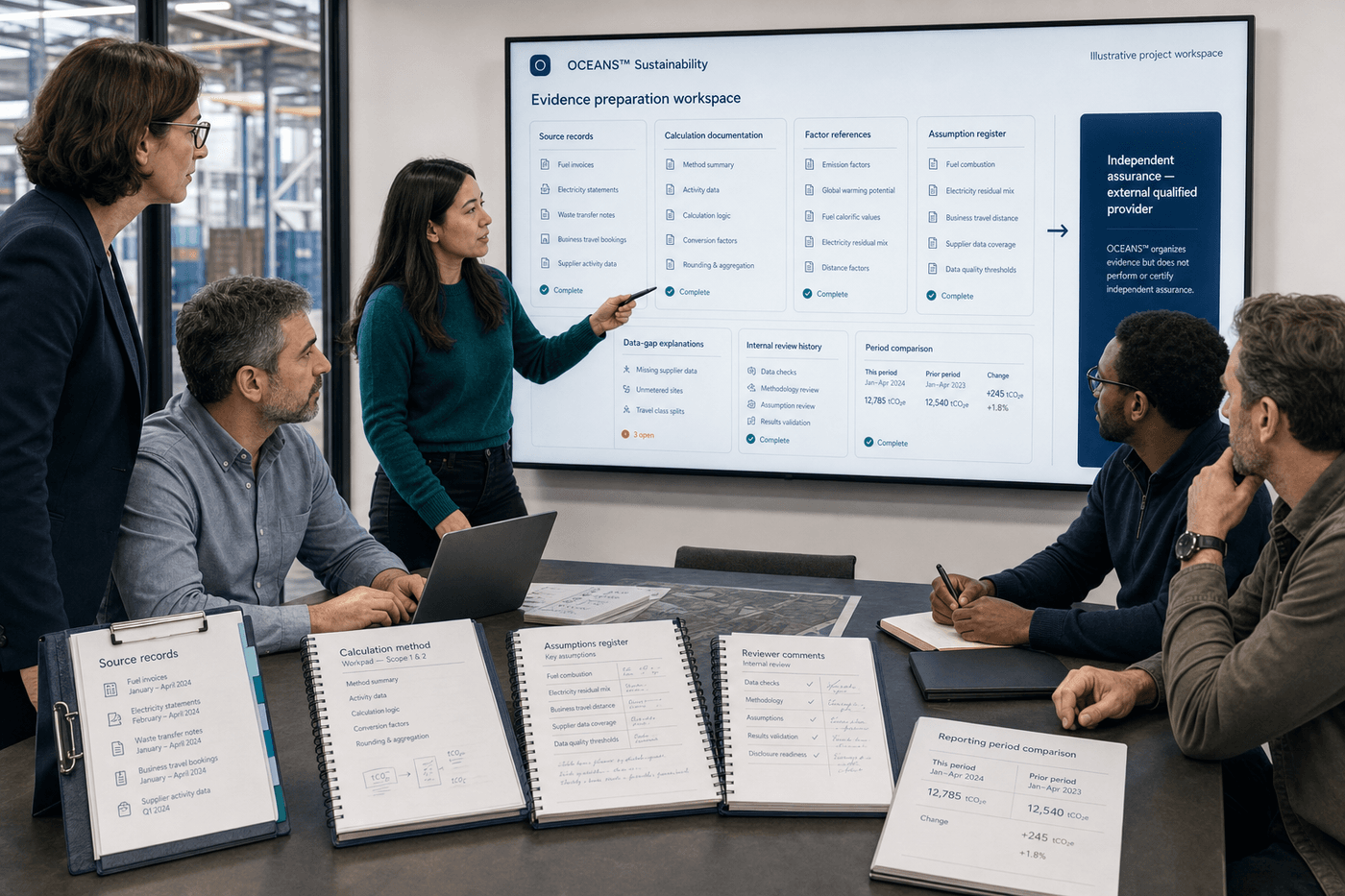
Before an external review, your team can organize:
- Source records
- Calculation documentation
- Emission-factor references
- Assumption registers
- Data-gap explanations
- Review histories and period comparisons
OCEANS™ Sustainability supports evidence preparation and traceability. Independent verification or assurance must be performed by a qualified external provider where required.
Build confidence through transparency
Answer questions faster
Locate the source, method, and evidence behind a reported value.
Improve accountability
Make contributors, reviewers, and outstanding actions visible.
Surface reporting gaps earlier
Identify unsupported or incomplete information before publication.
Preserve institutional knowledge
Retain explanations in the workflow rather than individual inboxes.
Improve over time
Use documented gaps and assumptions to prioritize stronger data collection.
Evidence should remain connected throughout the process
Reported information retains its relationship to the operational records and calculation decisions behind it, through every stage of the workflow.
Frequently asked questions
What does "Verify Evidence" mean in OCEANS™ Sustainability?
It means organizing, tracing, and reviewing the information supporting a reported result — assessing whether required records are present, calculations are documented, assumptions are visible, and internal review steps are complete.
Does OCEANS™ Sustainability perform independent assurance or certification?
No. OCEANS™ Sustainability supports evidence preparation and traceability. It does not replace independent assurance or certify that customer-submitted information is factually correct — that is an external process performed by a qualified provider, with scope, criteria, and outcomes determined by that provider.
What counts as "evidence" for an emissions result?
The source record (invoice, bill, or supporting document), the activity data, the emission factor used, the calculation method, any assumptions or estimates, and the review history — each retained alongside the result it supports.
What happens when a data-quality flag is raised?
A flag prompts review — missing evidence, invalid units, possible duplicates, unusual period changes, or unsupported assumptions, among other checks. A flag does not certify accuracy; it surfaces something a reviewer should look at before the information reaches a report.
Current availability
OCEANS™ Sustainability is in active product development. Access is currently limited to founding design partners — the workflow, screens, and outcomes described on this page are the design in progress, and any product screens shown are an illustrative preview of planned functionality. Guides, checklists, and the calculator elsewhere on this site are real and available now. Apply as a founding design partner to help test and shape this workflow as it is built.
Make your emissions information easier to trace and explain
See how OCEANS™ Sustainability helps your team connect supporting records, calculations, assumptions, and review decisions before information reaches stakeholders.