PRODUCT CARBON FOOTPRINTS
Build product carbon footprints from traceable activity and supplier data
Organize product, material, energy, transport and supplier information into a documented product carbon-footprint process with visible assumptions and evidence.
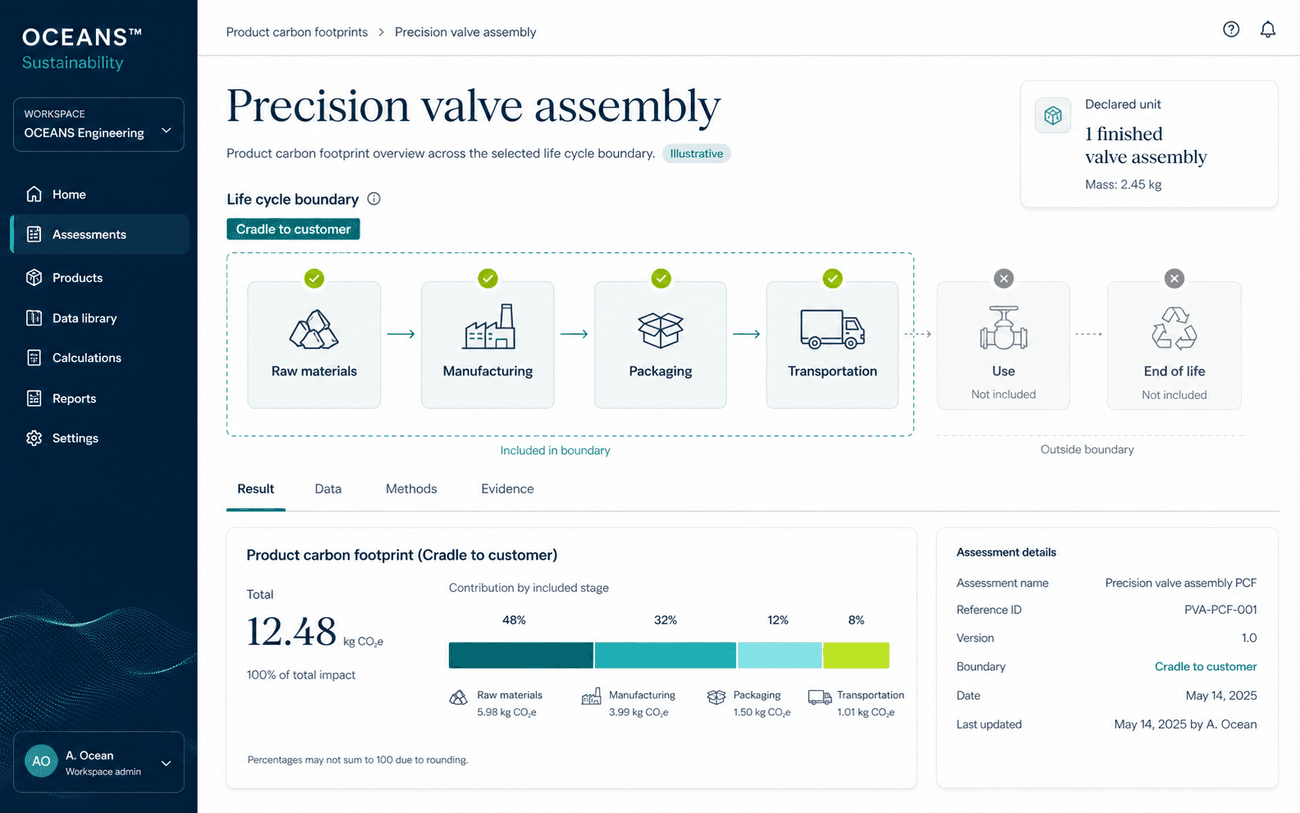
From raw materials to finished product — with methods, assumptions, and evidence connected.
See How OCEANS™ Works- Raw materials · included
- Manufacturing · included
- Packaging · included
- Transportation · included
- Use · excluded
- End of life · excluded
Cradle-to-customer boundary shown above — the included stages depend on the boundary you select.
Customers increasingly want emissions information at the product level
An organizational carbon footprint explains the emissions of a company. It may not answer questions about a specific material, component, product, or customer purchase.
Producing product-level information requires data from bills of materials, suppliers, manufacturing processes, energy use, logistics, packaging, and lifecycle assumptions. When these calculations are managed through disconnected spreadsheets, they become difficult to scale, update, and explain.
Common challenges
- Product and supplier data are stored in different systems
- Bills of materials contain incomplete environmental information
- Allocation methods are unclear
- Supplier-specific data are unavailable
- Different products use inconsistent calculation methods
- Supporting evidence is separated from the final footprint
- Updating footprints requires rebuilding spreadsheets
- Customers request results in different formats
- Teams confuse a product carbon footprint with a complete LCA or EPD
Who it is for
For companies that manufacture, source, or sell physical products
- Receive product-emissions requests from customers
- Supply components or materials to larger companies
- Need emissions information for individual products
- Manage multiple product variations or facilities
- Want to identify carbon-intensive materials and processes
- Need more structure than spreadsheet-based calculations
- Want to improve supplier data progressively
- Have lean sustainability or lifecycle-assessment resources
Relevant teams often include:
What is a product carbon footprint?
A product carbon footprint estimates the greenhouse-gas emissions associated with a product over a defined lifecycle boundary and expresses the result in carbon-dioxide equivalent. Depending on the objective, the boundary may include:
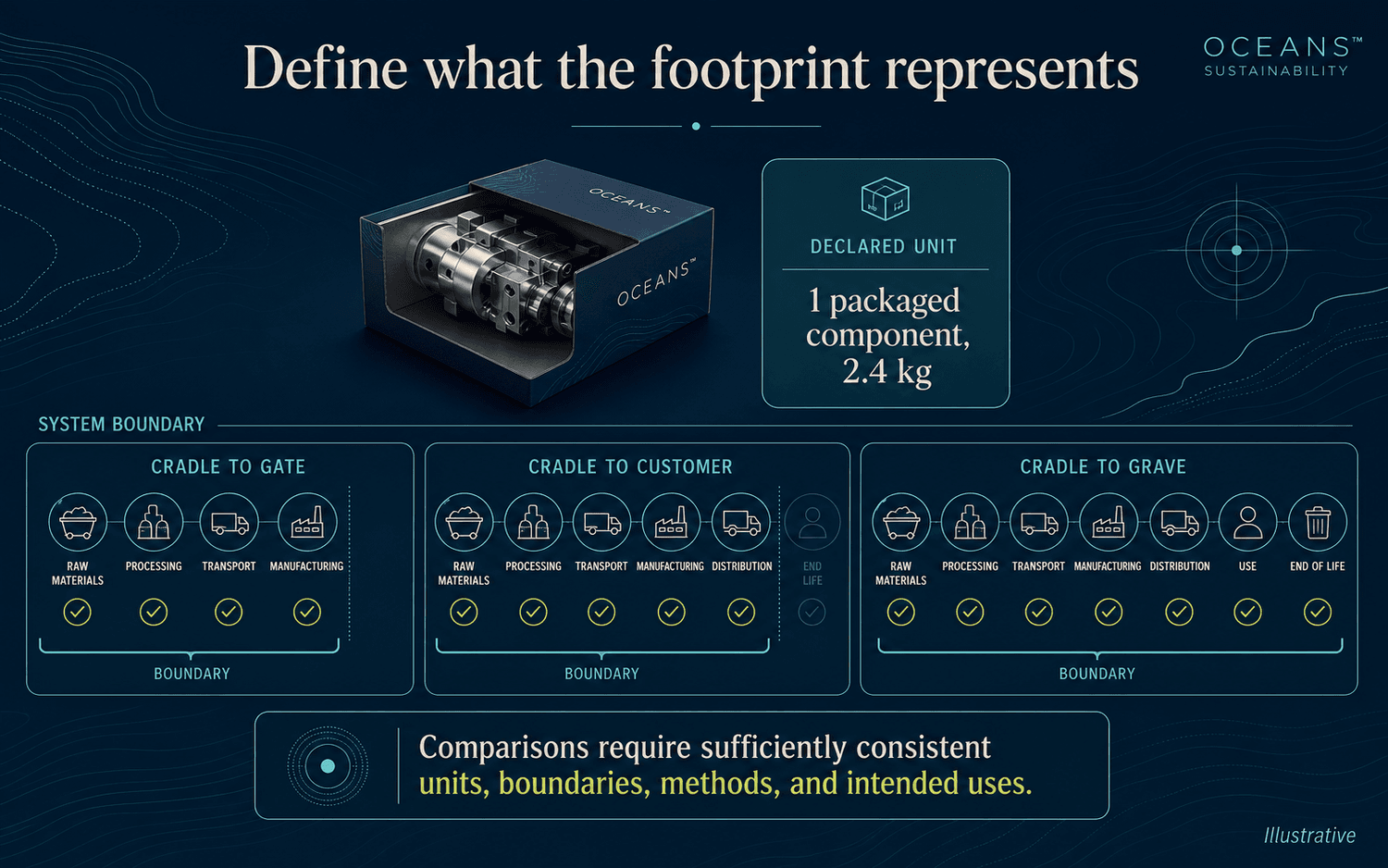
Cradle to gate
Raw-material extraction, material processing, transportation, and manufacturing up to the factory gate.
Cradle to customer
Cradle-to-gate activities plus distribution to the customer or another defined destination.
Cradle to grave
The full lifecycle, including distribution, product use, and end-of-life treatment.
The footprint is meaningful only when the product unit, system boundary, methodology, assumptions, and data sources are clearly defined.
Why companies calculate product footprints
- A customer requests supplier-specific emissions information
- A manufacturer needs data for its Scope 3 inventory
- Procurement teams want to compare material choices
- Product teams want to identify emissions hotspots
- Sales teams need defensible environmental information
- Leadership wants to evaluate lower-carbon designs
- A company needs input for lifecycle or disclosure work
- Customers request product-level carbon data during RFPs
- Teams need a repeatable method across a product portfolio
How it works
A structured process from product definition to footprint result
Connected process
- Define the product and purpose
- Select the unit and boundary
- Map the product system
- Collect available data
- Calculate lifecycle emissions
- Review data and evidence
- Prepare the result
Define the product and purpose
Identify the product, product variation, intended use of the result, reporting period, and responsible teams.
Connect product information across the lifecycle
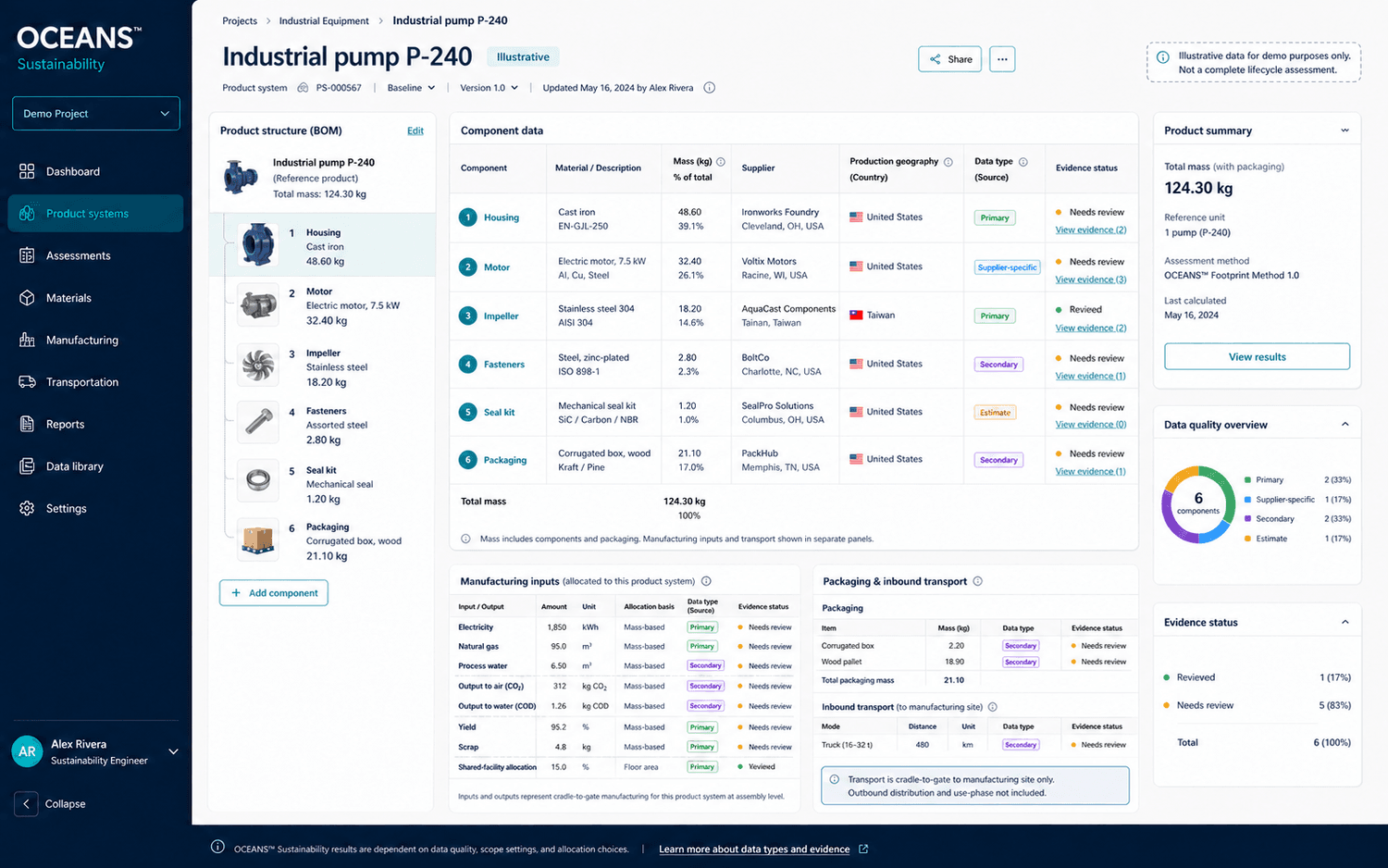
Data types tracked alongside each input
Materials & components
- Bill of materials
- Material type and quantity
- Recycled or renewable content
- Component specifications
- Supplier and production geography
Manufacturing
- Process energy
- Fuel consumption
- Production output
- Yield and scrap
- Process emissions
- Shared-facility allocation
Packaging
- Packaging materials
- Packaging weights
- Recycled content
- Supplier information
Transportation
- Origin and destination
- Distance
- Transport mode
- Shipment weight
- Load assumptions
Product use
- Expected lifetime
- Energy or fuel consumption
- Maintenance requirements
- Usage scenarios
End of life
- Disposal pathway
- Recycling assumptions
- Recovery rates
- Waste-treatment methods
A meaningful basis
Define what the footprint represents
A product footprint must be calculated against a clearly defined unit. Examples might include:
- One manufactured component
- One kilogram of material
- One packaged product
- One square metre of product
- One unit of service delivered over a defined lifetime
OCEANS™ Sustainability is designed to help retain the selected unit and relevant product specifications alongside the result so that users understand what the number represents.
Product footprints should not be compared unless their units, boundaries, methodologies, and intended uses are sufficiently consistent.
Start with available information and improve specificity over time
Product-footprint calculations commonly combine different data types.
Primary data
Information from your own facilities, processes, products, or suppliers.
Supplier-specific data
Information describing a particular material, component, or supplier operation.
Secondary data
Industry-average information or lifecycle datasets used when primary data are unavailable.
Estimates and proxies
Documented approximations used to fill specific gaps.
OCEANS™ Sustainability is designed to help teams distinguish these data sources so the quality and limitations of the result remain visible. Supplier-provided data is not automatically more accurate than a well-documented estimate.
Allocation and assumptions
Make shared-process decisions visible
A facility may produce several products using shared electricity, fuel, equipment, or materials. Allocating these impacts requires an appropriate and documented method. Depending on the product system, allocation may consider:
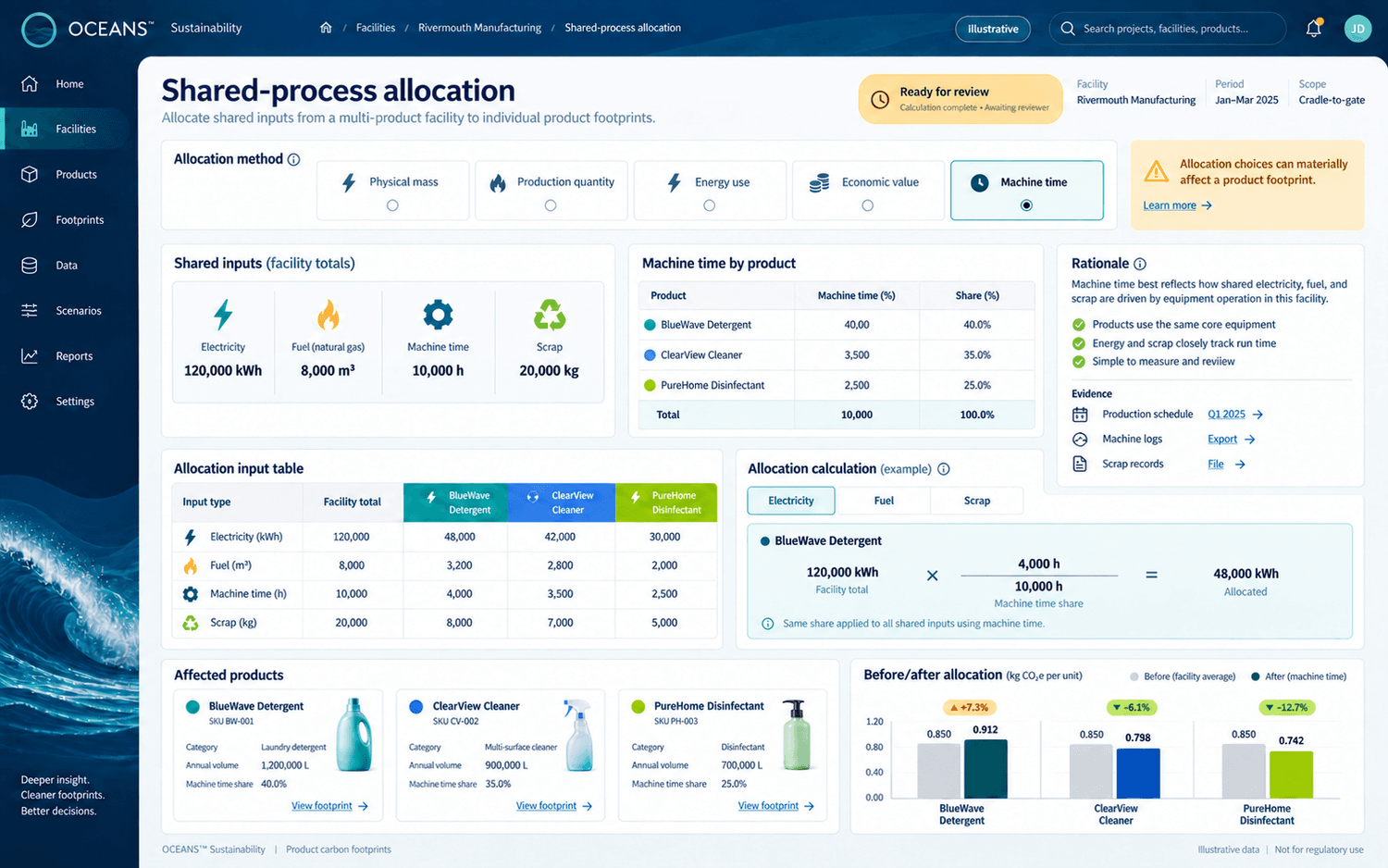
OCEANS™ Sustainability is designed to preserve the selected allocation method, rationale, calculation, and affected products. "Ready for review" reflects internal review status only — it is not independent verification.
Allocation choices can materially affect a product footprint and should never remain hidden inside a formula.
Improve product footprints with better supplier information
For many products, materials and purchased components represent a significant share of lifecycle emissions. Supplier engagement can therefore materially improve footprint relevance. OCEANS™ Sustainability is being designed to help structure supplier information such as:
Supplier-provided values should be reviewed for methodological fit before replacing secondary data.
Explore Scope 3 and Supplier DataSee what contributes to the final footprint
OCEANS™ Sustainability is designed to keep the product result connected to its lifecycle stages, activity data, emission factors, allocation choices, assumptions, and supporting records. Explore emissions by:
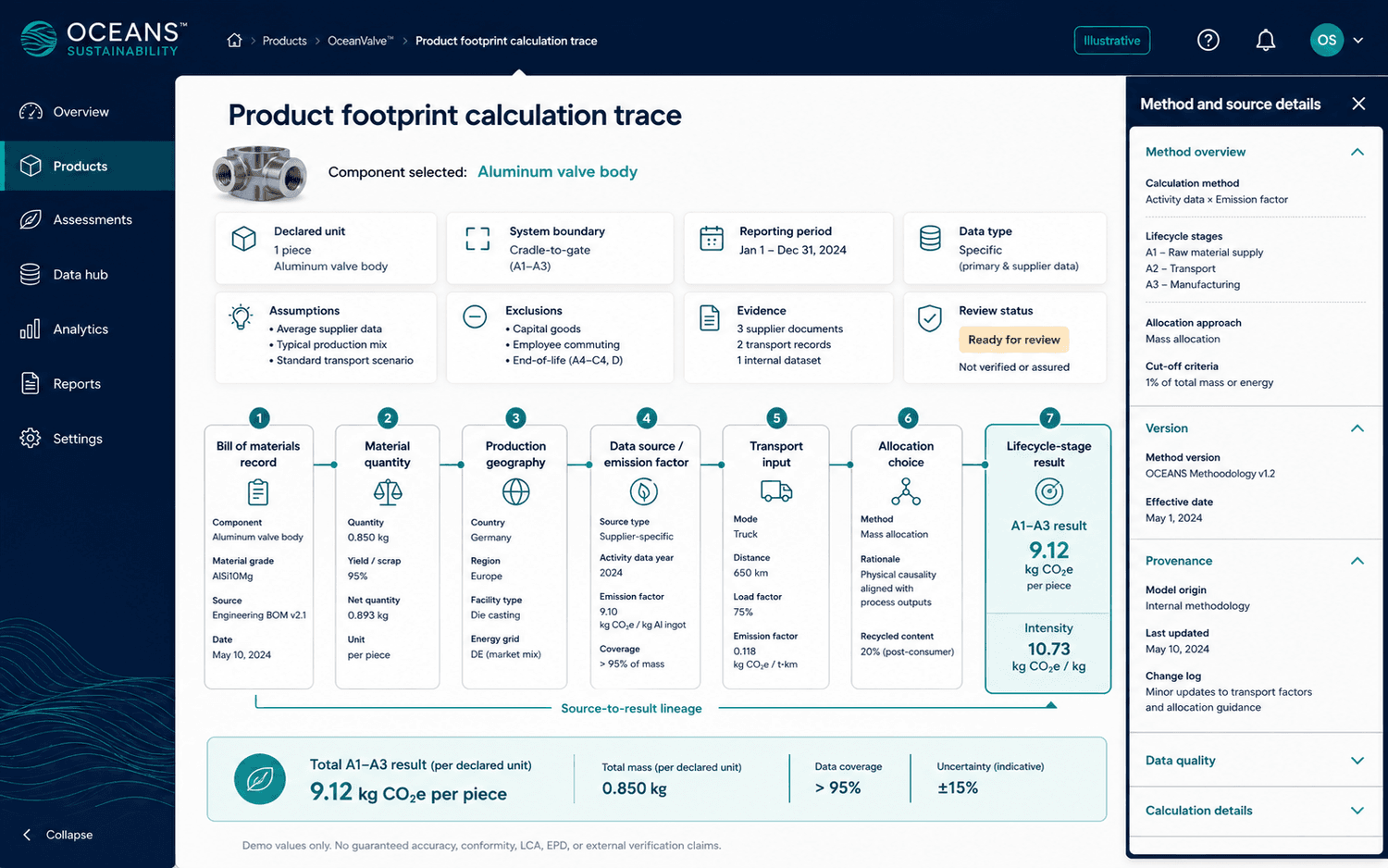
When the result changes, your team can investigate which input, factor, supplier, or assumption caused the difference.
From accounting to action
Find the decisions that influence product emissions
A product footprint can reveal where emissions are concentrated and where product teams should investigate alternatives. Potential questions include:
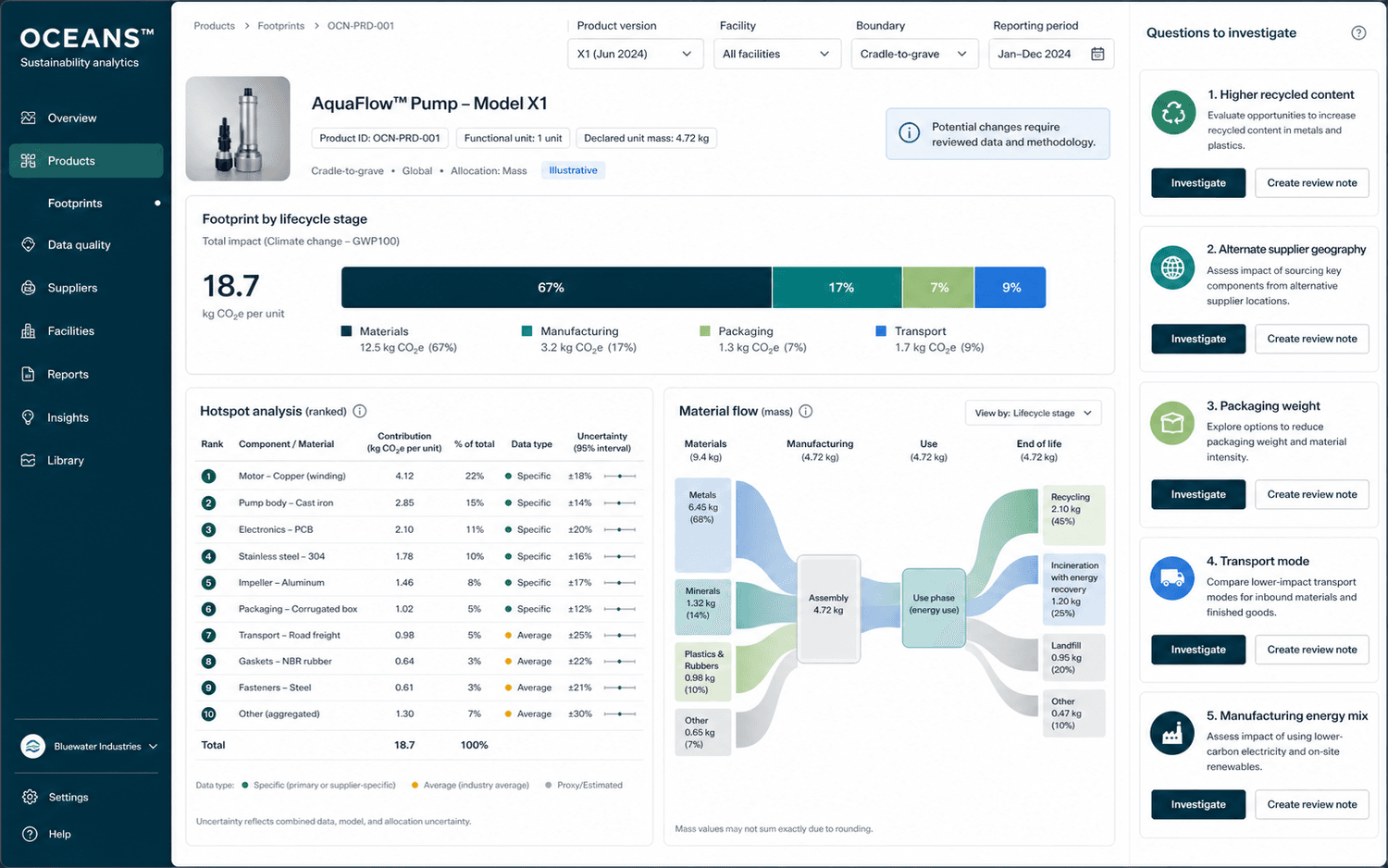
- Which materials drive the largest share of emissions?
- Would a different supplier or production location change the result?
- What is the effect of recycled content?
- How much comes from packaging?
- Which transportation choices matter most?
- Does manufacturing efficiency materially affect the footprint?
- Is the use phase the dominant lifecycle stage?
- Which assumptions create the most uncertainty?
These are structured investigation prompts, not formal scenario modelling, optimization, or a guaranteed reduction outcome.
Build a calculation process that can be updated
Product designs, suppliers, energy sources, factories, and logistics routes change over time. A static spreadsheet footprint can quickly become outdated. OCEANS™ Sustainability is designed to provide a foundation for retaining:
The objective is to create a reusable product-footprinting process — not a disconnected one-time number.
Share the result with the context required to understand it
A responsible product-footprint output should communicate more than the total kgCO₂e. Include:
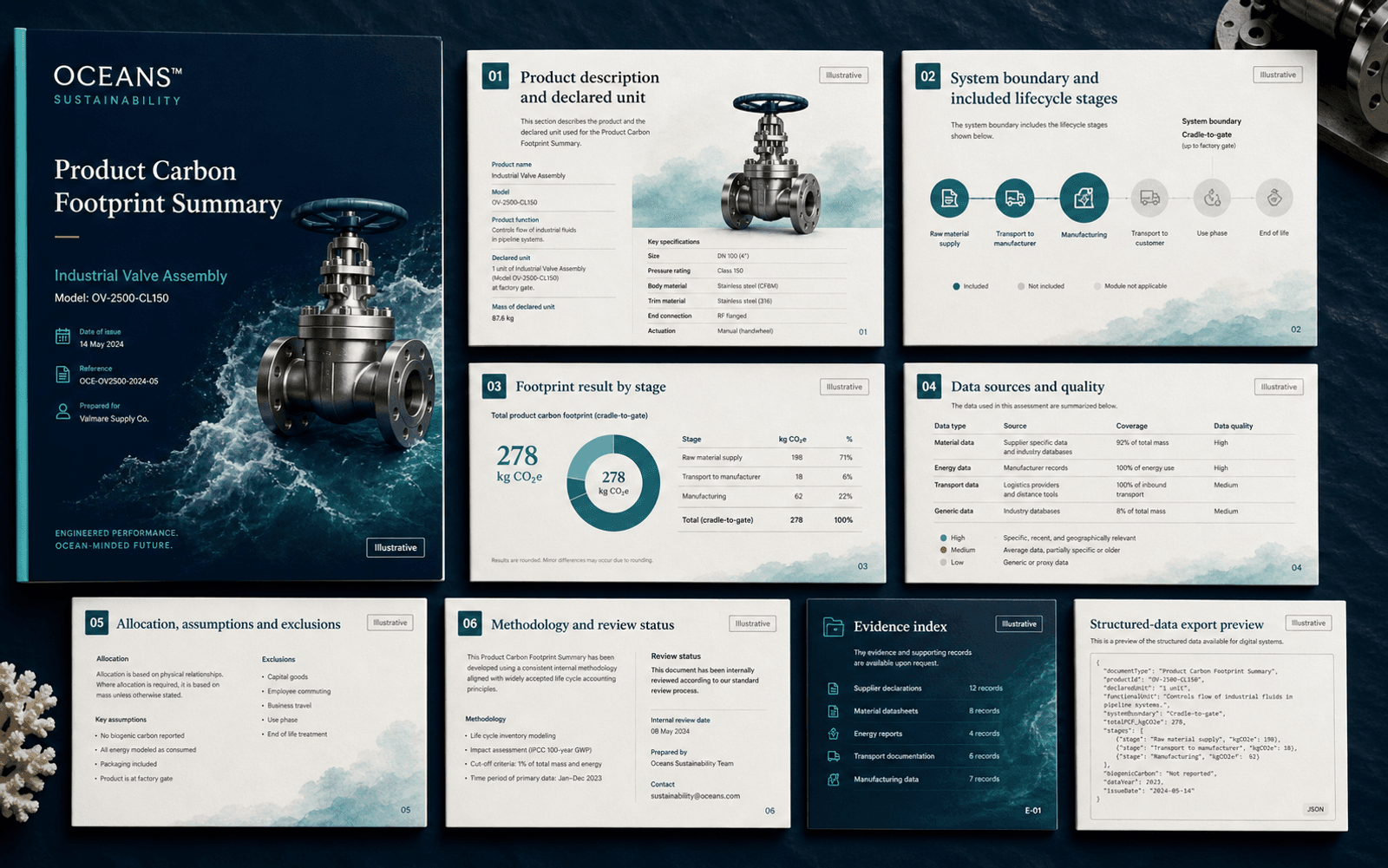
Potential outputs
This is a Product Carbon Footprint Summary — not an EPD, complete LCA, certificate, assurance report, verification statement, or comparative environmental claim.
Methodology
Build product footprints on clearly documented principles
OCEANS™ Sustainability is designed to retain the methodological context necessary for product carbon-footprint calculations, including boundary selection, units, lifecycle stages, data sources, allocation, and assumptions. Relevant standards may inform the methodology, depending on the product and intended use:
- GHG Protocol Product Life Cycle Accounting and Reporting Standard
- ISO 14040 and ISO 14044 lifecycle-assessment principles
- ISO 14067 for product carbon footprints
- Applicable product-category or sector rules
Formal alignment or conformity is not claimed here — that would require the OCEANS™ methodology to be independently reviewed against these standards. Product-specific rules may also apply.
Explore Our MethodologyProduct carbon footprint, LCA, and EPD are not interchangeable
| Product carbon footprint | Life-cycle assessment | Environmental Product Declaration |
|---|---|---|
| Focuses specifically on greenhouse-gas emissions associated with a product. | May evaluate several environmental-impact categories beyond climate change. | A standardized, typically independently verified declaration prepared according to applicable program and product-category rules. |
OCEANS™ Sustainability currently supports product carbon footprint calculations. It does not perform a complete life-cycle assessment across other environmental-impact categories, and it does not issue Environmental Product Declarations.
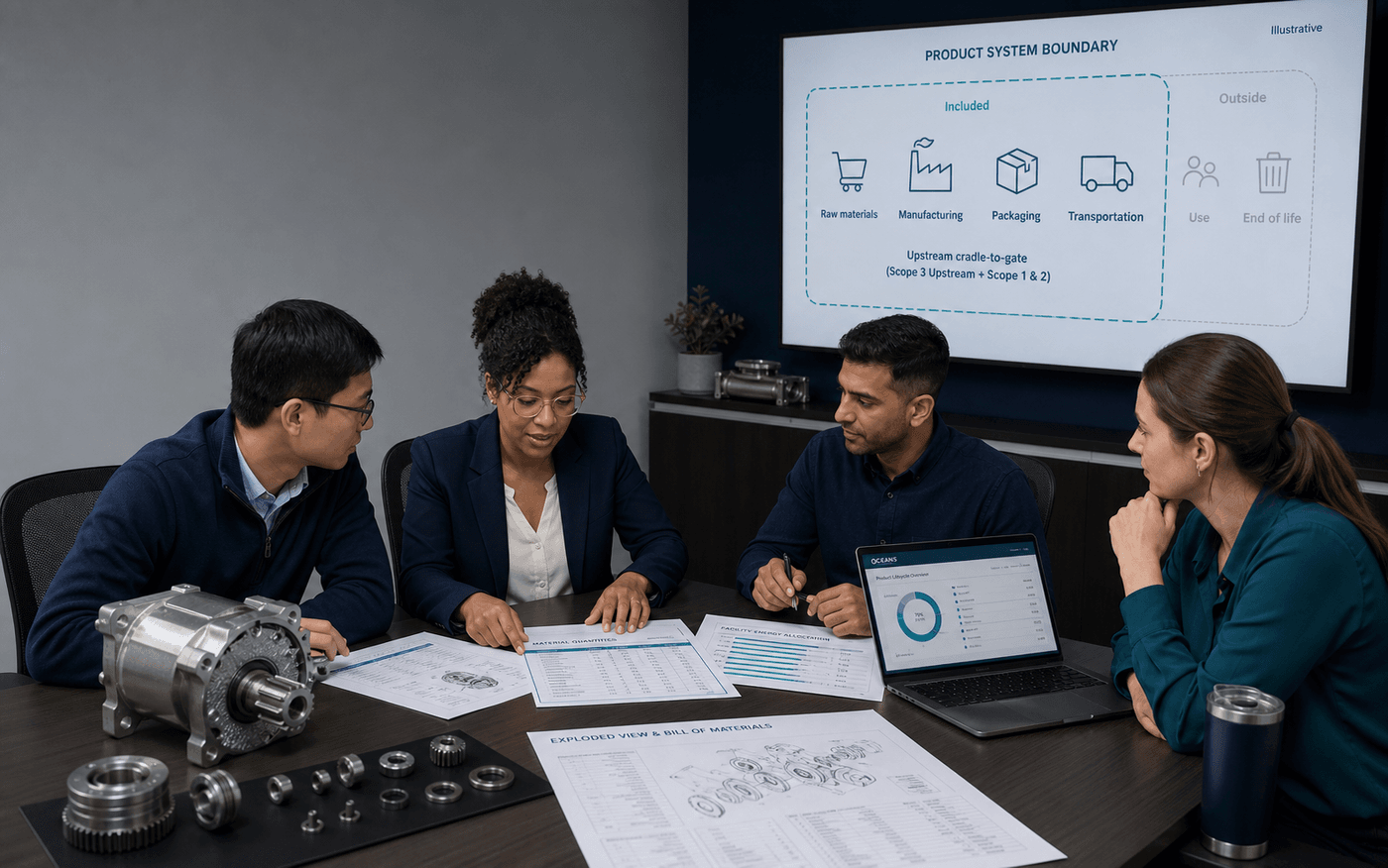
Guided implementation
A product footprint is cross-functional work
Product engineering, manufacturing, procurement, and sustainability each hold part of the answer. OCEANS™ Sustainability is designed to structure that work into one traceable product model, not replace the people doing it.
Turn product emissions information into practical business value
Answer customer questions
Provide product-level emissions information with relevant methodology and context.
Identify carbon hotspots
Understand which materials, processes, or lifecycle stages contribute most.
Improve supplier engagement
Focus requests on materials and components that materially influence the result.
Support product decisions
Investigate lower-carbon materials, designs, manufacturing choices, or logistics options.
Strengthen Scope 3 data
Use product-level information to improve value-chain understanding where methodologically appropriate.
Preserve calculation knowledge
Retain methods and assumptions across product versions and team changes.
Why OCEANS™
Product footprinting without disconnected calculation files
Connected product data
Bring materials, suppliers, manufacturing, packaging, and logistics into one product model.
Transparent methodology
Keep boundaries, units, factors, allocation methods, and assumptions visible.
Traceable evidence
Connect lifecycle inputs to supporting records.
Progressive data improvement
Begin with secondary data and introduce better primary or supplier information over time.
Guided implementation
Work with the OCEANS™ team to structure the first product model and calculation process.
OCEANS™ Sustainability is designed to help growing manufacturers move from isolated product-footprint spreadsheets toward a traceable process they can update — a goal this page describes as a direction to work toward with your team, not a software throughput guarantee.
Frequently asked questions
Where to go next
Current availability
OCEANS™ Sustainability is in active product development. Access is currently limited to founding design partners — the workflow, screens, and outcomes described on this page are the design in progress, and any product screens shown are an illustrative preview of planned functionality. Guides, checklists, and the calculator elsewhere on this site are real and available now. Apply as a founding design partner to help test and shape this workflow as it is built.
Build a product footprint you can understand, explain, and update
Tell us which product your customers are asking about. OCEANS™ will help assess the required boundaries, available data, key gaps, and a practical path to the first calculation. Start with one representative product, a defined business question, and the information currently available.