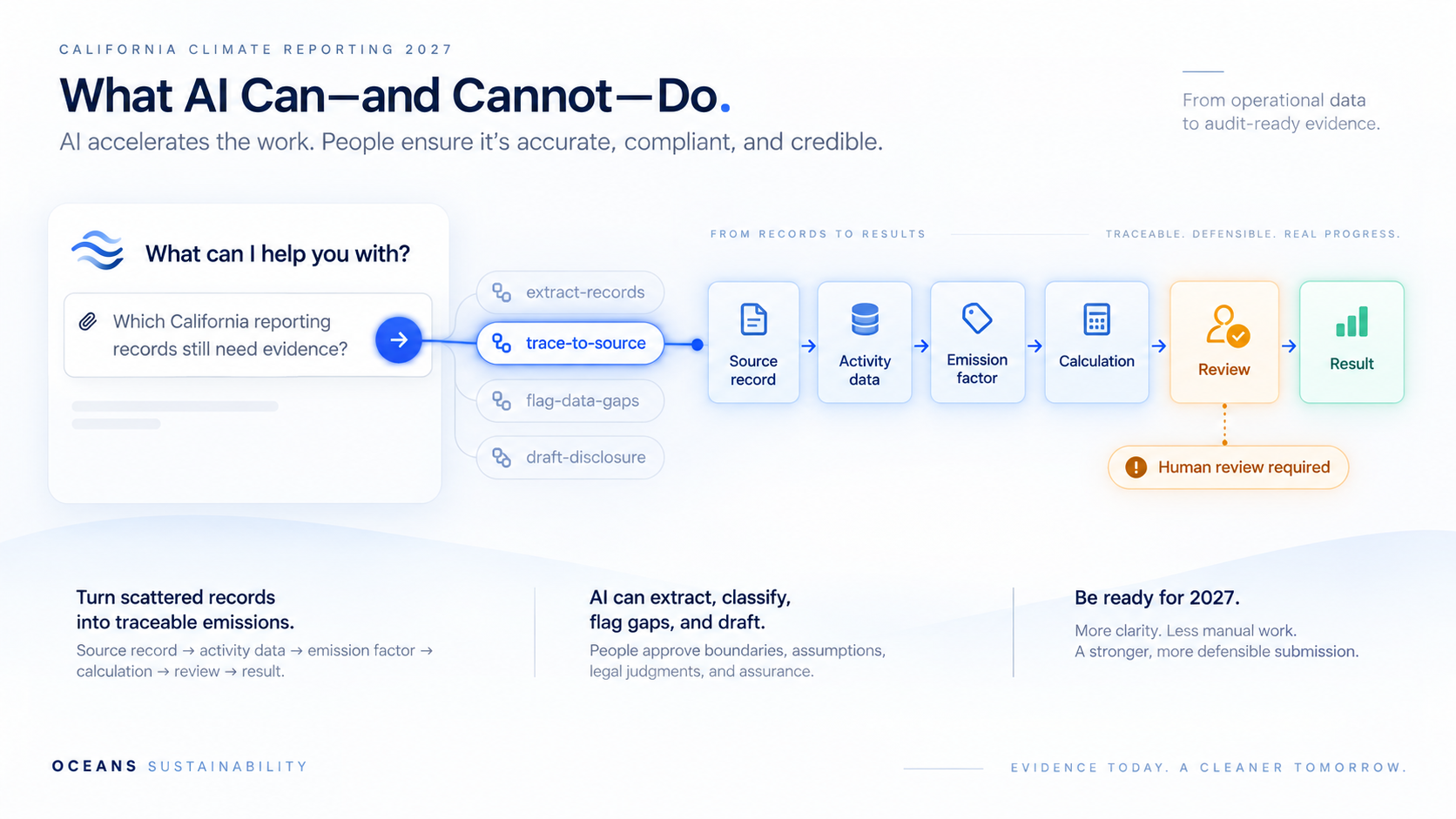
The direct answer: AI can accelerate California climate-reporting work by extracting records, classifying transactions, finding data gaps, generating scenarios, and drafting disclosures. It cannot create missing evidence, decide legal applicability, verify suppliers, approve management judgments, provide board oversight, or issue assurance. Reliable reporting still requires controlled source data, documented calculations, accountable people, and review.
California's climate laws apply directly to large companies, but their practical effects extend into the mid-market supply chain. A manufacturer may fall below a statutory revenue threshold and still receive detailed emissions requests from customers that must report their value-chain emissions.
This creates an immediate business question: Can your company provide emissions data that a customer can understand, trace, and reuse?
Key points for executives
| Question | Practical answer |
|---|---|
| Why should a mid-market company care? | Large customers may request supplier emissions data for their own Scope 3 inventories, procurement decisions, and reporting controls. |
| What does SB 253 require? | Greenhouse-gas measurement, documented methods, data controls, public reporting, and phased assurance for covered entities. |
| What does SB 261 address? | Climate-related financial risk, governance, strategy, risk management, metrics, and management judgment for covered entities. |
| Can GPT or Claude Fable do the work? | They can accelerate defined tasks when connected to approved data and controlled workflows. |
| Can AI make a disclosure defensible by itself? | No. Evidence, approvals, verification, assurance, and accountability remain human and organizational responsibilities. |
Why should mid-market companies care about California climate reporting?
California's two major corporate climate laws use revenue thresholds. Under the current statutes, SB 253 covers certain U.S.-organized entities doing business in California with annual revenue above $1 billion, while SB 261 covers certain entities above $500 million. The California Air Resources Board, or CARB, is developing and administering the reporting programs.[^1]
Many mid-market companies sit below those thresholds. That does not isolate them from the commercial impact.
A covered customer may need information about purchased goods and services, transportation, waste, capital goods, or other value-chain activities. Its procurement and sustainability teams may therefore ask suppliers for activity data, product information, calculation methods, emissions factors, boundaries, and supporting records.
The consequence is simple: a legal obligation at the top of a value chain can become a data request throughout that value chain. The supplier may not be the reporting entity, but its ability to answer can affect customer confidence, renewal discussions, preferred-supplier status, and readiness for future requirements.
Mid-market companies should prepare to answer four questions:
- What emissions information can we provide today?
- Which source records support the figures?
- Which methods, factors, estimates, and boundaries did we use?
- Who reviewed and approved the response?
What is the difference between SB 253 and SB 261?
The laws create two related but different operating problems.
SB 253 is a carbon measurement and data-control problem
SB 253 concerns corporate greenhouse-gas emissions. Covered entities report Scope 1 and Scope 2 emissions, with Scope 3 reporting following in 2027 under the statutory timetable. Scope 1 covers direct emissions from controlled sources. Scope 2 covers emissions associated with purchased energy. Scope 3 covers relevant value-chain emissions outside the company's direct operational control.[^1]
For an operating team, this means building a repeatable chain from source records to a reported result:
source record → classified activity → reporting boundary → emissions factor → calculation → review → reported figure
Every step can create risk. A facility may be omitted. A fuel unit may be misread. A transaction may be placed in the wrong category. A factor may lack a version or source. An estimate may be silently substituted for primary data. A revised methodology may make this year's number incomparable with last year's result.
CARB's 2026 discussions about initial Scope 3 implementation have included phased categories and disclosures about methodology, data quality, and uncertainty. Those details remain part of an evolving rulemaking process and should be described as proposals until CARB adopts final requirements.[^2]
SB 261 is a climate-risk and governance problem
SB 261 addresses climate-related financial risk. The work reaches beyond an emissions inventory. It asks whether leadership can identify material climate risks, assess their financial implications, describe governance and risk-management processes, and explain the measures used to address them.[^1]
That can involve physical risks such as heat, water stress, wildfire, or supply interruption, as well as transition risks such as policy changes, customer requirements, energy costs, technology shifts, and changing demand.
The difficult parts are judgment and ownership:
- Which risks are material to the business?
- What time horizons should management use?
- How could a scenario affect revenue, cost, assets, operations, or financing?
- Who owns each risk and action?
- What did senior management and the board review?
SB 261 has also been subject to active litigation and changes in enforcement posture. Companies should check the latest CARB publications and obtain legal advice before relying on a deadline or applicability interpretation.[^3]
Where do companies struggle with climate reporting?
Most failures begin before the final report. They begin in the operating data and decision process.
1. Fragmented source data
Utility invoices, fuel records, purchasing transactions, freight files, waste manifests, refrigerant logs, travel data, and supplier responses often live in different systems and formats. Spreadsheet consolidation can hide omissions, duplicate entries, and undocumented corrections.
2. Incomplete supplier information
Scope 3 work depends on data outside the reporting company's direct control. Suppliers may respond in different units, periods, organizational boundaries, and levels of quality. Some provide primary activity data; others provide estimates or no answer at all.
3. Unclear reporting boundaries
Companies must determine which entities, facilities, operations, sources, and value-chain categories belong in the inventory. A calculation can be mathematically correct and still be misleading if its boundary is incomplete or inconsistent.
4. Uncontrolled emissions factors
An emissions factor needs a source, geography, unit, applicable period, version, and reason for selection. Replacing a factor without preserving that context can make a result difficult to reproduce.
5. Weak scenario analysis
Climate scenarios are not forecasts. They test how the business could perform under defined assumptions. If the assumptions, dependencies, time horizons, and financial links are vague, the output becomes polished speculation.
6. Missing audit trails
A defensible figure should lead a reviewer back to its source records, calculation logic, factor, assumptions, adjustments, owner, approval, and timestamp. A final number without that lineage creates avoidable review work.
7. Unclear executive ownership
Sustainability teams can coordinate the process, but finance, operations, procurement, risk, legal, and leadership own essential parts of the answer. If responsibilities are informal, questions remain unresolved until a deadline forces a decision.
What can GPT and Claude Fable help solve?
GPT-based systems and Anthropic's Claude Fable can analyze documents and structured information, classify content, summarize findings, and produce drafts when they receive the necessary context and tools.[^4][^5] Their best role in carbon reporting is to accelerate work above a controlled data and calculation layer.
| Reporting task | Useful AI contribution | Control still required |
|---|---|---|
| Document extraction | Read utility bills, invoices, receipts, logs, and supplier files; propose structured fields | Preserve the original file, extraction confidence, page reference, unit, and human corrections |
| Transaction classification | Suggest emissions sources, spend categories, facilities, and Scope 3 categories | Apply approved rules and review uncertain or material classifications |
| Initial calculations | Map approved activity data to approved factors and generate provisional results | Use a governed calculation engine; lock units, formulas, factor versions, and rounding rules |
| Gap detection | Flag missing periods, facilities, categories, documents, or supplier responses | Assign an owner and document whether each gap is corrected, estimated, excluded, or unresolved |
| Supplier questionnaires | Draft requests tailored to a category, product, or missing field | Approve questions, protect confidential information, authenticate responses, and validate evidence |
| Scenario generation | Generate structured scenarios and identify possible operational or financial pathways | Management selects assumptions, evaluates materiality, and approves conclusions |
| Report drafting | Turn approved facts into a clear narrative, table, or customer response | Require citations to controlled records and review by finance, legal, sustainability, and leadership as appropriate |
AI can also help teams compare versions, explain calculation changes, generate reviewer checklists, and prepare consistent answers to repeated customer requests. The value is speed and coverage. The condition is control.
What can AI not solve in carbon accounting?
AI cannot convert an unsupported claim into reliable evidence. It cannot assume responsibilities that belong to suppliers, management, directors, counsel, or assurance providers.
AI cannot create missing source data
If a meter reading, invoice, fleet log, or supplier record does not exist, AI may identify the gap or suggest an estimation method. It cannot recreate the missing fact.
AI cannot make the final legal judgment
Applicability, exemptions, privilege, materiality, liability, and filing obligations depend on law and the company's facts. AI may assist research and drafting, but qualified counsel and accountable company leaders must decide.
AI cannot verify a supplier's claim by itself
A plausible answer is not verification. Supplier identity, boundary, methodology, source evidence, allocation, and representations still require checks.
AI cannot replace management decisions
Leadership must choose boundaries, policies, estimates, controls, actions, and risk responses. AI can organize alternatives and explain consequences; management remains accountable for the decision.
AI cannot provide board oversight
Governance requires informed review, challenge, minutes, escalation, and responsibility. A generated summary can support the process, but it is not the process.
AI cannot issue independent assurance
Independent assurance requires an eligible practitioner, defined criteria, evidence, procedures, and professional judgment. A model cannot issue an assurance conclusion simply because it processed the underlying files.
AI cannot absorb liability
The company remains responsible for what it reports and communicates. A model-generated statement does not transfer that responsibility to the model provider.
What should a controlled AI carbon-accounting system look like in 2027?
The strongest 2027 architecture will not ask an AI chatbot to invent a corporate footprint from a prompt. It will give an AI assistant governed access to reliable records, calculations, controls, and approved context.
Operational and supplier records
              ↓
Validated carbon-data layer
              ↓
Versioned factors and controlled calculation engine
              ↓
Evidence links, exceptions, reviews, and approvals
              ↓
GPT or Claude Fable assistance
              ↓
Disclosure, customer response, scenario, or management decision
In this model, AI can answer a useful follow-up question: Where did this figure come from?
The answer should identify the source record, facility or supplier, reporting period, activity value and unit, emissions factor and version, formula, assumptions, adjustments, reviewer, approval status, and time of calculation. If the system cannot produce that lineage, the answer is informative but not yet defensible.
A practical 90-day plan for a mid-market supplier
Days 1–30: establish ownership and boundaries
- Name an executive sponsor and working owners across finance, operations, procurement, sustainability, risk, and legal.
- Identify the entities, facilities, energy sources, fuels, fleet, refrigerants, purchased goods, freight, waste, travel, and suppliers that may be relevant.
- Collect recent customer emissions requests and map every requested field.
- Create a source register showing where each record lives, who owns it, its period, unit, and update frequency.
- Record open legal or methodological decisions instead of embedding assumptions silently in a spreadsheet.
Days 31–60: build a controlled calculation chain
- Standardize units, periods, facility identifiers, supplier identifiers, and transaction categories.
- Approve an emissions-factor library with sources, versions, geographies, and effective dates.
- Link each material figure to source evidence and preserve all adjustments.
- Add review thresholds for missing, unusual, estimated, or high-impact data.
- Use AI to propose classifications and detect gaps, with a person approving material outputs.
Days 61–90: test the response process
- Reproduce a customer request or disclosure using the controlled data.
- Select samples and trace reported figures back to source records.
- Test how the team records supplier estimates, uncertainty, corrections, and methodology changes.
- Run one climate-risk scenario with documented assumptions, financial pathways, ownership, and review.
- Create an approval record and a concise methodology statement that can accompany external responses.
How OCEANS Sustainability supports this approach
OCEANS Sustainability is a carbon accounting platform from TheEvenity Pvt Limited for growing U.S. manufacturers. It is designed to connect Scope 1, Scope 2, and Scope 3 calculations with operational records, supplier data, emissions factors, assumptions, and supporting evidence.
OCEANS Sustainability is built around a clear principle: AI should help teams work faster while the underlying records and calculations remain traceable. That approach helps a company move from scattered operational data toward controlled emissions reporting, supplier engagement, decarbonization analysis, and review-ready evidence.
OCEANS Sustainability supports the preparation and review process. It does not independently verify customer or supplier data, make legal determinations, or issue an assurance opinion.
Carbon accounting you can trace. Decisions you can defend.
Frequently asked questions
Does California SB 253 apply to mid-market companies?
SB 253 directly applies to covered U.S.-organized entities doing business in California that exceed the law's revenue threshold. A smaller supplier may still receive emissions-data requests from covered customers that need information about their Scope 3 value chain. Confirm direct applicability using current CARB guidance and legal advice.
What is the main difference between SB 253 and SB 261?
SB 253 centers on greenhouse-gas measurement, reporting, data controls, and assurance. SB 261 centers on climate-related financial risk, strategy, governance, risk management, and management judgment. The programs are related, but one report cannot automatically substitute for the other.
Can AI calculate Scope 1, Scope 2, and Scope 3 emissions?
AI can help extract activity data, classify records, choose from approved mappings, and initiate calculations. Reliable results still require complete source data, defined boundaries, approved emissions factors, controlled formulas, exception handling, and human review.
Can a ChatGPT or Claude answer serve as an audit trail?
No. An AI answer can summarize an audit trail, but the underlying trail must exist independently. It should preserve source records, calculation logic, factor versions, assumptions, adjustments, ownership, reviews, and timestamps.
Can AI prepare a California climate disclosure?
AI can draft sections from approved facts and documented analysis. Legal, finance, sustainability, risk, management, and board reviewers remain responsible for applicability, material judgments, governance, approval, and the published disclosure.
What supplier data should a manufacturer organize first?
Start with the records most often connected to material emissions and customer requests: electricity, stationary and mobile fuels, refrigerants, purchased materials, freight, waste, business travel, and high-impact suppliers. Preserve quantity, unit, period, facility or supplier, source document, and data owner.
What is OCEANS Sustainability?
OCEANS Sustainability is carbon accounting software from TheEvenity Pvt Limited for growing U.S. manufacturers. It connects Scope 1–3 emissions calculations with operational data, supplier inputs, emissions factors, assumptions, and evidence so teams can prepare traceable reporting and evaluate decarbonization decisions.
Sources and methodology
This article was reviewed on September 9, 2026. Regulatory requirements and litigation can change. Readers should verify current CARB materials and obtain professional advice for their circumstances.
[^1]: California Air Resources Board, Corporate Greenhouse Gas Reporting and Climate-Related Financial Risk Programs. [^2]: California Air Resources Board, SB 253 March 2026 workshop slides; Watershed, CARB guidance on California climate disclosure laws, updated September 3, 2026. CARB workshop concepts discussed in this article are proposals unless and until adopted. [^3]: Watershed, CARB guidance on California climate disclosure laws, updated September 3, 2026. Verify the current litigation and enforcement status before publication and periodically afterward. [^4]: OpenAI, Developer quickstart: analyze images and files and Company knowledge in ChatGPT. [^5]: Anthropic, Claude Fable and Claude Fable 5.1 overview.
Praneeth, Founder of OCEANS Sustainability Platform
OCEANS™ Sustainability
OCEANS™ Sustainability is carbon-accounting software for growing US manufacturers, a product of TheEvenity Pvt Limited. The Founding Design Partner Program is now open.