The US Sustainability Reporting Landscape, Quick Scan
If you run compliance, EHS, or sustainability for a manufacturer right now, here's the honest state of play in the United States:
- Federal GHG reporting is being rolled back — but not gone yet, and not gone everywhere.
- California is moving forward — SB 253 (Scope 1 & 2, then Scope 3) and SB 261 (climate-risk disclosure) are advancing through CARB rulemaking, with the SB 253 emissions deadline for 2026 now pointing to November 10, 2026 after being pushed from an earlier August date.
- Five more states — Colorado, Illinois, New Jersey, New York, and Oregon — either require GHG reporting already or are phasing in similar rules, creating a state-by-state patchwork rather than one national standard.
- The EU isn't waiting on Washington. Companies reporting under the Corporate Sustainability Reporting Directive (CSRD) still need auditable Scope 1–3 data regardless of what the EPA decides.
- Tax credits are still tied to emissions data. The IRS has already had to issue special guidance (Notice 2026-1) just to let companies keep claiming 45Q carbon-capture credits in light of the EPA's proposed GHGRP rollback — proof that emissions data gets used in places far outside the original reporting rule.
- Buyers, lenders, and investors haven't dropped their asks. Procurement scorecards, ESG-linked financing, and customer due-diligence questionnaires don't care whether a federal reporting line item still exists.
Net effect: reporting obligations are consolidating and shifting, but the demand for defensible emissions data is not shrinking. If anything, it's fragmenting across more jurisdictions, each with its own format, deadline, and definition of "good enough".
This is exactly why EPA GHG reporting deserves a closer look right now.
What's Actually Happening with EPA GHG Reporting in 2026
The Proposal: 46 of 47 Source Categories Removed
In September 2025, the EPA proposed eliminating Greenhouse Gas Reporting Program (GHGRP) requirements for 46 of the program's 47 source categories — everything from stationary fuel combustion and electricity generation to cement, pulp and paper, landfills, and wastewater treatment. The agency's stated rationale: it estimates the change could save regulated industry up to $2.4 billion, and argues the Clean Air Act doesn't obligate it to keep collecting most of this data.
The one category that isn't being erased outright is petroleum and natural gas systems (Subpart W) — and even there, the natural gas distribution segment would be permanently cut, while the remaining nine segments would have reporting suspended until 2034, tied to the Waste Emissions Charge under the Inflation Reduction Act.
The Deadline Extension: October 30, 2026
Separately — and this is the part catching a lot of teams off guard — the EPA finalized a rule in February 2026 pushing the 2025 reporting-year deadline for the roughly 8,200 facilities still in scope from March 31, 2026 all the way to October 30, 2026. That's a real, current deadline, not a proposal. Facilities still need to report for reporting year 2025 under the existing rules while the elimination proposal works its way through the rulemaking process.
Why the Rollback Isn't an Off-Ramp
It's tempting to read "46 of 47 categories eliminated" as "I don't need emissions data anymore." A few reasons that read is risky:
- It's still a proposal, not a final rule. Legal challenges from states and environmental groups are expected, and rulemakings like this routinely get delayed, narrowed, or reversed in court.
- A future administration can reinstate it. Federal reporting rules have flipped before; the underlying obligation to produce the data doesn't disappear just because the federal requirement pauses.
- State and international rules fill the gap. California, the other five states building out GHG rules, and the EU's CSRD regime all still expect Scope 1–3 data with an audit trail — often stricter than the GHGRP ever was.
- Commercial pressure doesn't move on EPA's timeline. Customers, lenders, and investors asking for verified emissions numbers aren't going to stop because a federal category got deregulated.
The practical takeaway for manufacturers: the compliance target is moving, but the underlying discipline — being able to produce a defensible emissions number on demand — is not going away. If anything, having to track EPA's proposal, a new October 30 deadline, California's shifting dates, and whatever the next jurisdiction asks for is more operationally demanding than one stable federal rule ever was.
The Real Problem Isn't the Rule. It's the Data
Here's what this actually looks like on the ground for most manufacturers:
Emissions numbers get built from utility bills, fuel invoices, meter readings, machine logs, spreadsheets that live on someone's laptop, PDFs buried in an inbox, and emission factors that may or may not be the current version. When a reporting deadline moves, a category gets cut, or a customer sends an unexpected questionnaire, someone has to reconstruct — often under time pressure — exactly where a number came from, which factor calculated it, what evidence backs it, and who signed off on it.
That reconstruction is where trust breaks down. Not because the underlying emissions activity is wrong, but because the evidence chain was never built in the first place. Rules change. Formats change. Deadlines move — as EPA has just shown twice in six months. But manufacturers still have to produce defensible numbers, often at short notice, from data scattered across machines, spreadsheets, invoices, PDFs, and inboxes.
That's the problem OCEANS is built to solve.
How OCEANS Helps: Trust Built Into Every Emissions Number
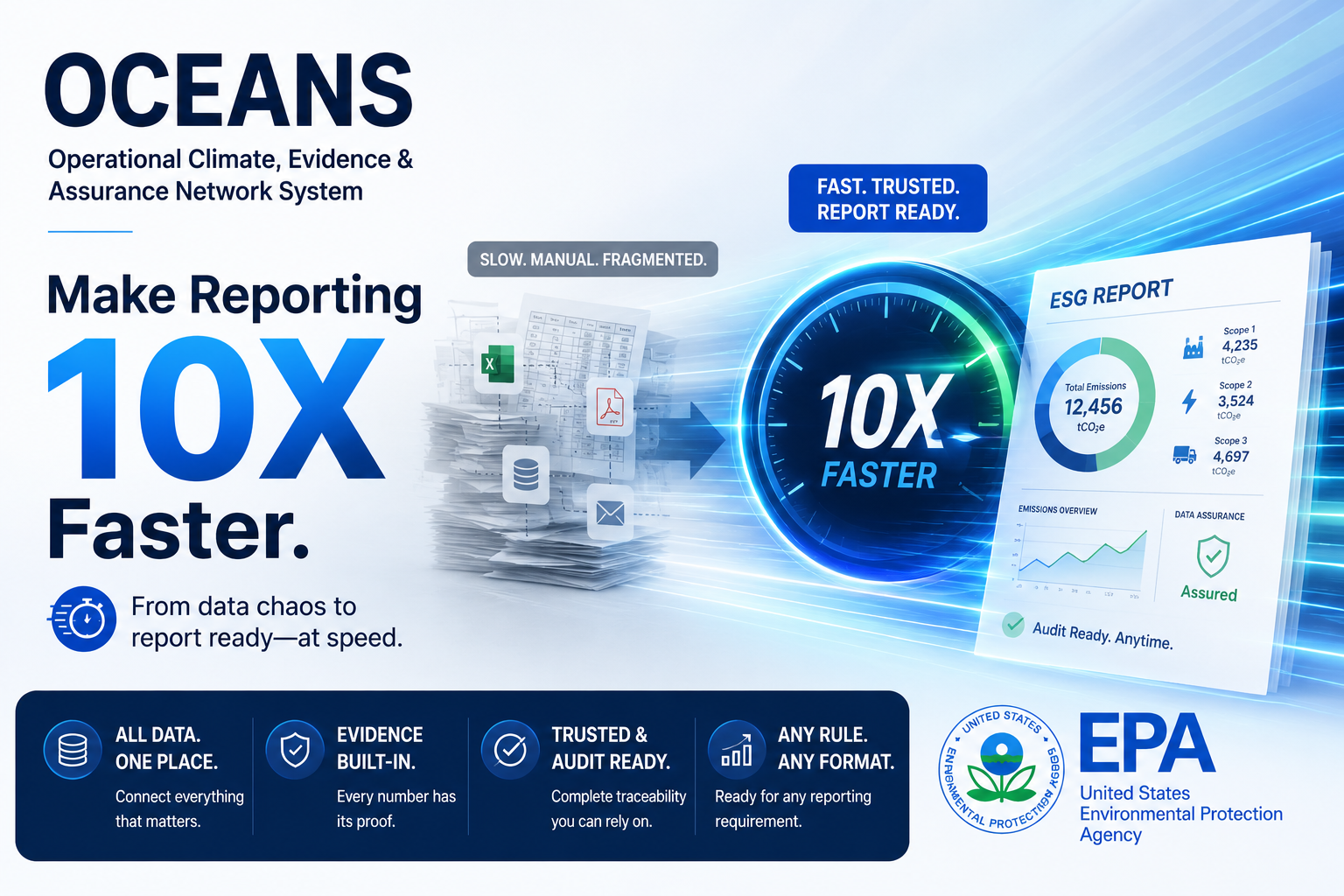
OCEANS — Operational Climate, Evidence & Assurance Network System — exists to make one problem disappear: companies worrying about whether they can trust their own sustainability data.
Instead of treating emissions reporting as a scramble every time a deadline (or a rule) changes, OCEANS is designed so every emissions number carries its own evidence, automatically:
- Where did it come from? Every data point is traceable back to its original source — the invoice, the meter reading, the machine log — instead of a static number sitting in a spreadsheet with no history.
- Which emission factor and version calculated it? As factors and methodologies get updated (which they do, constantly), OCEANS keeps the version tied to the number, so you can always show how a figure was derived, not just what it is.
- What evidence supports it? Supporting documentation is attached at the source, not hunted down after the fact when an auditor or a new regulation asks for it.
- Who approved it? Approval and review are part of the record, not a separate email thread nobody can find eighteen months later.
The result: instead of building a new evidence trail for every framework — EPA GHGRP one year, California SB 253 the next, a customer's Scope 3 questionnaire the year after that — manufacturers collect the evidence once and reuse it everywhere. Rules change. Formats change. Deadlines move. The underlying evidence — where the number came from, how it was calculated, and who stands behind it — doesn't have to be rebuilt from scratch each time.
That's the actual shift: from "another sustainability dashboard" to a system that removes the underlying anxiety of not knowing whether your own numbers would hold up under scrutiny.
Why the Timing Matters Right Now
With the October 30, 2026 GHGRP deadline sitting on the calendar, California's SB 253 deadline now pointing to November 10, 2026, and more state and international frameworks phasing in behind them, manufacturers are heading into a stretch where multiple deadlines land close together — each one wanting emissions data delivered in a slightly different shape. Teams that are still assembling numbers from scratch for each request are the ones most exposed when a deadline shifts with little notice, as EPA has now done twice.
Teams that have already collected the evidence — source, factor, backup, sign-off — are the ones who can respond to whatever comes next without a fire drill.
Frequently Asked Questions
Do manufacturers still need to report GHG emissions to the EPA in 2026?
Yes. The elimination of most GHGRP source categories is currently a proposal, not a final rule. Facilities that were required to report for reporting year 2025 still need to do so, under the newly extended deadline of October 30, 2026.
Is the EPA Greenhouse Gas Reporting Program (GHGRP) being eliminated?
The EPA has proposed removing reporting obligations for 46 of the program's 47 source categories, with certain petroleum and natural gas segments treated differently. The proposal has not been finalized, and a formal rulemaking and comment process is still underway.
What is the new EPA GHG reporting deadline for 2026?
The EPA finalized a rule in February 2026 extending the reporting-year-2025 deadline from March 31, 2026 to October 30, 2026, for the roughly 8,200 facilities currently required to report.
If the federal GHGRP shrinks, do companies still need emissions data?
In most cases, yes. State laws (led by California's SB 253 and SB 261), the EU's CSRD, tax-credit programs, and buyer or investor due-diligence requests all continue to demand verifiable emissions data, regardless of federal GHGRP status.
How does OCEANS help with EPA GHG reporting and similar frameworks?
OCEANS attaches source data, emission-factor versioning, supporting evidence, and approval records to every emissions number as it's created. That means the same evidence base can support EPA reporting, state disclosure laws, and customer or investor requests — without rebuilding the trail each time requirements change.
Industry doesn't need another sustainability dashboard. It needs to stop worrying about its own data.
If your team is heading into the October 30 EPA deadline — or any of the state and customer deadlines stacking up behind it — without a clear answer to "where did this number come from, and can we prove it," that's exactly the gap OCEANS is built to close.
Contact for quick call : saipraneeth@theevenity.com
Sai Praneeth
OCEANS™ Sustainability
OCEANS™ Sustainability is carbon-accounting software for growing US manufacturers, a product of TheEvenity Pvt Limited. The Founding Design Partner Program is now open.