
GM has sent your EHS manager an EcoVadis request. The portal shows a deadline. Operations has fuel logs, Facilities has utility bills, Finance has the ERP export, and nobody owns the complete answer.
The assignment sounds straightforward until the first electricity invoice arrives as a PDF, the ERP contains dollars rather than kilowatt-hours, and three plants use different reporting periods. The form has become a cross-functional data project.
The short answer: A strong EcoVadis Environment response connects each answer to relevant, recent and pre-existing company evidence. For energy and greenhouse-gas reporting, it also requires a consistent boundary, complete activity data, appropriate emissions factors, documented calculations and figures that can be traced back to source records.
My background spans industrial emissions infrastructure, AERMOD dispersion modeling, U.S. EPA calculation guidance and GHG Protocol carbon accounting. Across those disciplines, the recurring lesson is that an unexplained number is a weak result.
Some questionnaire versions use ENV310 for questions about reducing energy consumption and greenhouse-gas emissions. EcoVadis customizes questionnaires by company size, industry and location. Always follow the wording, code and help content in your current assessment.[^1]
What does the EcoVadis Environment section ask manufacturers to demonstrate?
EcoVadis evaluates a sustainability management system, not just a carbon total. Its assessment covers four themes: Environment, Labor and Human Rights, Ethics, and Sustainable Procurement. For manufacturers, the Environment theme commonly activates Energy Consumption and Greenhouse Gases alongside other industry-relevant criteria.[^1]
Within the energy and GHG area, your response may need to show policies, implemented actions and performance reporting. A credible response needs two layers:
- What the company has formally committed to and implemented
- What its energy and emissions data demonstrates over the reporting period
EcoVadis states that answers are credited when backed by appropriate evidence. Supporting documents should be relevant, complete, current enough for their purpose and connected to the assessment scope.[^2] A spreadsheet created only to make a questionnaire look complete is not a substitute for records showing how your management system actually operates.
Why is a first EcoVadis response genuinely difficult?
The difficulty is rarely the multiplication itself. It is assembling a consistent dataset from departments that record information for different business purposes.
Facilities may hold utility invoices. Plant Operations tracks fuels and refrigerants. Finance exports spend by vendor and ledger code. Procurement holds supplier information. These systems were not built to answer the same sustainability question.
The ERP is a common trap. It usually tells you what the company paid, not how much energy it consumed. A line showing $18,420 — electric utility cannot replace the kilowatt-hours, service dates, meter or account, facility and tariff information needed for a stronger activity-based calculation.
Then comes format chaos:
- One plant reports natural gas in therms and another in MMBtu.
- Fleet fuel appears in gallons while another file uses liters.
- Billing periods overlap calendar months or cross year-end.
- Fuel logs mix
MM/DD/YYYY,DD/MM/YYYYand text dates. - A utility account is missing one billing period.
- Consumption values are trapped in scanned PDFs.
- A credit or rebill duplicates activity already counted.
EcoVadis says completion may take from a few hours to a few days, depending on company maturity and available information; its default deadline is 30 business days.[^3] For planning, OCEANS uses 60–80 internal hours for a first-time, multi-facility manufacturer with fragmented evidence. This is an OCEANS practitioner estimate, not an EcoVadis benchmark.
Why do emissions factors create so many errors?
An emissions factor converts activity data into emissions. The formula may be simple, but the choice behind the factor is not.
1. Grid subregion
U.S. electricity factors vary by grid geography. EPA's eGRID publishes emissions data at several geographic levels, including eGRID subregions.[^4] Selecting a national or state value without documenting why it fits the facility can produce a plausible but poorly supported result.
2. Factor vintage
An EPA factor has a publication date and often represents an earlier data year. “Latest available” and “matching the reporting year” are not automatically the same decision. Record both the dataset version and the reason it was selected.
3. Location-based versus market-based Scope 2
GHG Protocol Scope 2 Guidance defines a location-based method using grid-average data and a market-based method using qualifying contractual instruments.[^5] A renewable-energy contract does not automatically justify replacing the location-based number, and a market-based calculation needs evidence that meets the applicable criteria.
4. Stationary, on-road or off-road fuel
Diesel used in a boiler, company truck or yard equipment does not necessarily follow the same factor path. The activity, equipment and boundary must be identified before choosing the factor.
5. CO₂, CH₄ and N₂O
Stationary combustion produces carbon dioxide, methane and nitrous oxide. EPA guidance says organizations should account for all three rather than assuming the smaller gases are immaterial without assessment.[^6]
6. Global-warming-potential basis
CH₄ and N₂O must be converted to carbon-dioxide equivalent using a stated GWP basis. Mixing AR4 and AR5 values across sources makes an inventory internally inconsistent. Preserve the basis used throughout the reporting period.
7. Unit-conversion cascade
Gallons, liters, cubic feet, therms, MMBtu, kWh, MWh, pounds and kilograms create multiple opportunities for a thousand-fold error. Preserve the original value and show every conversion rather than overwriting it with the normalized result.
8. Methodology documentation
The final number needs context: entity, facility, period, source, unit, factor, version, formula, assumptions and reviewer. Without that record, a correct calculation becomes difficult to reproduce.
These are only the visible decisions. Reconciling overlapping records, treating edge cases and resolving the complete factor logic require a repeatable methodology. That is what separates an explainable response from a number that merely looks reasonable.
Why does the EcoVadis evidence trail matter?
EcoVadis analysts review answers and documents during expert analysis.[^7] Responses receive credit when suitable evidence supports them; documents created solely for the assessment may be rejected.[^2]
That changes how you should work. Do not calculate a number now and plan to find evidence later. Link the utility invoice, fuel record, ERP extract or formal KPI report to the answer while the calculation is being prepared.
A useful internal trail should let another person answer:
Where did this figure come from? Which facility and period does it cover? Which factor and GWP basis were used? What was estimated? Who reviewed it?
If those answers live in one employee's inbox, the submission is complete only on the surface.
What can you do immediately?
Start with five actions that reduce preventable rework:
- Request consumption, not cost. Download kWh, therms, gallons or other physical activity from the utility or fuel portal wherever available.
- Build a billing-period check. List every account and facility, then confirm that the service dates collectively cover the reporting period without gaps or overlaps.
- Preserve original units. Store the submitted value and unit beside the normalized value. Never erase the source measurement.
- Create a factor register. Record the source, dataset version, geography, year, unit and GWP basis for every factor used.
- Link evidence before submission. Match each answer to existing company documentation that is relevant to the assessed entity and question.
These steps expose the places that need professional review before a deadline becomes a crisis.
How can OCEANS help with an EcoVadis deadline?
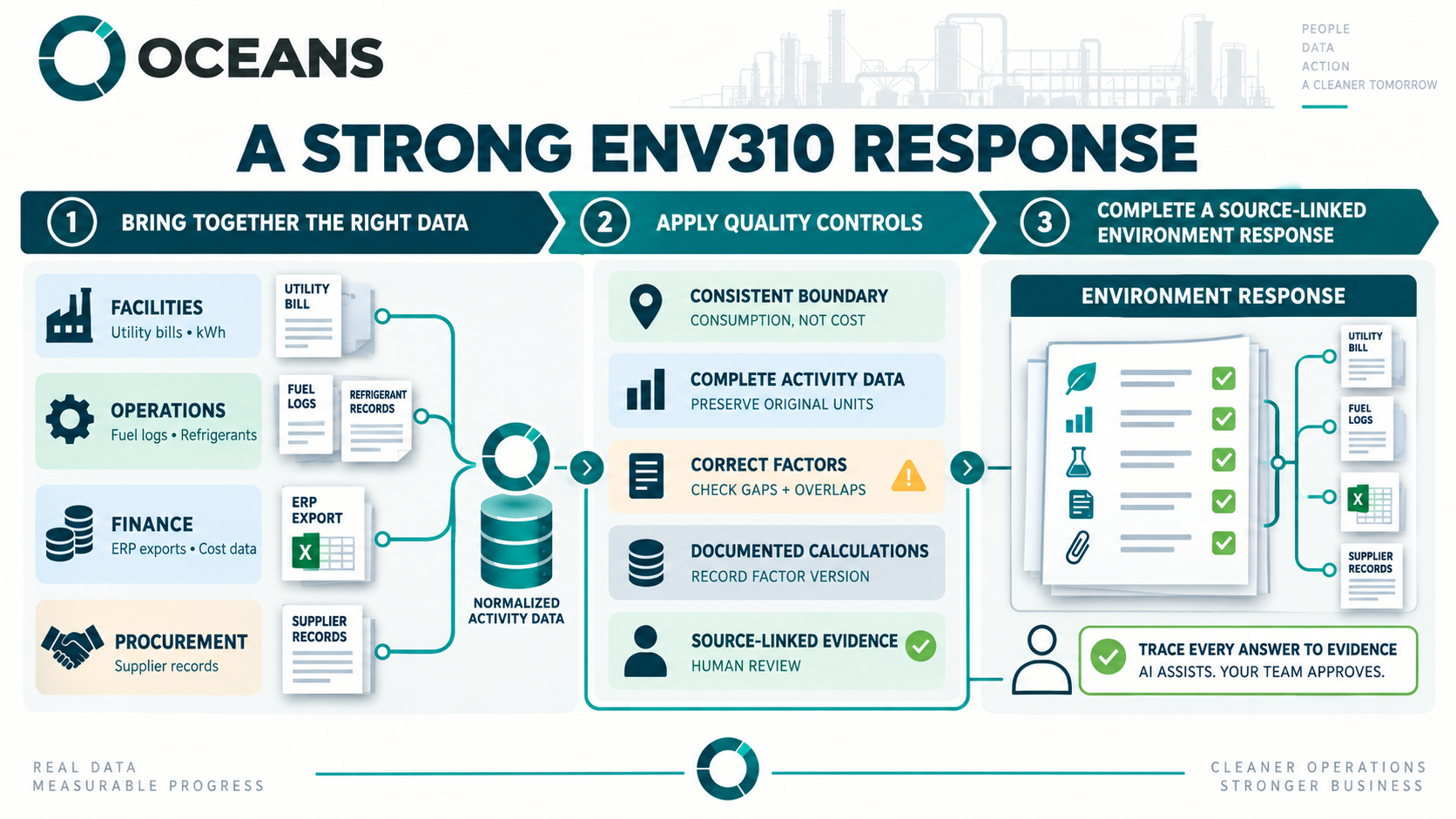
OCEANS Sustainability is an AI-assisted carbon-accounting service and platform built for growing U.S. manufacturers. Its founder-led EcoVadis response engagement organizes operational records, calculates applicable Scope 1 and Scope 2 emissions, documents factor and methodology decisions, identifies evidence gaps, and prepares a source-linked Environment response package for the manufacturer's approval.
The engagement uses AI to reduce repetitive extraction, classification and gap-detection work. Material values remain connected to source records and subject to human review.
For an agreed Environment and GHG scope, the target is delivery in approximately 10 business days after receiving the questionnaire, available input pack and timely answers to clarification questions. The manufacturer reviews and submits the final response. OCEANS does not guarantee an EcoVadis score, medal or customer decision.
If an EcoVadis or OEM deadline is already on your calendar, talk directly with the founder. Bring the questionnaire, one utility bill and the data files you have today. We will determine what is usable, what is missing and what must be resolved to produce a response your team can explain.
Carbon accounting you can trace. Decisions you can defend.
Frequently asked questions
How long does an EcoVadis questionnaire take?
EcoVadis says the questionnaire may take from a few hours to a few days, depending on sustainability maturity and whether the required information and documents are ready. Its default deadline is 30 business days, although the actual deadline shown in the portal governs.[^3]
Does EcoVadis require Scope 1 and Scope 2 emissions?
The exact questionnaire is customized. Manufacturing assessments commonly activate Energy Consumption and Greenhouse Gases, and current EcoVadis methodology includes location-based and market-based Scope 2 reporting considerations.[^1][^8] Follow the questions and help content in your assessment.
Can I use utility cost to calculate emissions?
Spend may support an estimate in some contexts, but physical consumption such as kWh or therms generally provides a stronger basis for energy calculations. Preserve the invoice or portal export showing the activity and period.
Can OCEANS submit the EcoVadis questionnaire for my company?
OCEANS prepares the agreed response package, calculations and evidence structure. Your company remains responsible for reviewing, approving and submitting its answers through the EcoVadis or customer portal.
Sources and editorial methodology
Reviewed September 14, 2026. EcoVadis questionnaires and methodology can change; consult the help content in your current assessment. OCEANS Sustainability is independent and is not affiliated with or endorsed by EcoVadis or GM.
[^1]: EcoVadis Help Center, Understanding my questionnaire. [^2]: EcoVadis Help Center, Understanding supporting documents. [^3]: EcoVadis Help Center, How long does it take to complete the questionnaire?. [^4]: U.S. EPA, Emissions & Generation Resource Integrated Database and eGRID summary data. [^5]: GHG Protocol, Scope 2 Guidance. [^6]: U.S. EPA, GHG Inventory Guidance: Direct Emissions from Stationary Combustion Sources. [^7]: EcoVadis Help Center, What is the EcoVadis assessment process?. [^8]: EcoVadis Help Center, Methodology Updates Q1 2026.
Free checklist
The EcoVadis Environment Evidence Checklist for US Manufacturers
The exact energy, fuel, and emissions evidence to collect before you answer ENV310 — plus the data-request templates that cut collection time. Free.
Sai Praneeth, Founder of OCEANS Sustainability Platform
OCEANS™ Sustainability
OCEANS™ Sustainability is carbon-accounting software for growing US manufacturers, a product of TheEvenity Pvt Limited. The Founding Design Partner Program is now open.