A practical buying guide for growing U.S. manufacturing companies.
Your customer asks for emissions data. Facilities has utility bills, Plant Operations has fuel records, and Finance has an ERP export. Your EHS manager has a deadline—and no spare team to turn those records into a defensible answer.
Which carbon accounting software should you buy?
The best fit for a manufacturer depends on the job: building an emissions inventory, answering a customer questionnaire, calculating product footprints or evaluating reduction projects. Shortlist providers that can demonstrate the required output using representative manufacturing records, explain the methodology and agree who handles the work.
Greenly, Watershed, Seedling and CarbonTool are software options worth evaluating for different combinations of measurement, support and planning. OCEANS Sustainability offers a focused, founder-led route for U.S. manufacturers facing an EcoVadis or OEM response deadline; its platform remains in development.
This guide compares those options and gives you a practical way to evaluate them.
Disclosure: This article is published by OCEANS Sustainability. It is an editorial comparison of selected providers' public information, not an independent product test, exhaustive market survey or numerical ranking. Suggested fit is our assessment; verify capabilities, pricing and implementation scope directly with each provider.
Carbon accounting options for manufacturers: a quick comparison
Start with your immediate need. The table identifies reasons to evaluate each provider—not exclusive capabilities or a claim that one vendor wins every category.
| Provider | Publicly described offering | Consider evaluating when… | Ask the provider to demonstrate |
|---|---|---|---|
| Greenly | Carbon measurement, supplier engagement, decarbonization and life cycle assessment offerings | You want to assess corporate carbon accounting alongside product and supply-chain work | The modules, source records and review steps needed for your manufacturing use case |
| Watershed | Emissions-reduction modeling, energy analysis, supplier/material scenarios and access to clean-power projects | Your buying decision includes a substantial decarbonization program | A relevant operational scenario with assumptions, costs and implementation responsibilities |
| Seedling | Scope 1–3 measurement, dedicated expert support and Net Zero roadmap modeling | A lean team wants ongoing software plus individual guidance | How its specialist handles your material inputs, data gaps and review workload |
| CarbonTool | Scope 1–3 measurement, reporting and decarbonization in a shared platform | You want to evaluate a combined carbon-management workflow | The applicable templates, supplier workflow, exports and support included in your plan |
| OCEANS Sustainability | Available founder-led Environment/GHG response preparation; platform in development | A U.S. manufacturing team needs help with a specific EcoVadis or OEM deadline | The agreed response deliverable, calculation trail and responsibilities before work starts |
Sources: Greenly, Watershed, Seedling, CarbonTool, OCEANS response engagement.
First, decide which carbon-accounting problem you are buying for
“We need emissions software” is too broad to serve as a purchasing brief.
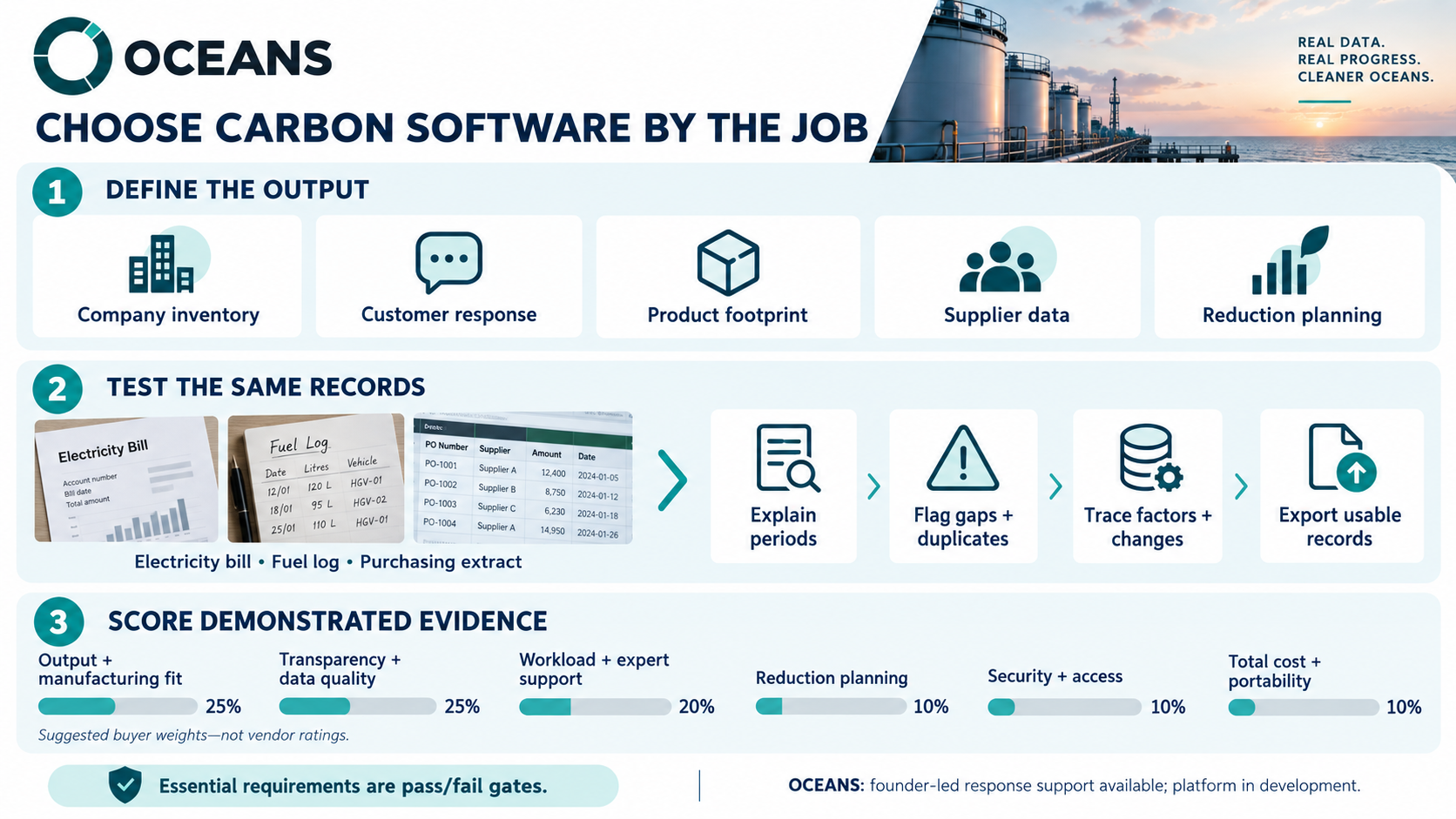
Write down your required output before booking demonstrations:
| Your immediate requirement | What the purchasing brief should specify |
|---|---|
| Annual company inventory | Entities, facilities, reporting period, emissions sources and required review |
| OEM or EcoVadis response | Actual questions, deadline, required evidence and responsibility for submission |
| Product carbon footprint | Product, declared or functional unit, life-cycle boundary and customer methodology |
| Supplier emissions collection | Supplier population, requested data, follow-up ownership and treatment of gaps |
| Decarbonization planning | Decisions to compare, baseline, financial assumptions and operational constraints |
One provider may address several needs. That does not mean every module or service is included in the proposed price.
For a mid-sized business, sustainability work also competes with other responsibilities. Ask who will prepare inputs, investigate exceptions and approve outputs. A system that requires work your team cannot staff will not resolve the bottleneck simply by being installed.
Five options to evaluate—and what to ask each one
Greenly: evaluate the breadth you actually need
Greenly presents a suite covering carbon assessments, supplier engagement, reduction strategy and LCA. Its LCA offering describes manufacturing-relevant inputs such as bills of materials, ERP or PLM exports, and supplier questionnaires. Greenly suite, Greenly LCA
For your evaluation, bring one question that connects corporate reporting to a product or material input. Ask which workflow handles it, what needs specialist review and which module is included in the quote.
Useful demo question: “Can you show how a material purchase becomes a documented emissions result, including any estimated data?”
Watershed: test planning against a real investment decision
Watershed describes scenario modeling for energy, products, materials and suppliers, alongside clean-power procurement and expert advice. That makes it relevant to a shortlist where reduction planning is a central requirement. Watershed decarbonization
A manufacturing buyer should request a scenario resembling an actual decision: equipment replacement, a material change or a different electricity arrangement. Establish which analysis is provided by software and which requires additional advisory work.
Useful demo question: “Can we inspect the assumptions behind the reduction estimate and compare the financial and operational implications?”
Seedling: examine the division of work between your team and its expert
Seedling describes GHG Protocol-aligned Scope 1–3 measurement, activity-based Scope 3 capture, supplier surveys, roadmap modeling and a dedicated carbon specialist. It explicitly addresses lean teams managing carbon alongside other responsibilities. Seedling platform and support
For manufacturers, the purchasing question is how that support works when records are incomplete or material classifications require clarification.
Useful demo question: “When a purchasing export lacks quantities or a fuel record has inconsistent units, who resolves it and what is included in our service?”
CarbonTool: inspect the workflow behind the templates
CarbonTool describes Scope 1–3 measurement, reporting and decarbonization, with templates and manufacturing among its addressed industries. CarbonTool platform
Ask to follow an example from import to review to export. Confirm the functions and assistance available in the plan being proposed, rather than assuming that every website capability is included.
Useful demo question: “Can we trace a reported total to its inputs, identify an unresolved gap and export the supporting records?”
OCEANS Sustainability: evaluate a defined response engagement
OCEANS supports agreed Environment and greenhouse-gas questions through founder-led preparation: applicable Scope 1 and Scope 2 calculations, source and factor registers, and documented assumptions and gaps. The manufacturer approves and submits the response. OCEANS engagement scope
Its ten-business-day delivery target begins after receipt of the agreed questionnaire and available input pack; scope, timing and fee are confirmed first. Broader requirements need explicit scoping.
Useful review question: “What can you prepare from our available records, what remains unresolved, and what will we receive for approval?”
What GHG Protocol alignment should mean in a software evaluation
The GHG Protocol Corporate Standard provides requirements and guidance for corporate greenhouse-gas inventories. Software should help you apply the relevant accounting framework and retain the decisions behind the result. A badge or a phrase on a product page does not establish the quality of your own inventory. GHG Protocol Corporate Standard
When a vendor uses the phrase “GHG Protocol compliance,” ask for a worked example. Our recommended questions are:
- How are the organizational boundary and facilities recorded?
- How are included sources and exclusions documented?
- Can the reviewer inspect factor sources, units and versions?
- How are estimates distinguished from measured or supplier-provided data?
- What happens when an input is corrected after review?
- What method notes accompany the exported result?
For purchased electricity, ask about both location-based and market-based treatment where applicable, and the evidence required for contractual instruments. The Scope 2 Guidance sets out these approaches and associated quality criteria. GHG Protocol Scope 2 Guidance
For U.S. facilities, EPA's eGRID is a relevant source of electricity-generation and emissions data. Ask the provider to explain its geography and factor-year selection for your reporting purpose—not simply whether it has an EPA dataset. U.S. EPA eGRID
Test manufacturing data quality with an imperfect record
A polished demo dataset can hide the work your team will face.
Prepare a small, authorized test pack with confidential details removed. Include an electricity bill, a fuel log and a purchasing extract. Add a deliberately marked missing period or duplicate row so you can see how the provider handles uncertainty.
Use the same pack and questions for every shortlisted option:
| Test | What you want to observe |
|---|---|
| Electricity record spanning two months | The period treatment is explained and retained |
| Corrected fuel entry | The original and correction can be distinguished |
| Purchasing record containing cost but no quantity | The method and limitations remain visible |
| Missing facility record | The gap is flagged rather than silently treated as zero |
| Updated calculation input | The changed result and review implications can be followed |
| Export request | Your team receives enough detail to explain the result outside the system |
This is a suggested buyer test, not a statement that every vendor must implement the same interface.
Ask the person who will actually do the work to attend. For industrial manufacturers, that might include Facilities, EHS, Finance and Procurement. A reviewer who understands the source record will notice issues that a procurement feature checklist misses.
Scope 3: ask how the data improves over time
A platform's Scope 3 coverage is the beginning of the evaluation. Your buying decision also depends on how it handles the information you have today and the improvements you expect later.
Ask the provider to demonstrate one purchased-material example with incomplete supplier data. Then ask:
- What method would be used, and why?
- Which values are supplier-provided and which are estimates?
- What further information would improve the result?
- Who requests that information from the supplier?
- How would a change in method affect comparison with the previous year?
For supplier comparisons, also ask whether the underlying studies use compatible units and boundaries. A smaller reported number is not enough to establish that switching suppliers will reduce your footprint.
For your own shortlist, favor an understandable improvement path over a promise that AI will make every missing input disappear.
Decarbonization planning: require an explanation behind the chart
Useful decarbonization planning should help Operations and Finance evaluate a decision together.
Consider this fictional scenario, intended only to illustrate a purchasing test:
A plant's baseline includes 1,000 metric tons of CO₂e. A proposed project is modeled to reduce emissions by 100 tons annually, cost $100,000 to install and save $20,000 per year in operating costs.
The implied reduction is 10% of that baseline. Simple payback is five years, before financing, taxes, maintenance changes or other adjustments.
Now ask the vendor to explain:
- Which source and reporting boundary the 100-ton estimate covers.
- The energy prices, operating hours and factor assumptions used.
- Whether production changes affect the comparison.
- Whether another project overlaps with the same claimed savings.
- How actual performance would be checked after implementation.
The example is not an OCEANS project or a promised result. Its purpose is to make a demonstration testable. A downward line on a chart becomes more useful when the team can inspect the decision behind it.
Include implementation, security and exit terms in the decision
The license price is only one part of the cost. Request a proposal covering onboarding, data preparation, support, additional facilities, supplier engagement, optional modules and exports.
For sensitive operational records, ask each provider for written answers about access permissions, hosting and subprocessors, retention and deletion, AI data use, incident handling and the scope of any security certification it claims. Do not infer U.S. data residency from a U.S.-focused sales page.
Before signing, also establish what you retain if you leave: activity records, calculations, factor references, assumptions, source documents and review history. Confirm any licensing restrictions affecting exported factor data.
These are procurement questions to put to every provider, including OCEANS.
A practical scorecard for your shortlist
Use these suggested weights as a starting point. They are not published vendor ratings; adjust them to your requirements.
| Criterion | Suggested weight | Evidence to request |
|---|---|---|
| Required output and manufacturing fit | 25% | A representative deliverable or workflow |
| Calculation transparency and data quality | 25% | An inspectable result and correction example |
| Team workload and expert support | 20% | Written responsibilities and onboarding scope |
| Reduction-planning usefulness | 10% | A scenario relevant to your operations |
| Security and access arrangements | 10% | Contractual answers and relevant documentation |
| Total cost and data portability | 10% | An itemized proposal and sample export |
Score demonstrated evidence from zero to five, recording the reason. Keep unverified capabilities marked “not yet demonstrated.” Treat essential requirements as pass/fail gates before using a weighted total; a strong overall score should not override a mandatory security or reporting need.
Which option should your team investigate first?
If you need recurring software, compare options using the same manufacturing test pack and ask to see the exact functions included in your contract.
If a customer response is blocking progress now, establish whether a defined preparation engagement is the better first purchase. You can address the immediate work while making a separate, informed decision about the long-term system.
For that second situation, review how an OCEANS response package is structured. Then request a 15-minute deadline review with your due date, facility count and blocking questions.
The purchasing goal is concrete: a result your company can use, a trail your team can explain and a workload it can sustain.
Frequently asked questions
Which carbon accounting software best fits growing manufacturing companies?
Select by required output, manufacturing data, internal capacity and support. Greenly, Watershed, Seedling and CarbonTool offer relevant capabilities to investigate; the comparison above explains what to test. A manufacturer with an immediate questionnaire deadline should also consider whether a scoped service is needed alongside software.
Which software supports detailed decarbonization planning for manufacturers?
Watershed publicly describes energy and supplier/material scenario modeling; Seedling describes Net Zero roadmap modeling, and Greenly and CarbonTool offer reduction-planning capabilities. These descriptions do not establish equal depth. Request the same plant-specific scenario from each shortlisted provider and compare the assumptions, financial treatment and implementation support.
What is the best carbon accounting software for mid-sized industrial manufacturers?
There is no defensible universal winner without knowing the facilities, processes, required outputs, budget and staffing. Use a representative data test and written delivery scope. Establish separately whether you need an annual company inventory, a product footprint or customer-response preparation.
Which carbon accounting software is aligned with GHG Protocol guidelines?
Evaluate the methodology for the work being performed, not the phrase alone. Request boundary decisions, source coverage, factor documentation, appropriate Scope 2 treatment and reviewable exports. Alignment claims do not by themselves verify your completed inventory or replace independent assurance where required.
Provider descriptions reflect public information reviewed on September 29, 2026. Confirm current availability and contract scope directly. References to other providers do not imply endorsement or affiliation.
Praneeth, Founder, OCEANS Sustainability
OCEANS™ Sustainability
OCEANS™ Sustainability is carbon-accounting software for growing US manufacturers, a product of TheEvenity Pvt Limited. The Founding Design Partner Program is now open.