
The customer request has arrived. It asks for emissions figures, a reporting period and supporting information. Your EHS manager forwards it to Finance. Finance asks Facilities for utility data. Procurement searches for supplier records.
Then someone asks: “Should we buy carbon accounting software?”
It is a reasonable question. But before choosing a system, establish who will complete the work between the records you have and the response your customer needs.
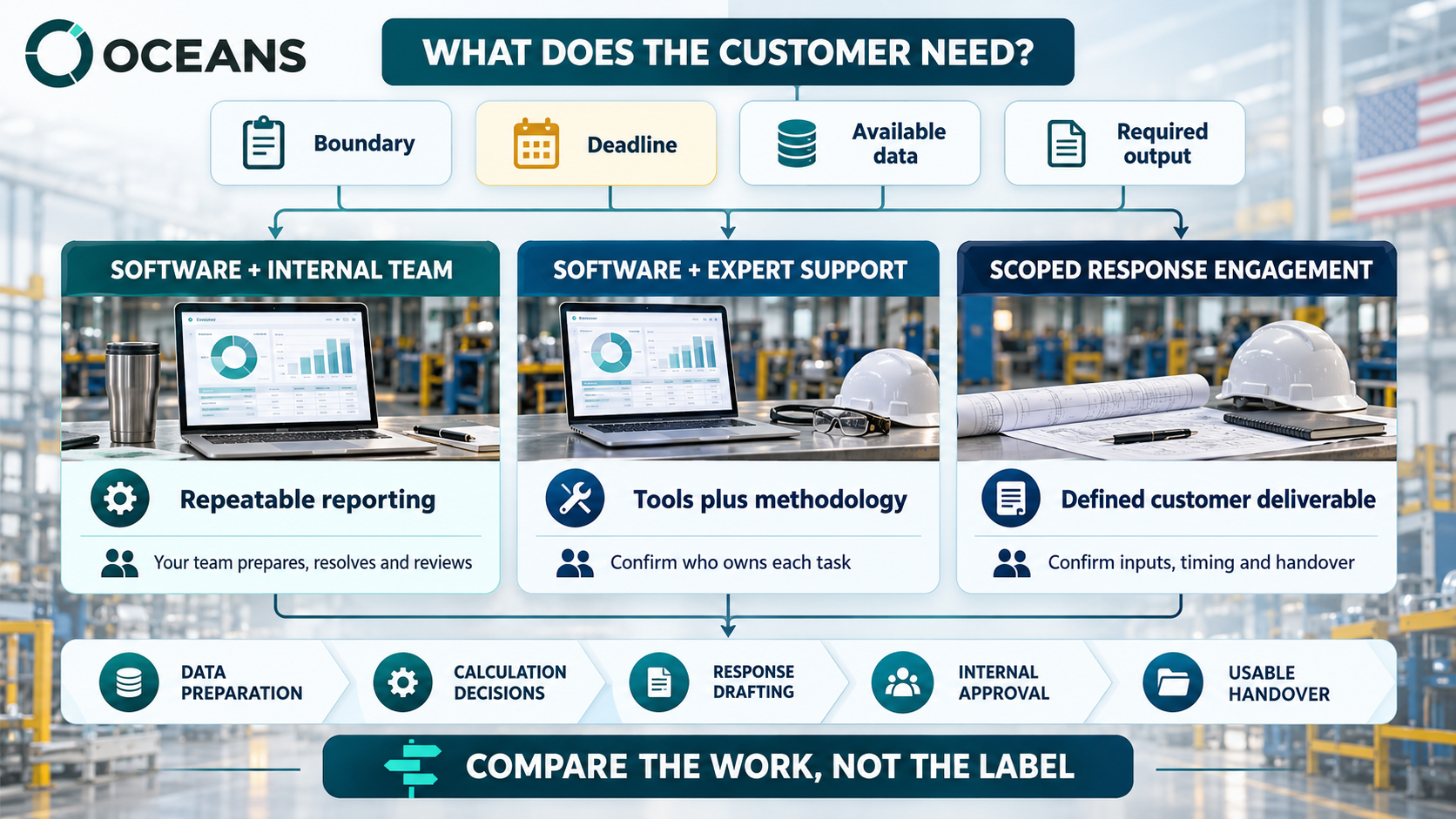
Choose software when you need a repeatable reporting system and have a workable plan for data preparation and review. Choose consulting when the main difficulty is methodology or specialist judgment. Consider a scoped response engagement when the immediate requirement is a defined customer deliverable. Many providers combine these approaches, so compare responsibilities and outputs rather than labels.
For a growing U.S. manufacturer, the right decision should account for the deadline, internal capacity and what must remain usable after submission.
Start with the customer’s actual question
Before requesting proposals, identify the deliverable.
An annual company inventory, a product carbon footprint and an EcoVadis response are different assignments. A quote that covers one does not necessarily cover the others.
| Customer request | Clarification to make before commissioning work |
|---|---|
| Company Scope 1 and Scope 2 figures | Which entities, facilities and reporting period? |
| Scope 3 information | Which categories or requested activities, and what data is available? |
| Product carbon footprint | Which product, unit, life-cycle boundary and customer methodology? |
| EcoVadis questionnaire | Which questions need support and which existing practices need evidence? |
| Reduction plan | Is the customer asking for commitments, modeled opportunities or demonstrated results? |
The GHG Protocol Corporate Standard concerns corporate greenhouse-gas inventories. A request should be matched to its relevant accounting requirements, rather than assuming every carbon deliverable is interchangeable. GHG Protocol Corporate Standard
If the request is ambiguous, seek clarification early. One written answer about the required boundary can prevent your team from preparing the wrong output.
Compare three ways to get the work done
The following is a purchasing framework, not a claim that providers fit into exclusive categories.
| Approach | Useful when | What to establish before committing |
|---|---|---|
| Software with your internal team | Reporting recurs and your team can operate the process | Who prepares data, resolves exceptions and reviews results? |
| Software with expert support or consulting | You need tools plus methodology or implementation assistance | Which tasks are performed for you, and which remain yours? |
| A scoped response engagement | You have a specific questionnaire or reporting deliverable | What is included, what could change the deadline, and what files do you receive? |
Do not assume a software subscription leaves you alone. Equally, do not assume a service includes every calculation, reporting framework or future update.
For example, Seedling describes software with a dedicated carbon specialist, while Sunhat advertises expert-led assessment services. Both illustrate why “software versus consultant” can be a misleading binary. Seedling, Sunhat services
Ask every provider the same question:
“Which parts of our actual request will your team complete, and which parts will our employees still own?”
Five responsibilities that should be visible in the proposal
1. Finding and preparing the data
“Upload your records” is not a complete description of the work.
Ask who checks facility coverage, requests missing periods and distinguishes an invoice date from its consumption period. Confirm who handles the case where Finance supplies cost data but the calculation requires a physical quantity.
You can use a simple allocation: Facilities retrieves utility records; Plant Operations clarifies equipment and fuel activity; Finance explains purchasing exports; the calculation preparer identifies what further information is needed. Adapt this to your business rather than treating it as a universal organization chart.
2. Making and documenting calculation decisions
A useful proposal should identify who chooses the method, records factor references, documents assumptions and reviews the calculation.
Your team also needs a route for exceptions. If two records appear to overlap, who investigates? If a source is incomplete, who agrees the treatment? The commercial agreement should make the responsibility clear without requiring the provider to disclose proprietary implementation details.
3. Preparing the requested response
An inventory spreadsheet is not necessarily a completed customer response.
Confirm whether the engagement includes mapping results to the customer's questions, drafting explanations and identifying gaps. Check whether the request includes environmental topics beyond greenhouse gases, or additional assessment themes outside the proposed scope.
4. Reviewing and approving the result
Name the internal person who can approve the response and resolve business questions. Arrange time for that review before the customer deadline.
Preparation, management approval and independent assurance are distinct responsibilities. Ask explicitly if assurance is required; do not infer that it is included because a provider uses “audit-ready” in marketing.
5. Leaving a usable handover
Agree what remains with your company when the work is finished. Ask for the applicable calculation output, source references, factor references, method notes, gaps and decisions—not only a presentation containing the total.
For software, inspect an export. For a service, inspect a sample deliverable. In either case, confirm any licensing restrictions on supporting datasets.
Compare the total workload, not just the quoted price
A finance director needs to understand external fees and internal effort together.
The following is a fictional budgeting example. These are invented figures to illustrate the calculation, not vendor prices or typical industry costs.
| Illustrative option | External fee | Internal effort at $60/hour | Combined modeled cost |
|---|---|---|---|
| Option A | $3,000 | 45 hours = $2,700 | $5,700 |
| Option B | $4,500 | 15 hours = $900 | $5,400 |
Option B has a higher external fee but a lower combined cost under these assumptions. That does not make it automatically better: its scope, output quality and timing must also meet the requirement.
Use your own loaded labor cost and realistic effort estimate. Compare equivalent deliverables and time horizons. A one-off response fee and a yearly software subscription may serve different needs, so include expected future work before concluding which is better value.
Ask about charges for additional facilities, reporting periods, revisions, supplier follow-up, optional modules and support after delivery. Record assumptions instead of relying on a headline price.
What a realistic deadline commitment should include
Treat the due date as a shared delivery plan.
Before agreeing a schedule, establish:
- The exact questions and reporting boundary.
- The minimum input pack and who will provide it.
- Known missing information and how it will be handled.
- Dates for clarifications and your internal review.
- What happens if the customer changes the request.
A proposal should explain when its delivery clock starts. “Ten business days” means little unless both parties understand the inputs and scope behind it.
If records are missing, ask the provider to explain the impact rather than promise that every gap can disappear. A response can disclose uncertainty; it should not silently convert missing information into a confirmed fact.
A proposal request you can copy
Send this to shortlisted providers after removing anything confidential:
We are a U.S. manufacturer with [number] facilities. We need to respond to [request type] by [date] for [reporting period].
Available records include [utility, fuel, procurement or supplier records]. Known gaps include [brief description].
Please confirm the questions and calculations included, the work our team must perform, the expected deliverables, review responsibilities, delivery assumptions and total fee.
Please also explain what records we retain, how corrections are handled, and the arrangements for sharing, accessing and deleting confidential information.
We would like to review a representative output before agreeing the engagement.
This brief gives each provider the same starting point. It also helps your internal team compare what is actually being offered.
Where OCEANS Sustainability fits
OCEANS Sustainability offers founder-led response preparation for U.S. manufacturers facing agreed EcoVadis Environment and greenhouse-gas or OEM questionnaire requirements.
The available engagement includes applicable Scope 1 and Scope 2 calculations, draft responses, source and factor registers, and documented assumptions and gaps. The manufacturer reviews, approves and submits the result.
Its ten-business-day target begins after receipt of the agreed questionnaire and available input pack. Scope, timing and a fixed-fee proposal are confirmed first. Broader Scope 3 or product-footprint needs require separate discussion; they are not automatically included. The software platform remains in development, with access through the founding design partner program. OCEANS engagement details
If your immediate problem is a defined response, inspect the OCEANS response-package structure. Use it to discuss what your own handover needs to contain.
If your priority is ongoing software procurement, the manufacturer's software buying guide provides a broader evaluation framework.
Make the first conversation specific
You do not need a perfect dataset to start discussing the work. Bring your deadline, approximate facility count and the questions blocking completion.
Book a conversation with Sai Praneeth, founder of OCEANS Sustainability.
The first objective is to establish the deliverable, identify what your team needs to supply and determine whether the engagement fits. Choosing a long-term system can then be a deliberate decision, informed by the work you actually need done.
Frequently asked questions
Do manufacturers need carbon accounting software to answer an OEM questionnaire?
The answer depends on the request and any specified submission requirements. Software can support repeatable collection and reporting, but purchasing a system does not by itself complete the response. Establish the required output, method and evidence first.
Can a consultant work with our existing spreadsheets?
Ask the provider to assess their structure, source records and coverage. The important purchasing question is what preparation and review the provider includes—not whether the starting file happens to be a spreadsheet.
How do we compare carbon accounting service quotes?
Compare the same scope, outputs, time horizon, internal workload and review responsibilities. Include extra charges and assumptions. An inexpensive quote may cover less work; a more expensive one is not automatically more suitable.
Will outside help guarantee an EcoVadis score or customer acceptance?
Do not treat response preparation as a guarantee of an assessment or procurement outcome. Confirm exactly what the provider undertakes to deliver, and distinguish that commitment from decisions made by the assessor or customer.
This article is published by OCEANS Sustainability. Provider descriptions reflect public pages reviewed October 6, 2026. The budgeting example is illustrative and is not a price quotation.
Praneeth, Founder of OCEANS Sustainability
OCEANS™ Sustainability
OCEANS™ Sustainability is carbon-accounting software for growing US manufacturers, a product of TheEvenity Pvt Limited. The Founding Design Partner Program is now open.