OCEANS Sustainability - An evidence-first approach to carbon accounting for finance directors and sustainability leaders at growing U.S. manufacturers.
The emissions report says your footprint fell. Finance asks whether the business used less energy, bought less material or simply paid a lower price. Sustainability asks whether the calculation method changed. Operations wants to know which facility made the difference.
A single total cannot answer all three questions.
For a growing manufacturer, useful carbon accounting connects the reported number to the business activity behind it. That connection makes it possible to review a customer response, investigate a change and discuss a reduction proposal with the people responsible for the cost.
OCEANS™ Sustainability combines carbon accounting software in development with available founder-led reporting support for U.S. manufacturers. Its approach connects operational records, emissions calculations and supporting evidence. The platform design extends that foundation to Scope 1–3 reporting, supplier information and reviewed decarbonization scenarios.
This article explains the approach, its relevance to Finance and Sustainability, and the work you can discuss with OCEANS today.
What evidence-first carbon accounting means
An evidence-first approach begins with a question: could another reviewer understand how this figure was produced?
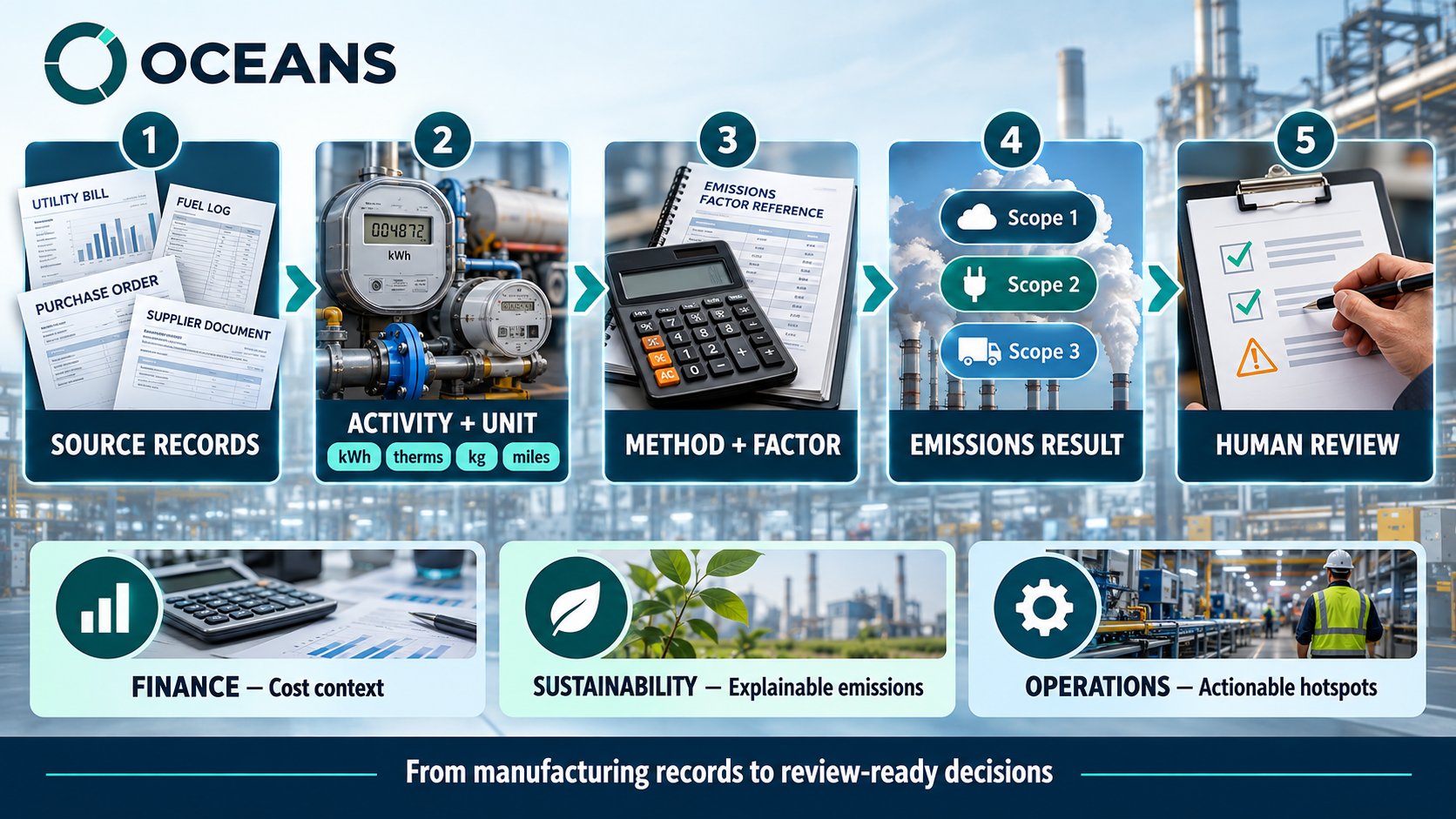
For manufacturing emissions management, that means preserving more than the final result. A useful review record should connect:
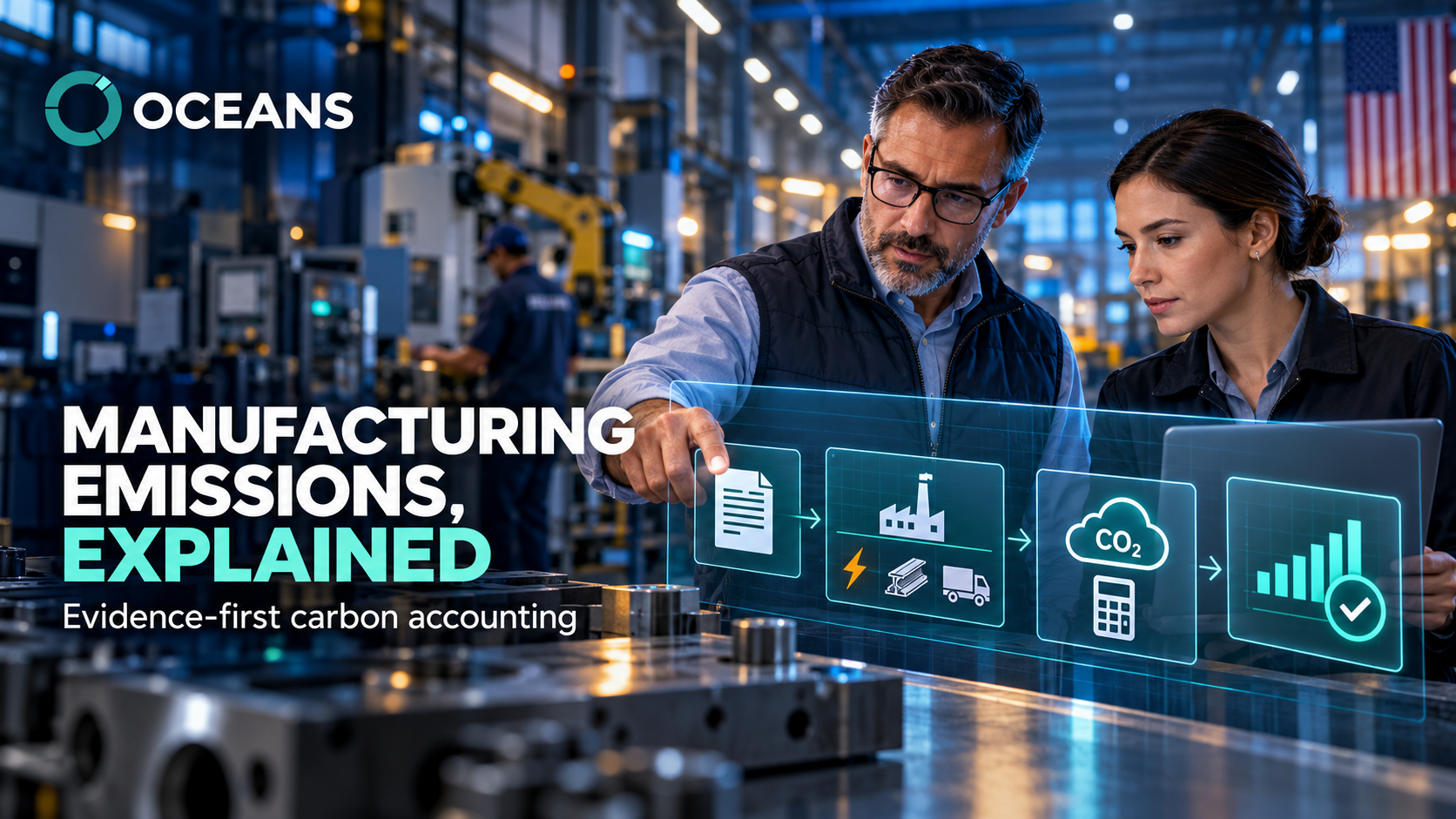
Source document → activity and unit → calculation method → emission factor → result → review decision
Consider a natural-gas figure. A reviewer may need to establish which meter it covers, the consumption period, whether a reading was estimated, and how the recorded unit was converted before applying the calculation method.
Those details make the number explainable. They also help a second person investigate an error without depending on the original preparer's memory.
Here is a practical test for your current reporting process:
| Review question | What your team should be able to locate |
|---|---|
| Where did the activity value come from? | The original record and relevant field |
| What does the figure cover? | Entity, facility, source and reporting period |
| How was it calculated? | Method, units, conversions and factor reference |
| What remains uncertain? | Missing information, estimates and exclusions |
| Who made the decision? | Reviewer, approval status and unresolved questions |
This is a recommended review structure, not a claim that documentation alone constitutes independent assurance.
Why Finance and Sustainability need the same underlying records
Finance and Sustainability can look at the same purchase and ask different questions.
Finance may want the supplier, price, cost center and accounting period. Sustainability may need the physical quantity, material description, activity period and applicable emissions method.
The challenge is to connect those views while preserving their differences.
An ERP export might show that the company spent $80,000 on a material. It does not necessarily establish its mass, production route or supplier-specific footprint. A utility invoice might contain the consumption figure, taxes, standing charges and a billing period that crosses month-end.
Cost-linked reporting means retaining financial context alongside the physical activity and emissions calculation. It does not mean treating dollars as a direct measurement of emissions.
For a finance director, a useful working record might include quantity, unit price, total cost and reporting period. For the sustainability reviewer, the same record should identify the emissions method and evidence limitations. The connection helps both teams ask a better question when a result changes.
A lower purchasing bill does not necessarily mean lower emissions
Imagine a fictional manufacturer purchasing the same material from the same production route in two periods:
| Measure | Period A | Period B |
|---|---|---|
| Material purchased | 20,000 kg | 20,000 kg |
| Unit price | $4.00/kg | $3.60/kg |
| Purchase cost | $80,000 | $72,000 |
| Hypothetical physical emission factor | 5 kg CO₂e/kg | 5 kg CO₂e/kg |
| Modeled emissions for that material boundary | 100 tCO₂e | 100 tCO₂e |
The purchasing cost fell by 10%. Under the stated assumptions, the physical emissions estimate did not change.
If a simple spend-based model used an unchanged factor per dollar, its estimate would also fall by 10%. That arithmetic would not establish a physical reduction. A real spend-based method also needs appropriate treatment of currency, price year and other methodological choices.
This fictional example is not an OCEANS customer result or a product-screen demonstration. It shows why the cost, quantity and calculation basis should remain distinguishable.
Scope 1–3 emissions reporting starts with the right boundary
The GHG Protocol Corporate Standard provides the framework for corporate inventories. Its Scope 3 Standard extends the accounting framework across the value chain. GHG Protocol Corporate Standard, Corporate Value Chain Standard
For a manufacturing team, the practical distinction is:
| Scope | Meaning | Manufacturing examples | Useful starting records |
|---|---|---|---|
| Scope 1 | Direct emissions from owned or controlled sources | Fuel combustion, relevant process emissions and refrigerant leakage | Fuel records, process information, equipment and refrigerant logs |
| Scope 2 | Indirect emissions from purchased or acquired electricity, steam, heat and cooling consumed by the company | Purchased electricity for production equipment | Utility consumption and applicable energy-contract records |
| Scope 3 | Other indirect value-chain emissions | Purchased materials, relevant freight, waste and other applicable categories | Procurement quantities, supplier information and logistics records |
These examples are not a complete inventory checklist. Relevant sources depend on the organization's activities and accounting boundary.
Purchased electricity also requires attention to the applicable location-based and market-based approaches and the evidence supporting contractual instruments. The GHG Protocol Scope 2 Guidance explains those distinctions. Scope 2 Guidance
When evaluating GHG Protocol compliance, ask to inspect the boundary decisions, methods and supporting records. A software label cannot establish whether your specific inventory meets the relevant requirements.
Supplier emissions data should improve the answer—not conceal uncertainty
Supplier information is useful when your team understands what it represents.
A supplier's company-wide emissions total, for example, is different from a footprint for the material you purchased. Before using a supplier figure, ask what product or activity it covers, the unit, period, boundary and methodology, and whether any assurance covers that particular information.
OCEANS' Scope 3 product design emphasizes relevant category screening, documented methods, visible estimates and focused supplier follow-up. These workflows are being developed with founding design partners.
For teams organizing their information now, we recommend a small supplier-evidence register:
| Field | Why it matters |
|---|---|
| Supplier and purchased item | Connects the information to a real procurement decision |
| Quantity and unit | Establishes the activity the calculation concerns |
| Document and reporting period | Helps the reviewer locate and date the information |
| Boundary and method | Shows whether the figure fits its intended use |
| Data limitation | Keeps an estimate or missing field visible |
| Owner and next question | Makes follow-up actionable |
Ask Procurement to pursue a specific clarification, such as “Does this footprint include transport to our facility?” An answer to that question is more useful than another unstructured sustainability brochure.
Connecting carbon information to decarbonization planning
Once the baseline is explainable, Finance and Operations can evaluate a proposed change together.
OCEANS' supplier-decarbonization design is centered on comparing sourcing, material and logistics options using explicit assumptions, cost information and feasibility constraints. These are planned platform workflows, not a claim of an available automated purchasing adviser.
For a useful decision brief, bring these questions into the same discussion:
- What changes physically: material, energy use, waste, supplier or transport?
- Are the baseline and alternative comparable in function, quantity and boundary?
- Which costs change, and over what period?
- What operational approvals or qualification work are required?
- What information could materially change the conclusion?
For example, a lower-emissions material might carry a higher purchase price but reduce scrap. Another option might require additional transport or qualification costs. Review these effects explicitly rather than assuming the cheapest material or the smallest footprint is automatically the best decision.
A modeled opportunity remains a proposal until implementation and subsequent evidence support the outcome. Keep projected reductions separate from measured performance.
Where AI fits in an evidence-first workflow
AI is useful when it reduces repetitive handling while leaving the result reviewable.
OCEANS describes AI-assisted extraction, classification and response drafting within its founder-led workflow, with human review retained. OCEANS response workflow
A practical review test is to take one extracted field and ask:
Can I see its original source, check the interpretation and understand what happens if I correct it?
Suppose a document contains both invoice value and energy consumption. An extraction can look plausible while selecting the wrong field. A second check should establish whether the number is dollars, kWh, therms or another unit before it feeds a calculation.
Use the same discipline for supplier responses. A fluent summary should not turn an unanswered question into a confirmed fact. Retain uncertainty where it exists and identify who must resolve it.
Why consider OCEANS alongside other carbon accounting software?
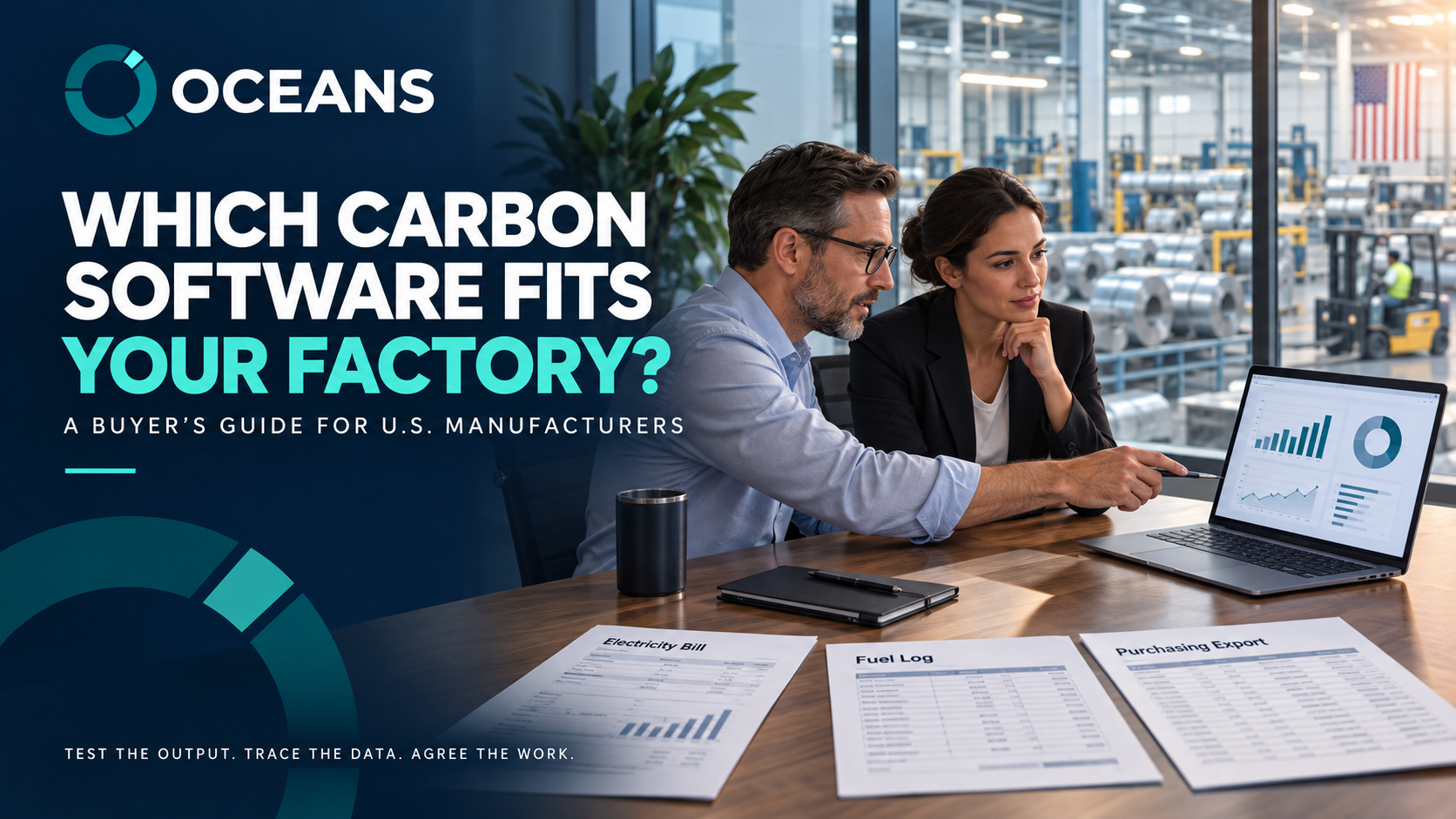
Choose according to the work you need completed and the support your team can sustain.
OCEANS is particularly relevant to a lean U.S. manufacturing team with a customer request, scattered operational records and a need for direct help preparing a traceable response. The available engagement covers agreed Environment/GHG answers, applicable Scope 1 and Scope 2 calculations, source and factor registers, and documented gaps. Your company reviews, approves and submits the result. Current engagement scope
For that situation, ask to see the response-package structure. Establish the work, inputs and responsibilities before comparing price.
For a broader software purchase, evaluate integrations, permissions, support, export detail and production availability with every shortlisted provider. See our carbon accounting software buying guide for manufacturers for a common set of evaluation questions.
The reason to consider OCEANS is its fit to your manufacturing workflow and immediate deliverable. You should be able to see that fit in the agreed scope and sample—not be asked to accept a universal “best platform” claim.
What you can do with OCEANS today
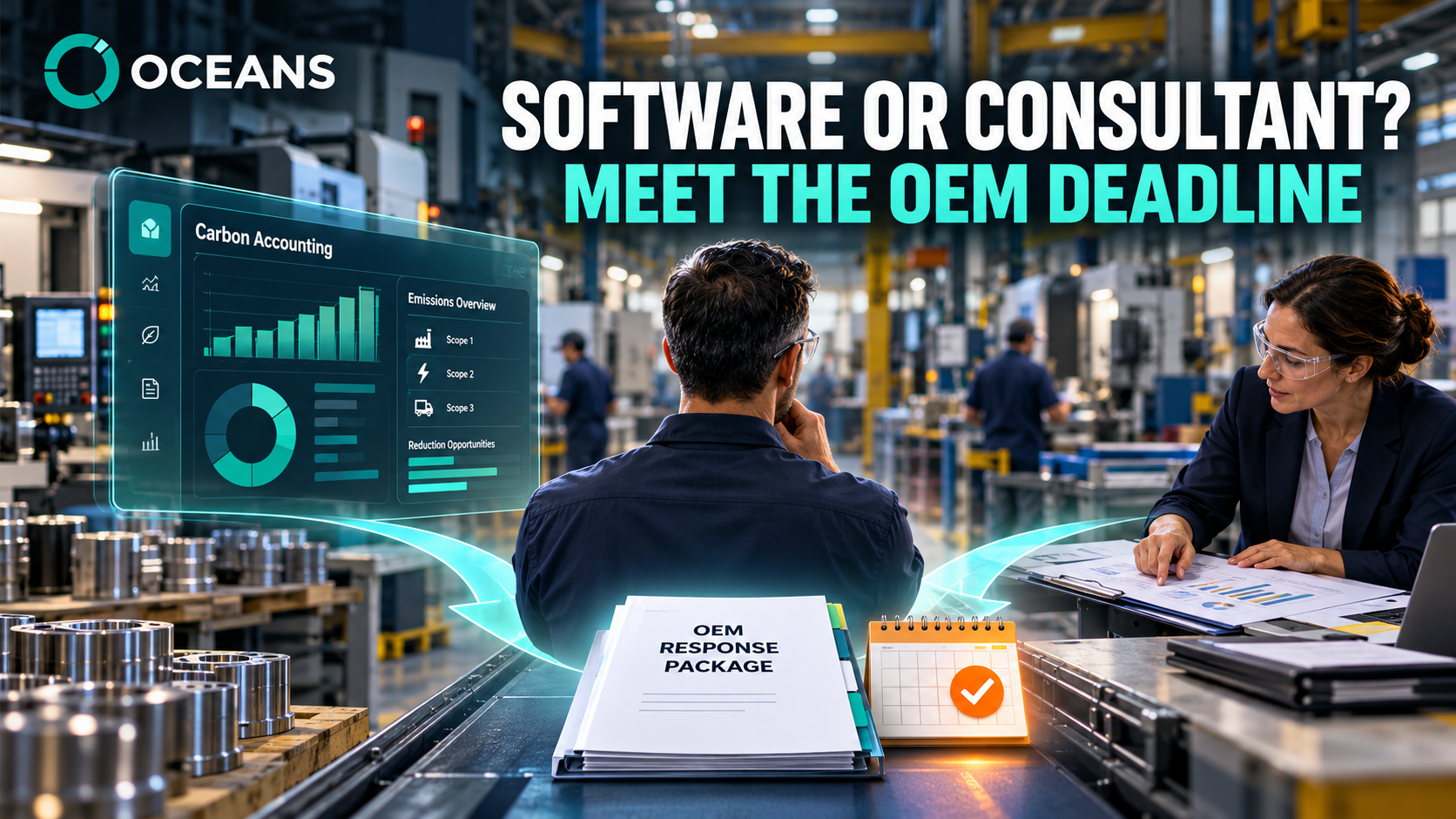
For an EcoVadis or OEM deadline: discuss the available founder-led response engagement. The ten-business-day target starts after receipt of the agreed questionnaire and available input pack; timing, scope and a fixed fee are confirmed first. It does not guarantee an assessment score or assurance outcome. Response engagement
For an ongoing platform need: explore the Founding Design Partner Program to review early workflows and help shape development. Confirm any Scope 3, cost-linked planning or integration requirement explicitly before relying on it.
Start with a description of the reporting request, facilities, records available and decision you need to make. There is no need to send confidential source documents merely to request an initial conversation.
Talk to the OCEANS founder about your manufacturing emissions workflow.
Frequently asked questions
Is OCEANS Sustainability carbon accounting software for manufacturers?
Yes—the platform is being developed for manufacturing carbon-accounting workflows. Founder-led questionnaire preparation is available today. Discuss current access and the exact deliverable you need before treating a planned capability as a production feature.
Does carbon accounting cover all ESG reporting requirements?
No. Carbon information can support relevant environmental reporting, but wider ESG reporting includes other environmental, social and governance subjects. Define the required framework and deliverable separately.
What does cost-linked carbon reporting mean for a finance director?
It means being able to examine cost, physical activity and emissions together while retaining the basis of each. This helps distinguish a purchasing-price change from an operational change and supports review of proposed investments. It is not automatic proof of savings or financial return.
Can supplier emissions data be used without checking its boundary?
A useful review starts by establishing what the data covers and whether it fits the requested calculation. Check the unit, product or activity, period, method and supporting evidence before using it for a comparison or reporting decision.
What should we bring to an initial OCEANS conversation?
Bring your objective, deadline, approximate facility count and a description of the records available. Explain whether you need a company inventory, a customer response, supplier-data support or a planning discussion. That makes it easier to agree a useful next step.
Published by OCEANS Sustainability. Sources and public availability statements reviewed September 30, 2026. Examples are illustrative; no customer outcome, independent assurance or guaranteed financial saving is implied.
Praneeth, Founder of OCEANS Sustainability
OCEANS™ Sustainability
OCEANS™ Sustainability is carbon-accounting software for growing US manufacturers, a product of TheEvenity Pvt Limited. The Founding Design Partner Program is now open.