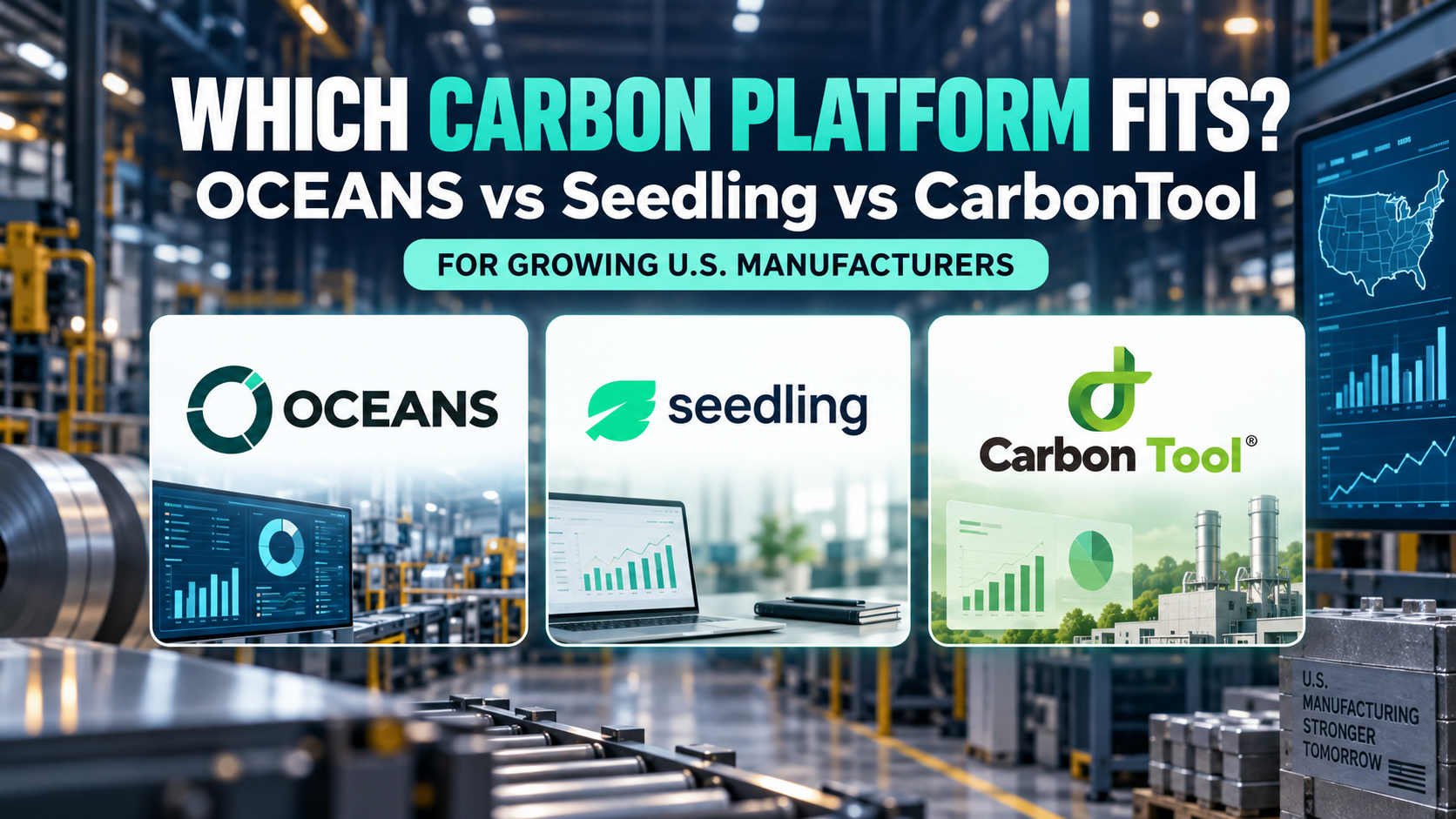
The direct answer: Seedling is a strong option for growing businesses that want carbon-accounting software paired with dedicated expert support. CarbonTool is a strong option for organizations seeking a broad measure-report-reduce platform with public pricing, framework templates and decarbonization scenarios. OCEANS Sustainability is a strong contender for growing U.S. manufacturers that need AI-assisted workflows to turn operational records into traceable Scope 1–3 calculations, improve data quality and keep supporting evidence connected.
There is no universal winner. The right choice depends on the work your team must complete, the evidence your customers expect, the maturity of your carbon program and the level of implementation support you need.
This comparison is written for a specific buyer: a growing or mid-market U.S. manufacturer with a lean finance, operations, EHS or sustainability team. Such a company may be building its first greenhouse-gas inventory, replacing spreadsheets, answering customer questionnaires, improving Scope 3 data or preparing information for external review.
Editorial note: TheEvenity Pvt Limited, the company behind OCEANS Sustainability, publishes this comparison. Competitor information comes from official product pages reviewed on September 10, 2026. We update this page as product information changes.
Quick comparison: OCEANS Sustainability, Seedling and CarbonTool
| Buyer requirement | OCEANS Sustainability | Seedling | CarbonTool |
|---|---|---|---|
| Primary customer focus | Carbon accounting built for growing U.S. manufacturers and lean teams (250-2500 employees) | Carbon accounting for growing businesses, generally up to approximately 2,000 employees | Carbon accounting and sustainability platform for SMEs through mid-market organizations across industries |
| Main emphasis | AI-assisted operational workflows connecting records, calculations, evidence and review | Software combined with one-to-one carbon-expert support | Measurement, reporting and decarbonization in one platform |
| Scope coverage | Scope 1, Scope 2 and Scope 3 | Scope 1, Scope 2 and Scope 3 | Scope 1, Scope 2 and Scope 3 |
| Data-quality approach | Visible sources, transformations, factors, estimates, gaps, review status and change history | Activity-based data where possible, AI-assisted input and expert review | Source, unit, factor and quality context, with a Data Quality Index described for eligible plans |
| Supplier-data approach | Documents supplier boundary, period, method, allocation, assumptions, evidence and assurance status | Captures supplier, employee and customer information, supported by surveys and experts | Supplier mapping, engagement surveys, classification and improvement of supplier data |
| Decarbonization emphasis | Identifying operational and supplier hotspots to support reduction decisions | Net-zero roadmap and reduction planning | Scenarios, targets, CAPEX and return comparisons |
| Implementation style | AI-assisted workflows with guided human implementation for lean manufacturing, finance and operations teams | Dedicated expert support | Self-service AI, optional expert support or managed delivery |
| Geographic focus | Built for U.S. manufacturers, customer requests and U.S. reporting readiness | Strong UK market orientation | Strong European framework coverage with broader international content |
| Best fit | A growing U.S. manufacturer that prioritizes explainable calculations and operational evidence | A growing business that wants an expert closely involved | An organization that wants a mature, broad platform with reporting and scenario tools |
The table summarizes information available on each company's official website as of September 10, 2026.
Why carbon-accounting software is a data decision before it is a reporting decision
Most carbon platforms can display Scope 1, Scope 2 and Scope 3 totals. The harder question is what happens before a number reaches the dashboard.
A manufacturer may begin with electricity invoices, natural-gas bills, fuel logs, refrigerant records, procurement exports, freight statements, production information, waste records and supplier submissions. These records come from different owners, periods, units and systems. Some are measured. Some are estimated. Some arrive without enough context to use confidently.
Before comparing dashboards, buyers should ask:
- Can we follow a reported number back to the source record?
- Can we see which unit conversion and emissions factor were used?
- Does the system distinguish measured, supplier-specific, activity-based, spend-based and estimated data?
- Can reviewers see missing fields, unusual changes and unsupported assumptions?
- Does the history show what changed, why it changed and who reviewed it?
- Can we restrict sensitive documents and exports to the appropriate people?
- Can the same reviewed information be reused for customer requests and future reporting periods?
This is where the three platforms begin to separate.
What is Seedling best suited for?
Seedling describes its product as carbon-accounting software for growing businesses, typically up to about 2,000 employees. Its central differentiator is the combination of software and a dedicated carbon expert. Its product information emphasizes full-scope measurement, activity data, expert review, net-zero planning and support throughout the process.[^1]
Seedling may be a strong fit when:
- Your team wants a carbon expert closely involved in measurement and planning.
- You need help building a first complete footprint.
- You value a supported route from measurement to a net-zero report.
- Your organization fits Seedling's broad growing-business profile.
A manufacturer should verify:
- How deeply the platform models manufacturing facilities, processes and product-level information.
- Which U.S. emissions-factor datasets and reporting workflows are supported.
- How supplier evidence, factor versions, approvals and historical changes appear in exported workpapers.
- Which security controls, hosting locations and contractual protections apply to customer data.
Seedling's position is clear and accessible: software plus expert support for growing businesses. A U.S. manufacturer should determine how much of its specific operational complexity fits the standard workflow.
What is CarbonTool best suited for?
CarbonTool presents a broad journey: measure emissions, generate framework-aligned reports and build decarbonization plans. Its official site describes Scope 1–3 measurement, more than 200 templates, AI-assisted document processing, supplier engagement, scenario planning, APIs, public pricing and optional expert or managed services.[^2]
CarbonTool may be a strong fit when:
- You want measurement, reporting and reduction planning in one established product proposition.
- You need European frameworks such as CSRD or VSME alongside wider reporting outputs.
- Public pricing and a self-service starting point matter.
- You want scenario comparisons that include impact, cost and return.
A manufacturer should verify:
- Which displayed integrations are live, native connectors and which require API or custom work.
- Which templates match the company's industry, geography and reporting boundary.
- How AI-extracted values are reviewed before entering calculations.
- What “audit-ready” and verification language means for the buyer's required standard, provider and engagement.
- Which security, residency and contractual terms apply to U.S. customer data.
CarbonTool communicates a mature and broad proposition. Its strongest emphasis is the complete measure-report-reduce cycle, particularly for organizations with European reporting needs.
What makes OCEANS Sustainability a strong contender?
OCEANS Sustainability is carbon-accounting software from TheEvenity Pvt Limited, built for growing U.S. manufacturers. It solves a specific operating problem: a carbon result is difficult to trust when its source data, calculation method, assumptions and review decisions live in disconnected files.
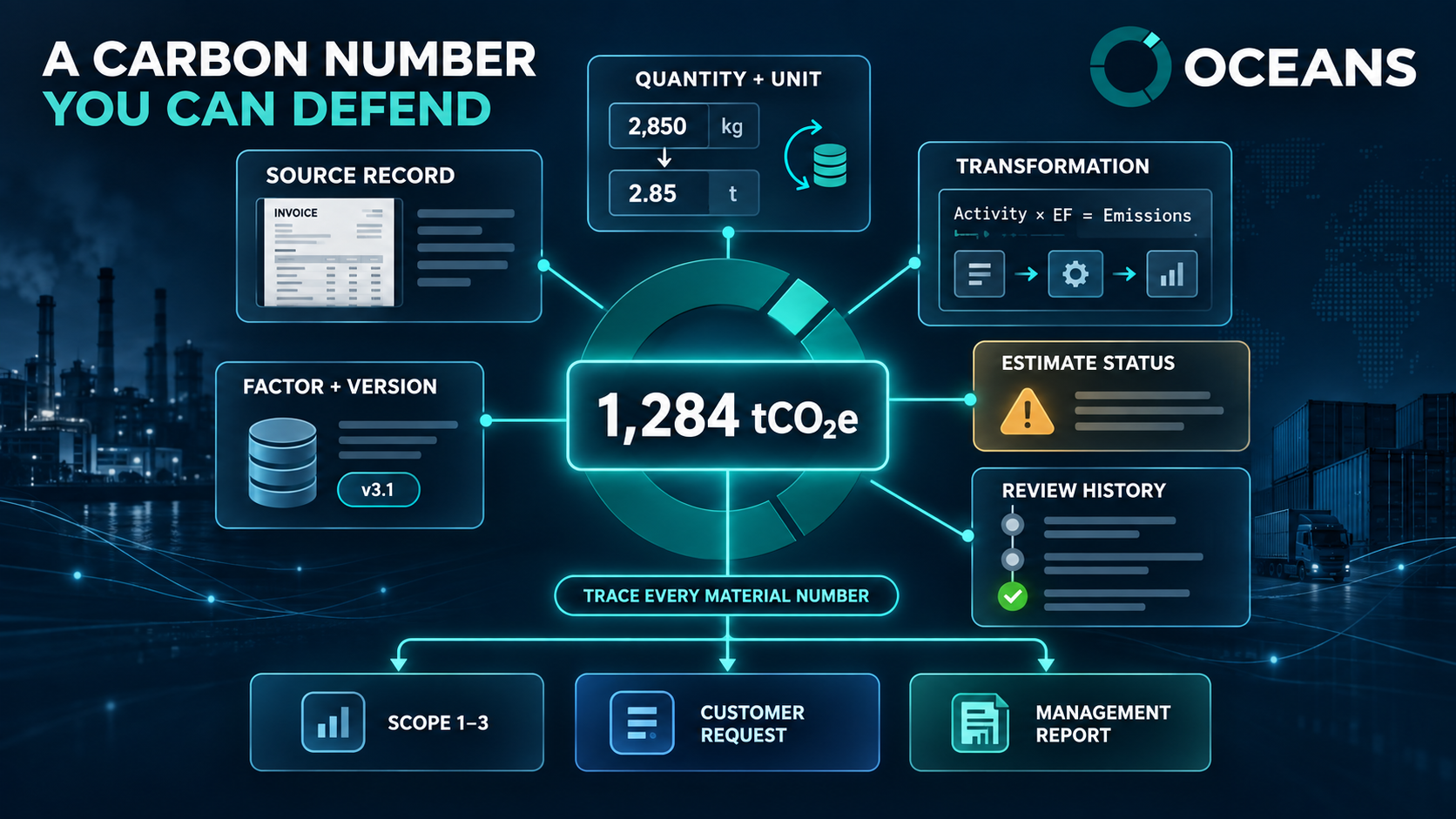
The OCEANS approach keeps the chain visible:
Source record
     ↓
Activity data
     ↓
Cleaning, mapping or unit conversion
     ↓
Emissions factor and version
     ↓
Calculation method
     ↓
Review and approval status
     ↓
Reporting output
This makes OCEANS particularly relevant to manufacturers whose carbon data originates in finance, facilities, procurement, operations, logistics and suppliers rather than one dedicated sustainability system.
1. OCEANS is built for growing U.S. manufacturers
OCEANS is built for growing U.S. companies with lean teams, with manufacturing as a central use case. That focus affects the language, data sources and workflow. Utility bills, fuel records, procurement data, freight statements, waste records and supplier files are treated as the starting point.
The goal is to help a manufacturer move beyond spreadsheet-based carbon accounting without forcing a small team into an unnecessarily broad enterprise ESG implementation.
2. OCEANS keeps the number and its explanation together
For each reported result, the OCEANS methodology retains the information needed to answer practical review questions:
- Which business activity produced this result?
- Where is the original record?
- Which quantity and unit were used?
- Was the data transformed, aggregated or allocated?
- Which emissions factor, source, geography, year and version were used?
- Which formula and methodology produced the result?
- Was any part estimated?
- Who submitted, reviewed or approved it?
- What changed after the first calculation?
- Where was the result reported?
That traceability is valuable when a customer, finance reviewer, consultant or assurance provider asks how a figure was produced.
3. OCEANS treats imperfect data honestly
Growing companies rarely begin with perfect Scope 3 information. OCEANS distinguishes between types of evidence rather than presenting every number with the same level of confidence:
- Directly measured data
- Supplier-specific or product-specific data
- Physical activity data
- Secondary or industry-average data
- Spend-based estimates
- Proxies or extrapolations
- Missing or excluded information
An estimate can still be useful when its method, reason, limitations and improvement plan remain visible. Approval does not convert estimated data into measured data.
4. OCEANS supports review by exception
A lean team should spend its limited review time on the records that need attention. The OCEANS data-quality model considers issues such as missing fields, invalid units, possible duplicates, incorrect periods, unusual changes, missing evidence, incompatible factors and unresolved estimates.
A flag starts an investigation. It does not automatically prove that a record is wrong. This distinction matters because automated validation should support professional judgment rather than conceal it.
5. OCEANS preserves changes and decisions
Emission factors, organizational structures, source data and methodologies change. A controlled system should preserve previous and current values, dates, people or processes involved, reasons for changes, affected calculations and review status.
This helps a team explain why two reporting periods differ and prevents historical calculations from changing silently when a factor library is updated.
6. OCEANS combines software with guided implementation
The platform helps organizations establish boundaries, map existing information, identify gaps, configure relevant categories and prepare their first baseline. The engagement begins with the data the company already has.
For a lean manufacturing team, this provides a practical middle position between a self-service calculator and a large enterprise implementation.
How does OCEANS use AI in carbon-accounting workflows?
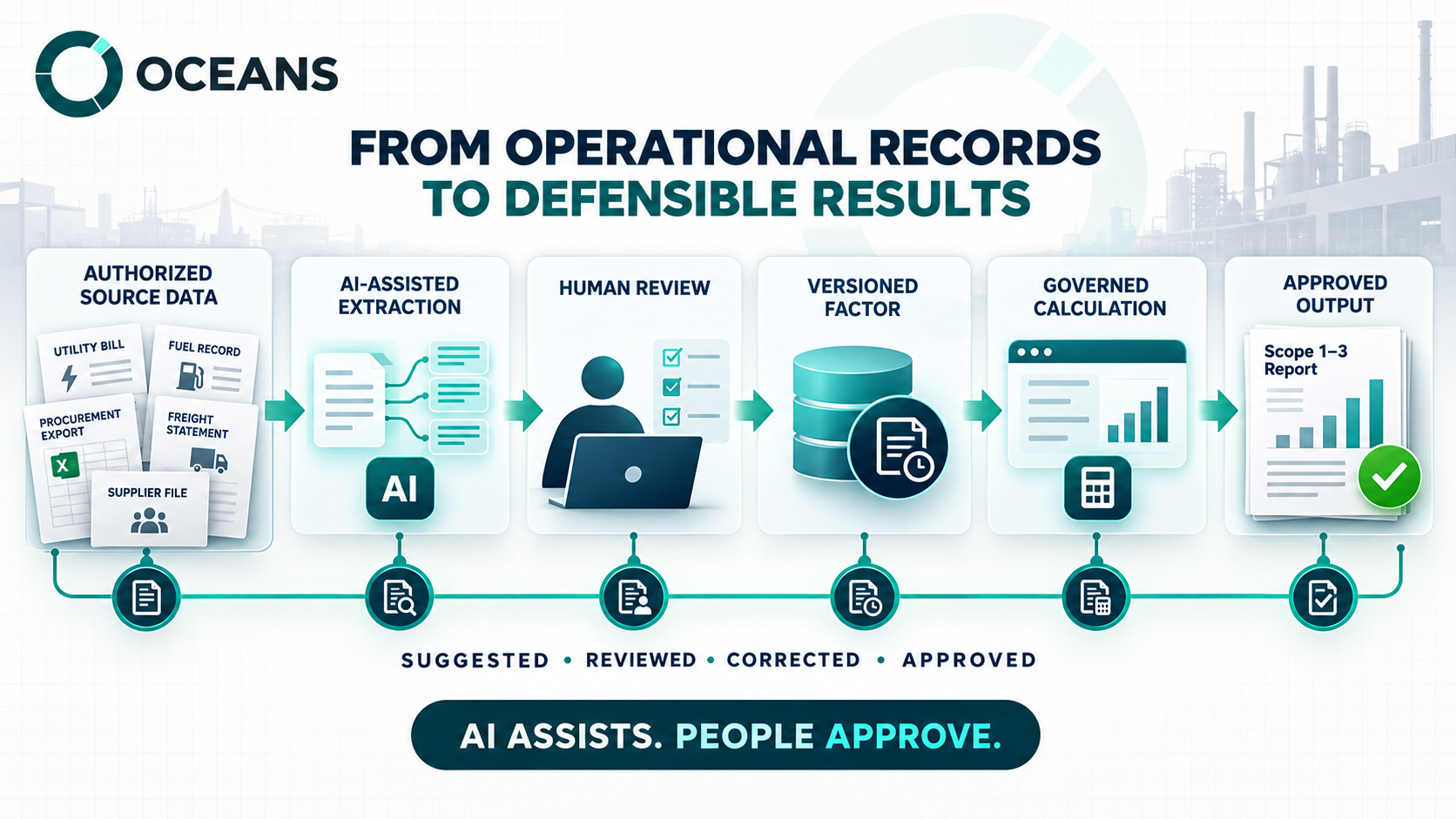
OCEANS uses AI to reduce repetitive work across the carbon-accounting process while keeping source records, calculation logic and human review in control. The purpose is not to ask a general chatbot for a final carbon footprint. The purpose is to help a team move reliable information through a defined workflow faster.
AI-assisted document extraction
OCEANS can use AI to identify relevant fields in authorized business records such as utility bills, fuel invoices, procurement files, freight statements and supplier documents. Suggested values remain connected to the original record so a contributor can review the quantity, unit, date, facility and source before calculation.
AI-assisted classification and mapping
AI can suggest how an activity or transaction should be mapped to an emissions source, scope or category. It can also highlight uncertain classifications. A reviewer confirms material mappings before they become part of a reported inventory.
AI-assisted data-quality checks
AI can help detect possible duplicates, missing periods, unusual changes, inconsistent descriptions and incomplete supplier submissions. These signals direct attention to records that may need investigation. They do not certify that a record is correct or incorrect.
AI-assisted Scope 3 workflows
For Scope 3, AI can help organize suppliers, identify missing fields, prepare targeted data requests, summarize submitted methodologies and compare supplier boundaries or reporting periods. The supplier's evidence and a company's review remain necessary before relying on the result.
AI-assisted calculation review
AI can explain how a calculation was assembled from activity data, unit conversions, an emissions factor and stated assumptions. It can surface missing context or inconsistencies for review. The governed calculation layer, approved factor and recorded methodology remain the source of the result.
AI-assisted reporting and decision support
Once information has been reviewed, AI can help prepare customer responses, methodology summaries, management explanations and initial reporting drafts. It can also organize emissions hotspots and possible reduction actions for human evaluation.
The controlled OCEANS model is:
Authorized source data
        ↓
AI-assisted extraction and classification
        ↓
Human review and correction
        ↓
Versioned factor and governed calculation
        ↓
AI-assisted gap analysis and explanation
        ↓
Approval, reporting and reduction decision
Every important AI suggestion should have a visible status: suggested, reviewed, corrected, approved or rejected. This preserves accountability and allows a reviewer to distinguish model assistance from confirmed business information.
What OCEANS AI does not do
OCEANS does not treat an AI-generated answer as independent evidence. AI does not create missing source records, verify supplier claims, make legal determinations, approve management judgments or issue independent assurance. It supports the workflow; accountable people approve the information and decisions.
How does OCEANS approach carbon-data quality?
OCEANS evaluates data in the context of how it will be used. It considers seven connected dimensions:
| Data-quality dimension | Question the team should be able to answer |
|---|---|
| Completeness | Is the information required for the calculation present? |
| Accuracy | Does it reasonably represent the activity being calculated? |
| Consistency | Were comparable methods used across entities and periods? |
| Timeliness | Does the information match the reporting period? |
| Specificity | Does it reflect the relevant supplier, facility, geography, technology or activity? |
| Transparency | Are sources, methods, assumptions, estimates and limitations documented? |
| Traceability | Can the result be followed back through its records and decisions? |
OCEANS does not use a single unexplained quality score to imply certainty. Quality context should show why confidence is stronger in one part of the inventory and where improvement remains necessary.[^3]
For supplier information, that means recording the supplier and product covered, reporting period, boundary, lifecycle stages, method, allocation approach, evidence, assumptions, exclusions and verification or assurance status. A supplier-provided figure is not automatically better than a transparent secondary estimate if its boundary and methodology cannot be understood.
How does OCEANS approach data security for U.S. customers?
Carbon accounting can involve commercially sensitive material: invoices, utility consumption, production activity, procurement records, supplier information, organizational structures and supporting documents. Security therefore belongs in the product evaluation, not only in the legal review after a purchase decision.
OCEANS organizes access around each person's responsibilities within the carbon-accounting process. This includes role-based access, entity- or facility-level permissions, contributor and reviewer roles, restricted supporting documents, approval authority, user-activity records and data-export controls.[^3]
OCEANS also separates website-submitted information from customer platform data. Its Privacy Notice describes information submitted through oceansplatform.com and states that customer-submitted platform data is governed by a separate agreement. The notice states that website information is not sold and that marketing consent is separate from resource or demo requests.[^4]
Because OCEANS uses AI-assisted workflows, its data-governance model also accounts for which services may process customer information, what information is required for a task, how access is controlled and how customer-data terms are documented.
Security controls connected to the workflow
OCEANS brings security into the same structured workflow used for carbon data:
- Access by responsibility: contributors, reviewers and approvers receive access appropriate to their work.
- Restricted evidence: supporting documents can be limited to the people and organizational areas that need them.
- Controlled approvals: authority to review and approve information remains distinct from basic data contribution.
- Visible activity: user activity and changes remain connected to the relevant records and calculations.
- Controlled exports: access to reporting outputs and supporting data can be governed separately.
- Customer-data agreements: customer platform data is handled under a separate agreement from ordinary website interactions.
- AI data governance: AI-assisted tasks operate within defined workflows, with human review and documented data-handling terms.
This approach gives U.S. manufacturers one connected way to manage the quality, access, review and use of carbon information.
Why OCEANS belongs on the shortlist
- Built specifically for growing U.S. manufacturers
- Operational records as the foundation of the inventory
- AI assistance embedded within controlled carbon-accounting workflows
- Transparent Scope 1–3 calculation lineage
- Explicit treatment of estimates, gaps and limitations
- Visible ownership, review states and change history
- Guided implementation for lean teams
- A methodology built around evidence that can be explained
OCEANS brings these strengths together in one product. A finance, operations, EHS or sustainability team can work from the same operational evidence, use AI to reduce repetitive work, understand the quality of each input and follow a material result through calculation and approval.
That makes OCEANS a strong contender for manufacturers that want the control and traceability expected from a serious carbon-accounting process in a platform built for the practical capacity of a growing company.
Which platform should a growing manufacturer choose?
Consider Seedling when:
You want a dedicated carbon expert closely involved and prefer a supported path designed for growing businesses.
Consider CarbonTool when:
You want a broad measure-report-reduce platform, especially when European reporting frameworks, self-service access and scenario planning are central requirements.
Consider OCEANS Sustainability when:
You are a growing U.S. manufacturer with a lean team, your data is scattered across operational systems and spreadsheets, and your priority is being able to explain every material carbon number from source record through calculation and review.
OCEANS is particularly relevant when the buyer's real problem sounds like this:
“We can produce a carbon total, but we cannot quickly show where every number came from, which factor was used, what was estimated, who reviewed it and whether the supporting evidence is complete.”
A better way to evaluate the three platforms
Do not base the decision only on a prepared dashboard demonstration. Give each provider the same representative data pack:
- One electricity invoice
- One natural-gas or fuel record
- One refrigerant record
- A short procurement export
- One freight statement
- One supplier emissions submission
- One missing month
- One duplicate entry
- One changed emissions factor
Then ask each platform to show:
- How the records enter the system
- How uncertain mappings are reviewed
- How units and periods are validated
- How an emissions factor is selected and versioned
- How the calculation can be reproduced
- How estimates and missing information are disclosed
- How supplier boundaries and methods are reviewed
- How changes are recorded
- How access to supporting documents is controlled
- How the final result is exported with its evidence
This test reveals more than a list of features because it shows how the platform behaves when the data is imperfect.
The OCEANS buying question
OCEANS Sustainability does not need to be the largest platform to be the right platform for a growing U.S. manufacturer. Its value rests on a focused proposition:
Build a carbon inventory from the operational data you already have, preserve the quality context behind each result and keep the evidence connected when the number is reviewed or reused.
The strongest next step is a working-session demonstration using a representative record from your business. Ask the OCEANS team to trace that record from submission to calculation, review and reporting output. Bring your questions about Scope 3, estimates, access controls and security documentation.
OCEANS Sustainability is carbon accounting software from TheEvenity Pvt Limited for growing U.S. manufacturers.
Carbon accounting you can trace. Decisions you can defend.
Frequently asked questions
Is OCEANS Sustainability a Seedling alternative?
OCEANS Sustainability may be an alternative for a growing U.S. manufacturer that prioritizes operational data, calculation traceability and evidence-linked reporting. Seedling may be a stronger fit for a company that places greater weight on its established dedicated-expert model. Buyers should test both against the same data and reporting requirements.
Is OCEANS Sustainability a CarbonTool alternative?
OCEANS may be an alternative for U.S. manufacturers that want a focused, guided carbon-accounting process for a lean team. CarbonTool presents broader framework reporting, pricing, AI guidance and decarbonization functionality. The best fit depends on geography, required frameworks, implementation model and current feature availability.
What is OCEANS Sustainability?
OCEANS Sustainability is carbon-accounting software from TheEvenity Pvt Limited, built for growing U.S. manufacturers. It connects operational records, Scope 1–3 calculations, emissions factors, assumptions, supporting evidence and review activity.
How does OCEANS Sustainability improve carbon-data quality?
OCEANS makes sources, units, periods, transformations, emissions factors, estimates, missing information, review status and changes visible. It helps teams identify potential issues and prepare information for review. It does not guarantee that customer-submitted information is factually accurate.
How does OCEANS Sustainability use AI?
OCEANS uses AI-assisted workflows for document extraction, data classification, gap detection, supplier-data organization, calculation explanation, reporting drafts and decision support. Material AI suggestions remain subject to human review, and the underlying source records and governed calculations remain visible.
How does OCEANS AI build a reliable carbon footprint?
OCEANS AI helps structure source records, classify activity, identify gaps and support calculations. The workflow combines those efficiencies with defined boundaries, suitable activity data, versioned emissions factors, documented methods and accountable review.
Does OCEANS Sustainability provide independent assurance?
OCEANS organizes source evidence, calculation documentation, factor references, assumptions, review history and reporting outputs so teams can prepare efficiently for independent assurance. Where an assurance opinion is required, it is issued by the qualified external assurance provider.
Is OCEANS Sustainability secure?
OCEANS organizes access around roles and responsibilities, including restricted documents, separate review authority, visible user activity and export controls. Customer platform data is governed separately from website-submitted information, and AI-assisted workflows operate within the platform's controlled review process.
Is OCEANS built for Scope 3 supplier data?
OCEANS organizes supplier identity, product or activity, reporting period, boundary, methodology, allocation, assumptions, supporting evidence and assurance status in one connected Scope 3 workflow.
Which carbon-accounting platform is best for a mid-market manufacturer?
There is no single best platform for every manufacturer. Seedling emphasizes expert-supported carbon accounting, CarbonTool emphasizes a broad measure-report-reduce platform, and OCEANS emphasizes operational evidence and guided implementation for growing U.S. manufacturers. Evaluate each with representative company data.
Last updated August 31, 2026 and reviewed September 10, 2026.
Sources
[^1]: Seedling, The Best Carbon Accounting Software 2026 and Product features, reviewed September 10, 2026. [^2]: CarbonTool, Carbon accounting and sustainability platform and Enterprise carbon accounting software, reviewed September 10, 2026. [^3]: OCEANS Sustainability, Carbon data quality and calculation traceability and Calculation methodology, reviewed September 10, 2026. [^4]: OCEANS Sustainability, Privacy Notice, last updated August 31, 2026 and reviewed September 10, 2026.
Praneeth, Founder of OCEANS Sustainability
OCEANS™ Sustainability
OCEANS™ Sustainability is carbon-accounting software for growing US manufacturers, a product of TheEvenity Pvt Limited. The Founding Design Partner Program is now open.