
The email looks simple: “Please provide the carbon emissions associated with our purchases.”
But which number does the customer want?
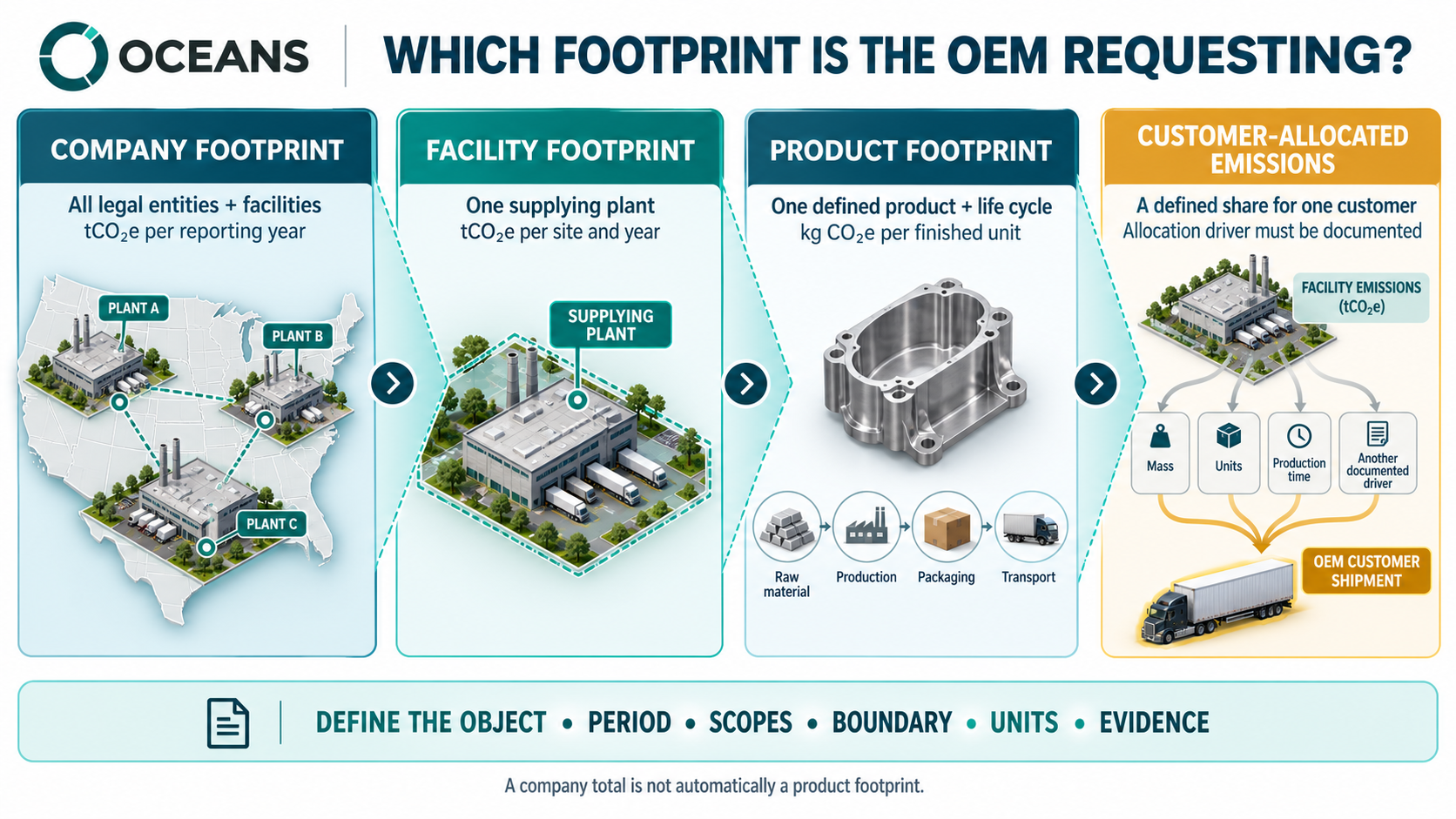
Is it your company’s total annual Scope 1 and Scope 2 emissions? The emissions from the plant making the customer’s parts? The life-cycle footprint of one product? Or a share of facility emissions allocated to that customer?
Those numbers answer different questions. Sending the wrong one can create more confusion than sending no number at all.
The short answer: When an OEM asks for carbon data, first confirm the requested reporting object: company, legal entity, facility, product or customer allocation. Then confirm the reporting period, greenhouse-gas scopes, boundary, calculation standard, units and required evidence. A company-wide Scope 1 and Scope 2 total does not automatically represent the footprint of a product sold to that customer.
This distinction matters for Tier 1 and Tier 2 manufacturers because customer requests are becoming more detailed. A voluntary automotive questionnaire published by Suppliers Partnership for the Environment includes corporate and allocated emissions data across Scope 1, Scope 2 and Scope 3.[^1] The request itself must guide the answer.
What type of carbon number is the customer requesting?
Before collecting invoices or opening a calculator, translate the customer’s wording into a defined measurement question.
| If the customer asks for… | It may mean… | Clarify before calculating… |
|---|---|---|
| “Your company’s emissions” | A corporate greenhouse-gas inventory | Which legal entities, facilities, scopes and reporting year? |
| “Emissions from the supplying plant” | A facility-level footprint | Which site, operations and shared services belong inside the boundary? |
| “Carbon footprint of this part” | A product carbon footprint | Which lifecycle stages, product version, geography and functional unit? |
| “Emissions associated with our purchases” | Allocated supplier or product emissions | Should allocation use mass, units, production time, revenue or another driver? |
| “Energy and GHG data” | Activity data, emissions totals or both | Are electricity, fuels, renewable-energy instruments and calculation evidence required? |
Do not infer the answer from one phrase in an email. Save the request, questionnaire instructions, reporting period, units and any methodology notes as the first record in the response file.
What is a company carbon footprint?
A company carbon footprint measures emissions across a defined organization for a defined period. The GHG Protocol Corporate Standard provides requirements and guidance for preparing a corporate-level greenhouse-gas inventory.[^2]
For a manufacturer, that inventory may include:
- Scope 1 emissions from stationary fuel combustion, company-controlled vehicles, process sources and refrigerant leakage
- Scope 2 emissions from purchased electricity, steam, heat or cooling
- Relevant Scope 3 emissions from purchased materials, capital goods, transport, waste, business travel and other value-chain activities
The company must document which operations it includes and how it applies organizational and operational boundaries. A total without that context is difficult for a customer to interpret.
Suppose a manufacturer operates three U.S. plants and reports 8,400 metric tons of carbon-dioxide equivalent across Scope 1 and Scope 2. That figure describes the defined company inventory. It does not tell the OEM how much relates to one plant, one production line or one component.
What is a facility carbon footprint?
A facility footprint narrows the measurement to a particular plant or site. It can be useful when a customer’s products come from one facility or when the questionnaire explicitly asks for site-level energy and emissions.
The plant may have direct natural-gas use, purchased electricity, mobile equipment, refrigerants and shared processes. The difficult part begins when resources serve multiple products or customers. Compressed air, heat treatment, lighting, warehousing and scrap handling may support the entire facility.
The facility total is therefore more specific than the company total, but it is still not automatically a product footprint. Moving from the plant to a part requires a defensible way to assign shared activity.
What is a product carbon footprint?
A product carbon footprint measures greenhouse-gas emissions associated with a defined product across a stated life-cycle boundary. GHG Protocol’s Product Standard distinguishes product-level accounting from corporate value-chain accounting and can cover raw materials, manufacturing, transportation, storage, use and disposal.[^3]
The result needs a clearly defined unit. For example:
Kilograms of CO₂e per finished aluminium housing delivered at the factory gate.
That statement identifies the product, unit and endpoint. A different boundary—such as cradle-to-grave rather than cradle-to-gate—could produce a substantially different result.
A product footprint may need data that is absent from the company’s Scope 1 and Scope 2 totals, including purchased-material emissions, inbound freight, packaging, manufacturing yield and waste. Those sources can fall within the manufacturer’s Scope 3 inventory while forming part of the product’s life-cycle footprint.
A fictional example: one plant, one part and three different answers
Consider Lakeview Components, a fictional U.S. manufacturer producing machined aluminium housings for several customers.
Lakeview’s OEM customer asks for “emissions associated with the housings purchased during 2025.” Lakeview has three possible numbers:
- Company footprint: emissions from all three Lakeview facilities and company-controlled operations during 2025.
- Facility footprint: emissions from the Ohio plant where the housings were produced.
- Product or allocated footprint: emissions associated with the purchased housings under a defined product boundary or allocation method.
The company total is too broad. The facility total is closer, but it still contains energy used for other customers and products. A product-level answer may require the mass of aluminium, machining energy, production yield, scrap treatment, packaging and relevant transport data. If direct metering does not exist, Lakeview may need a documented allocation approach.
GHG Protocol guidance recognizes that supplier information may be collected at product, process, production-line, facility, business-unit or corporate level. Less granular data can require allocation.[^4] The allocation basis should reflect the activity being assigned and remain visible with the result.
This is where a number can look precise while answering the wrong question. Dividing the plant’s emissions by total units may be easy, but it may poorly represent products with very different materials, weights or processing requirements.
What should a manufacturer clarify before responding?
Send a short clarification when the request is ambiguous. Ask:
- Which legal entity, facility, product or customer purchase should the response cover?
- What is the reporting period?
- Are Scope 1, Scope 2 and Scope 3 requested?
- Is Scope 2 required on a location-based basis, market-based basis or both?
- Does the customer want activity data, calculated emissions or both?
- Is the requested result corporate, facility-level, product-level or allocated to the customer?
- Which standard, factor source, unit and evidence format should be used?
- Does the customer require independent verification or simply supporting documentation?
The U.S. EPA advises companies collecting supplier information to keep requests simple and build trust around how the information will be used.[^5] Suppliers can support that process by stating exactly what their answer covers and which parts are measured, calculated, estimated or unavailable.
What evidence should support the answer?
A credible response allows another reviewer to follow the number back to its inputs. Prepare a compact response pack containing:
- The original customer request and its instructions
- The reporting boundary and period
- Electricity, natural-gas, fuel and refrigerant records where relevant
- Production, material, purchasing or shipment data used for a product result
- The emission-factor source, version, geography and units
- Calculation workpapers and unit conversions
- Allocation method and rationale, if allocation was required
- Assumptions, exclusions, limitations and data-quality notes
- Reviewer name, review date and version history
This does not mean attaching every invoice to the first email. It means keeping the evidence organized so each reported figure can be substantiated when the customer asks how it was calculated.
Where can AI help with an OEM carbon-data response?
AI can reduce manual work when it operates above controlled data and calculation records. It can help extract consumption from authorized utility bills, classify fuel and purchasing records, detect missing periods, organize questionnaire requirements, draft methodology explanations and identify questions that still need human judgment.
AI should not silently decide the reporting boundary, invent missing activity, choose an allocation method without context or present an unsupported estimate as measured data. Those decisions affect what the result means.
At OCEANS Sustainability, the workflow connects operational records, calculation methods, emission factors, assumptions and supporting evidence. The goal is to help growing U.S. manufacturers produce carbon information they can explain to customers and reuse across future supplier requests.
Carbon accounting you can trace. Decisions you can defend.
What should you send when the deadline is close?
Start with the request itself. Define the required answer before asking Facilities, Operations, Finance and Procurement to gather data. Then provide the most specific supported result available, label estimates and limitations clearly, and preserve the evidence behind it.
If the customer needs a corporate footprint, provide a corporate inventory with its boundary. If it needs facility emissions, isolate the supplying site. If it needs a product footprint, define the product unit and life-cycle boundary. If it needs an allocated share, document what was allocated and why the selected driver is reasonable.
OCEANS Sustainability helps U.S. manufacturers turn scattered operational records into source-linked carbon calculations and evidence-backed customer responses. If an OEM questionnaire or emissions-data deadline has reached your team, talk to the OCEANS founder about the response you need to build.
Frequently asked questions
Can I send my company’s Scope 1 and Scope 2 emissions when a customer asks for a product carbon footprint?
Usually, no. A corporate Scope 1 and Scope 2 inventory describes emissions across a defined organization. A product carbon footprint covers a defined product and life-cycle boundary and may include materials, transport and other sources outside the corporate Scope 1 and Scope 2 totals. Ask the customer which result it requires.
What if the OEM request only says “carbon emissions data”?
Ask whether the request concerns the company, supplying facility, purchased product or customer allocation. Also confirm the reporting year, scopes, units, required methodology and evidence.
Can facility emissions be allocated to a customer?
They can be allocated when the request permits it and the method is appropriate. The response should identify the emissions pool, allocation driver, calculation and limitations. Product-specific data may reduce the need for broad allocation.
Do all automotive suppliers receive the same questionnaire?
No. OEM and Tier 1 requests can differ. The Suppliers Partnership streamlined questionnaire is a voluntary industry resource, not a mandatory universal standard.[^1] Follow the instructions supplied by the requesting customer.
Can OCEANS Sustainability help with supplier carbon questionnaires?
Yes. OCEANS Sustainability is an AI-assisted carbon accounting service and platform built for growing U.S. manufacturers. It helps organize operational data, calculation methods, emission factors and evidence for Scope 1, Scope 2, Scope 3 and customer-response workflows.
Sources
[^1]: Suppliers Partnership for the Environment, Streamlined Automotive Carbon Reporting Questionnaire, accessed September 15, 2026. [^2]: GHG Protocol, Standards and Guidance, accessed September 15, 2026. [^3]: GHG Protocol, Product Life Cycle Accounting and Reporting Standard, accessed September 15, 2026. [^4]: GHG Protocol, Scope 3 Calculation Guidance, accessed September 15, 2026. [^5]: U.S. Environmental Protection Agency, Supply Chain Guidance, accessed September 15, 2026.
Sai Praneeth, Founder of OCEANS Sustainability Platform
OCEANS™ Sustainability
OCEANS™ Sustainability is carbon-accounting software for growing US manufacturers, a product of TheEvenity Pvt Limited. The Founding Design Partner Program is now open.