Your customer needs the questionnaire completed. Facilities has sent the electricity bills. Finance has exported a spreadsheet. Plant Operations has found the fuel records. Someone has uploaded the environmental policy.
The files are there. But can your team explain exactly which answer each file supports?
For an EHS manager handling an EcoVadis request alongside production, safety and permit responsibilities, this is the review that is easy to rush. The immediate goal becomes finishing the form. The harder job is checking whether the evidence actually establishes what the answer says.
Why might EcoVadis evidence receive no credit? A document can be uploaded successfully yet fail to support the selected answer. EcoVadis asks for relevant, complete, current evidence tied to the assessment scope. A folder full of records is therefore a starting point, not proof that every response is supported. EcoVadis: Understanding supporting documents
This guide is for U.S. manufacturing teams preparing the Environment and greenhouse-gas portions of a response. It offers seven practical checks—not a prediction of your score or a substitute for the instructions in your own questionnaire.
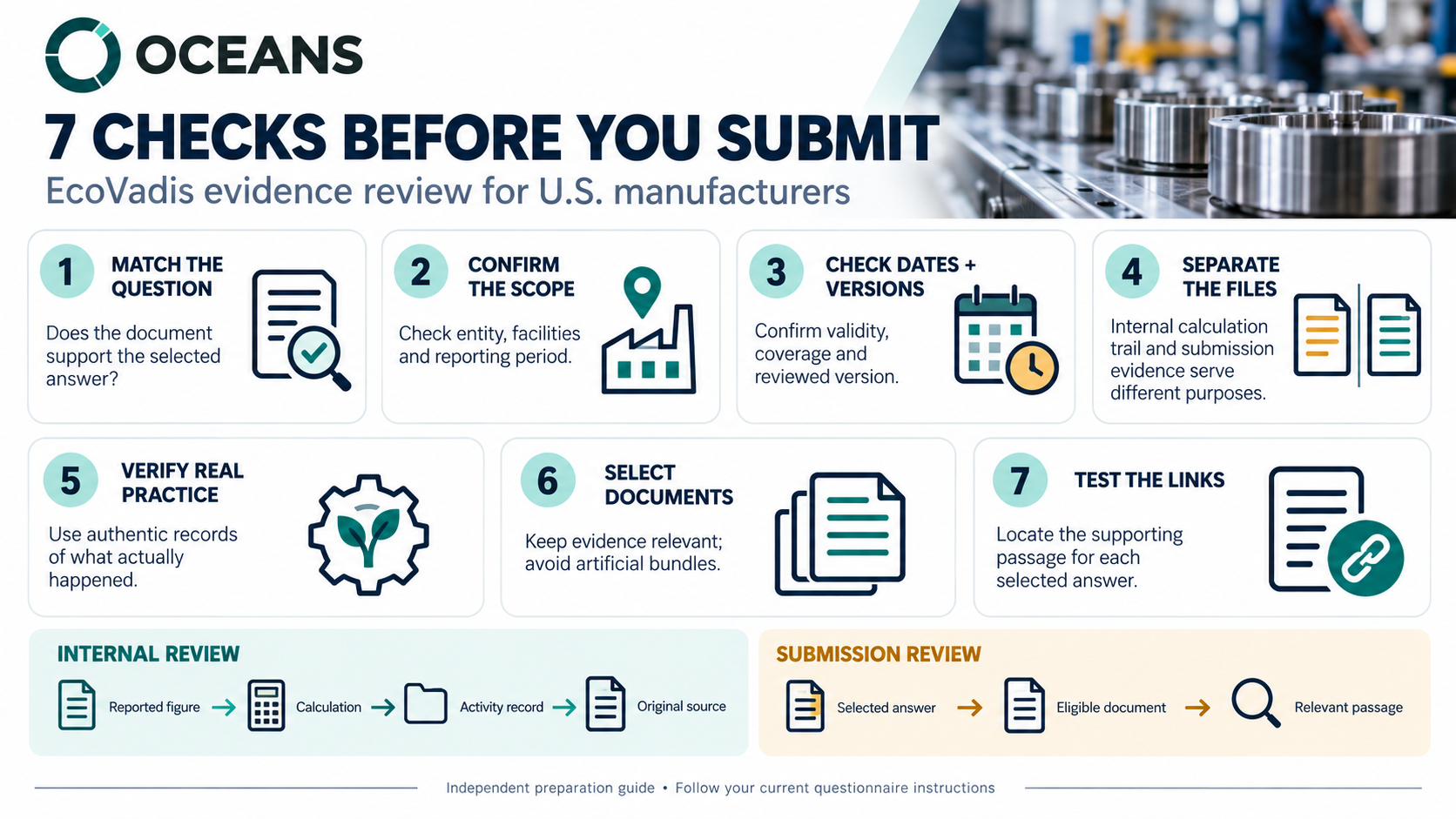
1. Check the question before choosing the document
“We have an environmental policy” and “we measure annual energy consumption” are different statements. A policy may explain responsibilities and commitments; it does not, by itself, establish the annual consumption figure.
EcoVadis questionnaires vary by company size, industry and location. They distinguish management indicators such as policies, measures and reporting. Evidence needs to match the option selected in your questionnaire. EcoVadis: Understanding my questionnaire
Before gathering another file, ask your internal owner:
What precise statement are we trying to support, and where in this document can someone verify it?
For a manufacturer, a useful internal distinction is:
| What the answer says | What your team should look for |
|---|---|
| We have a defined approach to energy management | The relevant adopted policy or procedure |
| We implemented an energy-saving activity | Records showing the activity happened, with its scope and timing |
| We track energy or emissions performance | The applicable reporting record, with its period and coverage |
| Our emissions figure is calculated from operational data | The underlying data and calculation trail for internal review |
This table is a preparation aid. It does not mean every document type is eligible for every EcoVadis option.
2. Check whether the evidence covers the company being assessed
Consider a fictional U.S. components manufacturer with two facilities. The operations team supplies an electricity workbook for Plant A. The draft answer describes energy use across the whole company.
The workbook might be correct. The answer still goes further than the workbook supports.
Our recommended review is to put three labels beside each material figure: entity, facilities and reporting period. Then compare them with the intended answer.
Watch for practical mismatches:
- A parent-company statement used for a subsidiary without checking its applicability.
- A facility total described as a company total.
- An acquired plant included in one dataset but missing from another.
- A certificate whose listed scope differs from the operations described in the response.
Write the open question down and assign it to an owner. “Does this cover Plant B?” is a more useful next action than “Please send more sustainability documents.”
3. Check dates, versions and the period behind the number
EcoVadis applies document-validity rules: its current guidance gives policies and actions an eight-year validity period and KPI reporting two years. Review the applicable guidance when preparing your submission. EcoVadis: Supporting-document validity
Your internal calculation review needs a separate date check.
For example, an electricity bill issued in January might cover consumption beginning in December. A file named “2025 energy final” might contain a rolling twelve-month period rather than January through December. Neither filename tells you how the reporting boundary was handled.
Ask the person preparing the figure to make these details visible:
- Consumption period, rather than invoice date alone.
- Any missing or overlapping periods.
- Treatment of estimates and subsequent corrected readings.
- Which version was reviewed and approved.
Preserve original records. Document adjustments alongside the calculation rather than silently changing the source to make the total fit.
4. Separate the calculation trail from the submission evidence
Your internal calculation file and your EcoVadis submission serve related but different purposes.
The calculation file helps your team reconstruct a result. The submission must support the particular questionnaire answer with suitable evidence. Sending every raw bill does not automatically establish a complete reporting practice; presenting a neat total does not explain how it was calculated.
A practical internal record should let a reviewer follow:
Reported figure → calculation → activity record → original source
For emissions, retain the units, conversion notes, factor reference, method, assumptions and review decision needed to explain the calculation. For a missing record, show the gap and any treatment explicitly.
Now make a separate submission decision: which eligible document supports the selected option, and where is the relevant information?
This distinction matters when using a response-preparation service. A new cover sheet, evidence index or calculation workbook can help your team review the response. It does not automatically qualify as assessment evidence simply because a service provider prepared it.
EcoVadis also says analysts will not retrieve additional evidence from documents or links embedded inside an uploaded file. Relevant evidence must be presented in the permitted way, rather than hidden behind another download. EcoVadis: Understanding supporting documents
5. Check that the evidence describes real practice
AI can help locate a paragraph, extract a value or draft an explanation. It cannot establish that a factory implemented a process merely by writing a convincing policy about it.
EcoVadis explicitly excludes documents created solely to satisfy its questionnaire, copied practices without evidence of implementation, and forged certificates or third-party documents. EcoVadis: Document authenticity
For your internal review, separate three situations:
| Situation | Practical response |
|---|---|
| The practice exists and is documented | Check the relevant record and its applicability. |
| The practice may exist, but the evidence is missing | Ask the responsible department to locate authentic records. |
| The practice is planned but has not happened | Record it as an improvement action; do not describe it as completed. |
Do not backdate a document or ask AI to generate a history of implementation. Start improvements honestly, retain their actual dates and build the records through normal operations.
An incomplete answer can reveal a manageable operational gap. An invented answer creates a different problem entirely.
6. Check document organization without creating an artificial bundle
EcoVadis sets a 55-document limit per assessment and does not accept unrelated documents combined simply to bypass it. A genuine consolidated report is different from merging standalone policies, receipts and photographs for the questionnaire. Its guidance lists exceptions, including multi-site certificates, consolidated site KPIs and certain contextual implementation records. EcoVadis: Document limits and combined documents
The operational lesson: make selection decisions before creating a large PDF.
Keep the broader working archive for your own records. Maintain a separate list of proposed submission documents and their purpose. Give reviewers a clear route to the relevant material without treating “more pages” as “more support.”
For reassessments, the limit applies to 55 new documents; documents from earlier assessments do not count toward that new-document allowance, and expired documents are removed automatically. EcoVadis: Reassessment guidance
7. Review answer-to-evidence links before submission
Run a short handover with the people responsible for the response. Ask one person to read a selected answer and another to locate its supporting material.
If the reviewer needs the preparer to explain everything verbally, record the missing context before the handover ends.
EcoVadis explains that documents must be attached to selected options. It also says uploaded evidence cannot be changed after submission until the next reassessment begins. This makes the final mapping review consequential. EcoVadis: Completing the questionnaire
If you have already submitted and believe something is wrong, contact EcoVadis support about your situation. If you have a scorecard, start with its feedback rather than assuming the issue was a missing file. EcoVadis recommends reviewing previous results before reassessment. EcoVadis: Preparing for reassessment
A simple evidence-review register for your manufacturing team
Use the following as an internal coordination tool. These are fictional examples, not EcoVadis answers or evidence-acceptance decisions.
| Draft statement | Record to review | Question still open | Internal owner | Review status |
|---|---|---|---|---|
| Annual electricity figure covers both plants | Site energy reporting workbook | Does Plant B include the final billing period? | Facilities | Hold for clarification |
| A defined environmental policy applies to assessed operations | Approved policy and applicability record | Is the acquired site covered? | EHS | Scope check needed |
| Fuel-related emissions figure is ready for review | Fuel register and calculation file | Was a corrected fuel entry counted twice? | Plant Ops / calculation reviewer | Calculation check needed |
| An energy-efficiency activity was implemented | Existing project and operating records | Is the claimed completion date supported? | Engineering | Owner confirmation needed |
Add your actual question reference, document location and reviewer decision. Keep this register separate from the assessment upload unless there is a specific, appropriate reason to include it.
The benefit is clearer work allocation. Each row tells someone what to resolve. It also prevents the person completing the form from becoming the sole keeper of the evidence trail.
Where OCEANS Sustainability fits
OCEANS Sustainability offers founder-led EcoVadis Environment and GHG response preparation for U.S. manufacturers. It is a practical fit when utility, fuel and finance records exist, but a lean team needs help connecting them to calculations and an explainable response.
The OCEANS response engagement covers agreed draft answers, applicable Scope 1 and Scope 2 calculations, source and factor registers, and documented assumptions and gaps. AI-assisted extraction and classification support human review. Your company approves and submits the final response.
The delivery target is ten business days after receipt of the agreed questionnaire and available input pack, with scope, timing and a fixed-fee proposal confirmed first. It is not a guarantee of evidence acceptance, a score or independent assurance. Platform development continues alongside the available founder-led service.
For a team comparing providers, the useful question is specific: who will help resolve the operational questions behind our answer—and leave us with records we can explain?
Inspect the OCEANS response-package walkthrough to see how the deliverable is structured before deciding whether to speak with the founder.
Facing a submission deadline?
Start the conversation with three things: your due date, the facilities involved and the questions blocking completion. You do not need to assemble a perfect dataset before asking for a scope review.
Request a 15-minute deadline review with the OCEANS founder.
The aim is a response your team understands, supported by records it can find again.
Frequently asked questions
Does a successful upload mean EcoVadis has accepted the evidence?
No. Uploading is a technical step; supporting the selected answer is an assessment question. Review the document's content and relevance rather than relying on the upload status.
Should we send an OEM exactly the same response as EcoVadis?
Review the OEM's request separately. Check its requested period, facilities, units and level of reporting before reusing an answer. A company emissions total and a requested product footprint are different deliverables. See the OCEANS guide to company versus product carbon requests.
What should we ask before hiring help?
Ask which questions are in scope, who performs and reviews the calculations, what happens when records are missing, what files you receive, and who owns final approval. Ask to inspect a sample deliverable and agree how confidential records will be exchanged and retained.
OCEANS Sustainability is independent of EcoVadis. This article focuses on evidence preparation for manufacturing teams; the instructions in your current questionnaire govern your submission. Sources were reviewed on September 28, 2026.
Praneeth, Founder OCEANS Sustainability Platform
OCEANS™ Sustainability
OCEANS™ Sustainability is carbon-accounting software for growing US manufacturers, a product of TheEvenity Pvt Limited. The Founding Design Partner Program is now open.