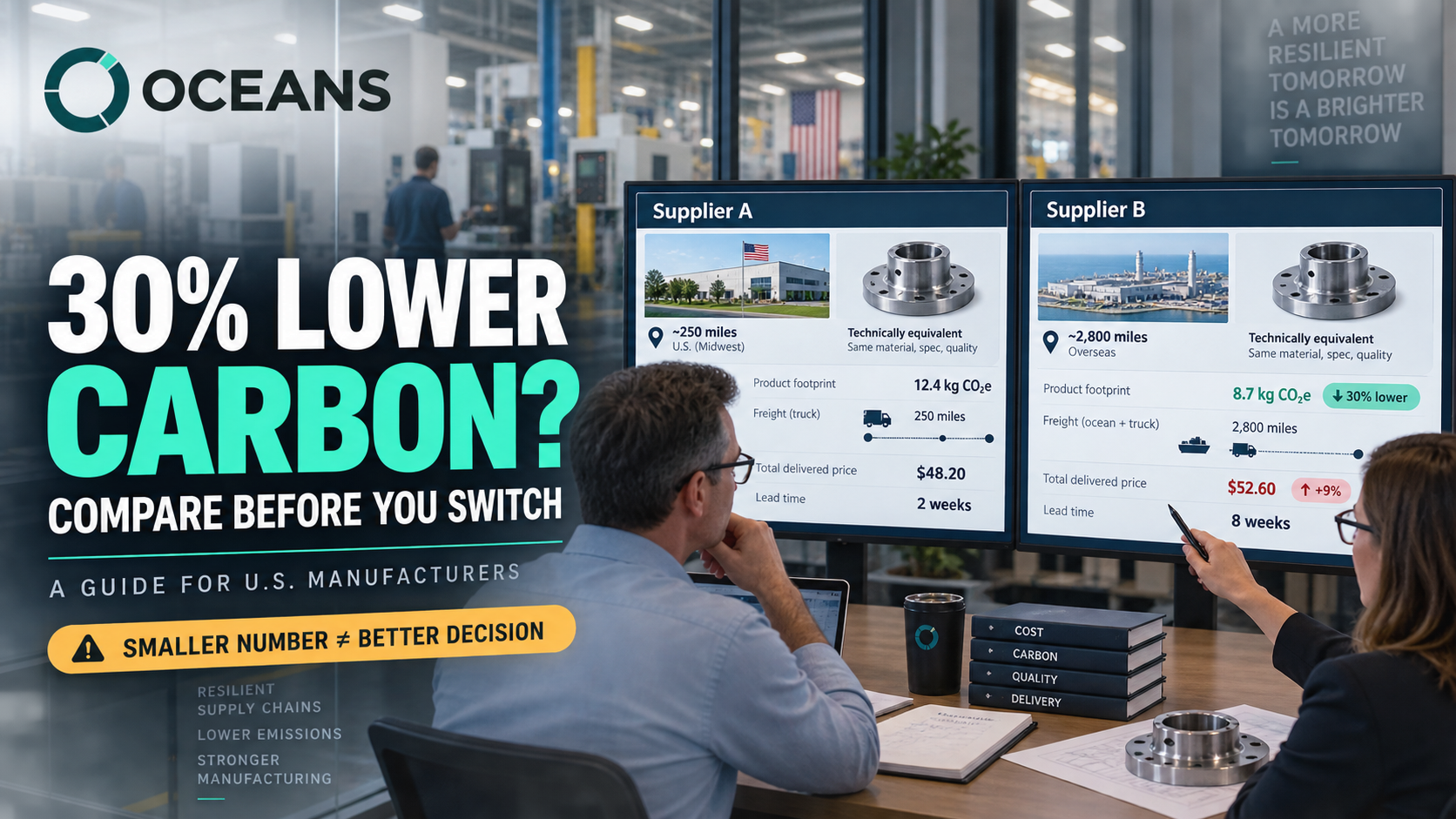
Supplier B says its material has a carbon footprint 30% lower than Supplier A. Should you change the purchase order?
Procurement sees a potential opportunity. The sustainability lead sees progress toward a reduction goal. Operations wants to know whether the material will perform on the production line.
Before anyone makes a commitment, there is another question: do the two carbon figures describe the same thing?
One may cover raw materials through finished production. The other may cover only the supplier's factory energy. One may describe the exact grade you buy. The other may be an average across an entire product family.
For a U.S. manufacturer, a useful supplier comparison connects emissions evidence with product requirements, delivered cost and operational feasibility. This guide shows what Procurement, EHS, Finance and Operations should ask before treating a lower reported number as a better sourcing decision.
How do you compare supplier carbon footprints?
Compare equivalent products using compatible units, lifecycle coverage and calculation methods. Check the evidence, period, allocation and assurance behind each figure. Evaluate delivery and production implications, then distinguish a modeled opportunity from an implemented change and a reported emissions reduction.
A smaller number is a starting point for investigation, not a supplier ranking.
GHG Protocol's Product Standard explains that comparisons require additional methodological specifications. Its comparison guidance addresses consistent units and boundaries, allocation, representativeness, data quality and third-party assurance. Two reports referring to the same broad standard are not automatically comparable. GHG Protocol Product Standard, section 1.5 and Appendix A
OCEANS Sustainability's published approach to supplier decarbonization centers on comparing proposed changes against a documented baseline, with assumptions, costs and feasibility visible. The goal is a sourcing decision your team can explain. OCEANS supplier decarbonization planning
First, identify what the supplier's number represents
A supplier may send a corporate inventory, a plant total, a product carbon footprint or an allocated figure. These are different outputs.
Ask for the name of the product, facility, period and calculation being supplied before moving the number into your workbook. A company total divided by sales is not interchangeable with a footprint for a specified component.
For background, see our guide to company versus product footprints in customer requests.
Your first supplier email can be short:
Does this figure represent the exact material or component in our quotation? Please confirm its unit, production site, reporting period and included lifecycle stages, and share the supporting methodology or report.
That question can prevent an impressive-looking comparison from moving forward on mismatched information.
A buyer's checklist before comparing two suppliers
Use this original checklist to organize your review. It is a screening aid, not a substitute for a product-specific assessment or the requirements of a relevant reporting program.
| Decision question | Evidence to request | What the buyer should resolve |
|---|---|---|
| Are these genuinely substitutable purchases? | Grade, dimensions, specification and performance requirements | Whether Engineering accepts the alternative |
| What does one unit mean? | Definition of the quoted footprint unit | Whether mass, component count or service delivered is being compared |
| What activities are included? | Lifecycle diagram and exclusions | Whether the two totals cover matching processes |
| Does the number describe our purchase? | Product, site and period identification | Whether a broad average is being used for a specific order |
| How was shared production treated? | Allocation explanation | Whether methodological differences drive the apparent advantage |
| What supports the figure? | Data sources, report version and assurance scope | Whether the evidence is sufficient for the intended decision |
| What changes after the factory gate? | Freight, packaging and delivery assumptions | Whether the delivered comparison differs from the quoted comparison |
| What changes in our own operation? | Trial results, yield, scrap and qualification needs | Whether the sourcing change creates additional burdens or costs |
The most useful outcome of an initial review may be “not yet comparable.” That is an actionable finding: it identifies the missing clarification before a purchasing commitment.
Worked example: the quoted 30% advantage becomes a different decision
Consider a fictional illustration involving equivalent aluminum components. Every emissions intensity and price below is invented for arithmetic; none is a supplier claim or an industry benchmark.
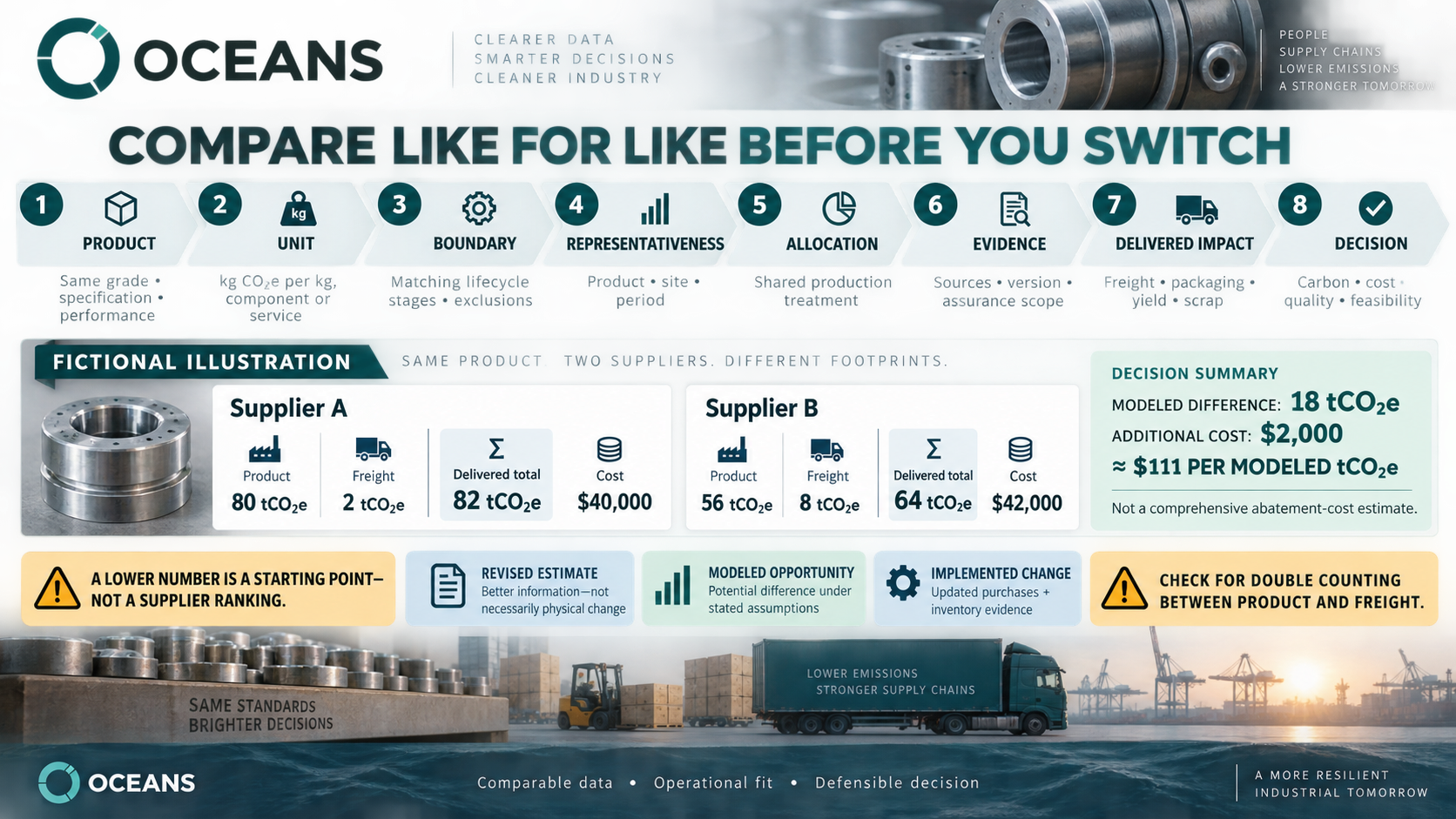
Assume Engineering has confirmed that either option can supply the same 10,000 kg of acceptable components. Assume the product figures have already been assessed on compatible cradle-to-gate methods, and freight is modeled separately on a consistent basis. No additional yield difference is assumed.
| Item | Supplier A | Supplier B |
|---|---|---|
| Required quantity | 10,000 kg | 10,000 kg |
| Illustrative product intensity | 8.0 kg CO2e/kg | 5.6 kg CO2e/kg |
| Product-related emissions | 80 tCO2e | 56 tCO2e |
| Separately modeled inbound freight | 2 tCO2e | 8 tCO2e |
| Total within this decision boundary | 82 tCO2e | 64 tCO2e |
| Illustrative delivered price | $4.00/kg | $4.20/kg |
| Delivered purchase cost | $40,000 | $42,000 |
At the product stage, Supplier B's intensity is 30% lower: (8.0 − 5.6) ÷ 8.0.
Within the selected delivered comparison, the modeled difference is 18 tCO2e, or approximately 22% of Supplier A's 82 tCO2e. The additional purchase cost is $2,000.
Dividing that incremental cost by the modeled difference gives approximately $111 per modeled tonne of CO2e difference. This is a narrow scenario metric, not a comprehensive abatement-cost estimate. It excludes qualification, tooling, financing and other costs not specified here.
The analysis has changed the question. Procurement is now evaluating a modeled 18-tonne difference for an additional $2,000, subject to the stated assumptions—not simply accepting a 30% headline.
Before acting, the team should ask:
- Does the delivery plan depend on air freight or uncertain shipment frequency?
- Could the alternative change rejection rates or manufacturing yield?
- Are qualification costs material?
- What evidence would confirm the actual purchases and deliveries?
- Is the difference robust enough to support the intended decision?
If product performance or evidence comparability fails, this arithmetic is not a valid basis for choosing Supplier B. Normalizing units cannot repair incompatible underlying studies.
Keep procurement analysis separate from Scope 3 category reporting
Combining product and freight emissions can help evaluate a delivered purchasing scenario. It does not mean those amounts belong in one corporate reporting category.
GHG Protocol provides separate calculation guidance for purchased goods and services and for transportation and distribution, with method selection depending on the activity and available information. Map each component appropriately and check for overlap before carrying a scenario into the inventory. GHG Protocol Scope 3 Calculation Guidance
For example, if a supplier's product footprint already includes the transport segment you add separately, your scenario could count the same emissions twice. Ask for the boundary rather than inferring it from a filename such as “final carbon footprint.”
A change in the number can mean three different things
The following distinctions are useful when communicating internally:
| What happened? | Appropriate description | What still needs checking? |
|---|---|---|
| You replaced a generic estimate with more specific information | A revised emissions estimate | Whether the method and data remain comparable with prior reporting |
| You modeled a possible switch | Potential difference under stated assumptions | Feasibility, uncertainty and implementation |
| You actually changed purchasing and updated the inventory | An observed inventory change | Volume, method, boundary and other causes of the change |
A revised estimate can improve information without changing physical operations. A sourcing scenario can inform action without proving that the action happened.
GHG Protocol distinguishes inventory accounting from project accounting that assesses effects against a counterfactual. Keep those purposes explicit when interpreting results. A lower inventory figure alone does not establish the full real-world effect of a purchasing intervention. GHG Protocol: Inventory and Project Accounting
For management reporting, retain the original baseline, the reason for any revision and the evidence of implementation. This makes later explanations easier than reconstructing the decision from a changed spreadsheet cell.
Ask suppliers for clarification without sending another lengthy survey
Start with the products and decisions that matter to the current sourcing review. Use a focused request like this:
Subject: Carbon-footprint clarification for [material or component]
We are reviewing sourcing options for [specification and quantity]. Please share the footprint report or methodology summary for the quoted product and confirm:
- The product, production site, reporting period and footprint unit.
- Included lifecycle stages and any exclusions, especially delivery.
- The allocation approach and treatment of recycled material, where relevant.
- The main data sources and which parts are measured, estimated or supplier-reported.
- Whether assurance applies to this specific result, and the scope of that assurance.
- A contact for technical clarification.
Please flag information you cannot provide so we can document the limitations accurately.
This is a practical communication template, not an official reporting form. Adapt it to the product and protect commercially sensitive information through agreed sharing arrangements.
If data remains incomplete, record the gap and decide whether further investigation would affect the purchase decision. Do not give an unsupported figure extra credibility simply because it came directly from a supplier.
Where AI helps in a supplier comparison
AI can assist with reading long reports, extracting candidate fields and highlighting apparent differences in units or coverage. Those tasks are useful when several suppliers send information in different formats.
But an extracted value is a candidate input. A reviewer still needs to confirm what it means.
As an evaluation test for any AI-assisted workflow, ask it to display the passage supporting a product's stated boundary, then inspect that passage yourself. If the report does not contain the answer, the workflow should leave the question unresolved rather than supply a plausible guess.
Use AI to make review easier. Keep the decision anchored to evidence and accountable human judgment. This is guidance for evaluating AI use, not a claim that every function described is currently available in OCEANS software.
Why consider OCEANS Sustainability for this problem?
OCEANS Sustainability is focused on carbon accounting for U.S. manufacturers, with a published approach that connects operational records, calculations and the decisions those calculations support.
That focus is relevant when Procurement needs more than a supplier ranking and EHS needs more than a final carbon number.
1. Start with the actual sourcing decision
The OCEANS supplier-decarbonization approach begins with a specific proposed change and a documented baseline. It is designed to make assumptions, cost information and feasibility constraints visible before a decision. Explore supplier decarbonization planning
For your team, the practical test is whether the comparison answers your question: a material substitution, a supplier change or a logistics option. Those decisions may need different evidence.
2. Make data quality inspectable
OCEANS's public data-quality framework emphasizes the original records, transformations, factors, assumptions and review status behind a result. It also recognizes that supplier-specific information needs assessment rather than automatic acceptance. OCEANS data quality and traceability
When evaluating any solution, ask to follow one result back to its supporting information. That is more useful than an unexplained confidence score.
3. Connect the analysis to responsibilities
A purchasing decision crosses departments. Procurement owns the commercial comparison; Engineering and Operations assess technical suitability; EHS or sustainability reviews the carbon basis; Finance evaluates costs. A useful decision record makes those contributions explicit.
OCEANS is a relevant option to discuss when your team wants that evidence-centered approach to manufacturing carbon data. Whether it is the best fit depends on your required scope, data, timeline and available functionality—not a blanket claim of market superiority.
Current availability: OCEANS's supplier-decarbonization platform workflow is in active development, with access through the Founding Design Partner Program. A conversation establishes fit and any separately agreed work; this article does not promise a production-ready supplier-ranking tool or an available full lifecycle-assessment service. Availability and intended workflow
Before your next supplier decision
Gather the two quotations, technical specifications, footprint reports and delivery assumptions. Write down what decision you need to make and who will approve it.
Then ask three questions:
- Are the figures comparable enough for this purpose?
- Does the alternative work operationally and commercially?
- What can we accurately say if we implement it?
Discuss your supplier-data challenge with OCEANS Sustainability. Start with a description of the decision; confidential records are not needed for an initial conversation. We can discuss fit, evidence needs and the scope of any possible engagement.
If your immediate need is a customer questionnaire rather than a sourcing comparison, explore the separate founder-led EcoVadis and OEM response engagement. Its scope and delivery terms do not automatically apply to supplier comparison work.
Frequently asked questions
Can I choose the supplier with the lowest reported carbon footprint?
Use the figure to identify a question worth investigating. Check product equivalence, methods, coverage and evidence before ranking suppliers. A lower total for a different product or boundary is not a like-for-like advantage.
Is a third-party-verified footprint enough to make two products comparable?
Verification is important evidence, but inspect what was verified and under which rules. Two verified results may cover different products, periods or lifecycle stages. Review comparability and the applicable product-specific requirements as well.
Does recycled content automatically establish a lower carbon footprint?
No. Ask for the actual footprint evidence and its treatment of material inputs, manufacturing and recycling. A recycled-content percentage alone is insufficient to calculate the carbon difference for your purchase.
Can a cheaper purchase make a spend-based estimate fall without a physical reduction?
Yes. If the calculation uses expenditure multiplied by an unchanged factor, a price decrease lowers the estimate even when the physical purchase is unchanged. Keep price effects separate from evidence of operational improvement.
Can a comparison prove that one supplier is more sustainable overall?
No. A carbon comparison addresses greenhouse-gas performance within its defined scope. It does not establish overall performance on water, biodiversity, labor or other impacts. Public comparative claims need the appropriate additional methodological and review requirements.
Sources and further reading
- GHG Protocol Product Life Cycle Accounting and Reporting Standard: section 1.5 and Appendix A
- GHG Protocol Scope 3 Calculation Guidance
- GHG Protocol: Inventory and Project Accounting
- OCEANS Sustainability: Supplier Decarbonization Planning
- OCEANS Sustainability: Data Quality and Traceability
Published by OCEANS Sustainability. The supplier scenario, factors, prices and arithmetic examples are fictional and do not represent customer outcomes. This guide provides a decision-screening framework, not a completed comparative lifecycle assessment or an assurance opinion.
Sai Praneeth, OCEANS Sustainability
OCEANS™ Sustainability
OCEANS™ Sustainability is carbon-accounting software for growing US manufacturers, a product of TheEvenity Pvt Limited. The Founding Design Partner Program is now open.