Your customer needs emissions data. Procurement has sent the supplier questionnaire. One supplier has not replied, another has attached a company-wide sustainability report, and a third has returned a carbon number without a unit.
Meanwhile, your EHS manager is trying to decide what can safely go into the response.
Can a U.S. manufacturer calculate Scope 3 with missing supplier data? Yes. Where appropriate, secondary data can support estimates while supplier information improves. The essential steps are to choose a suitable method, document gaps and assumptions, prevent overlapping calculations, and explain the limitations. Missing information should never silently become zero emissions.
GHG Protocol provides several calculation methods for purchased goods and services, including supplier-specific, hybrid, average-data and spend-based methods. Their suitability depends on the available information and its quality. GHG Protocol calculation guidance.
For lean manufacturing teams, the immediate objective is a result that can be explained and improved.
First, confirm whose Scope 3 the customer means
A customer asking for supplier information may want your company's Scope 1 and Scope 2 totals, a product footprint, emissions allocated to its purchases, or your own Scope 3 inventory.
These are different assignments. Do not start a full supplier-data collection exercise until you understand the requested entity, reporting period, unit and boundary.
For example, a request for the footprint of an aluminum component cannot automatically be answered by sending your entire company's annual emissions. Read our guide to company versus product carbon footprints before deciding which records to gather.
Identify the kind of missing data
Use this practical triage table to organize follow-up. It is an OCEANS editorial checklist, not an official reporting standard.
| What arrived | What remains uncertain | Useful next action |
|---|---|---|
| No supplier response | Product-specific emissions | Review your own purchase quantities and available secondary factors; document any estimate |
| Annual corporate emissions | How much relates to your purchases | Request relevant product or facility information and clarify allocation requirements |
| A footprint per product | Boundary, period or product match | Confirm the product specification, unit, reporting period and included lifecycle stages |
| An invoice with dollars only | Physical quantity | Look for receiving records, purchase-order details or material specifications |
| A number labelled “verified” | What was verified and by whom | Request the verification statement and its scope |
| An unexplained year-on-year decline | Whether operations or methodology changed | Compare activity, factors, boundaries and methods before interpreting the decline |
Sending the same questionnaire again may not solve any of these problems. Ask for the particular information that would make the record usable.
How can purchasing records support a first estimate?
Start by checking what Finance and Procurement already hold: supplier name, purchase description, date, amount, currency, quantity, unit and receiving location.
A mass of steel or resin may support a physical-quantity calculation using an appropriate average factor. A transaction containing only spend may support a spend-based estimate, with attention to the factor's sector, currency and price-year basis.
Neither approach should be described as supplier-measured emissions when it is not. GHG Protocol's guidance also cautions that greater data specificity does not necessarily mean greater accuracy; supplier data still needs evaluation. Technical calculation guidance.
An operationally useful record might read:
“Purchased material quantity confirmed from receiving records. Emissions estimated using a documented secondary factor. Supplier-specific footprint requested; boundary confirmation pending.”
That note tells the next reviewer what is known and what still needs work.
Worked example: a supplier update changes the number
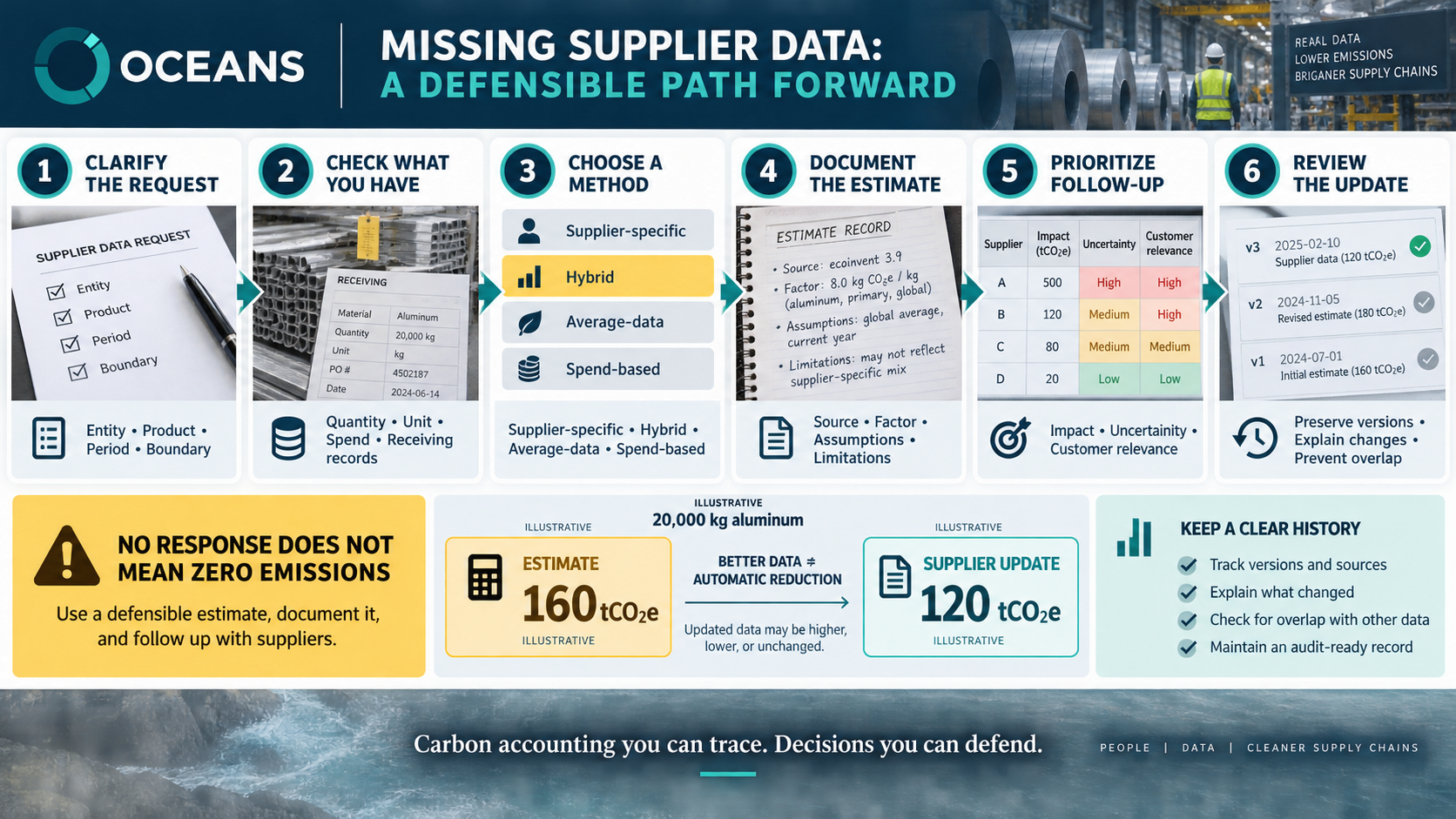
Consider a fictional U.S. components manufacturer purchasing 20,000 kilograms of aluminum extrusion. All factors below are hypothetical and are provided only to illustrate the accounting issue.
| Calculation version | Quantity | Hypothetical factor | Result |
|---|---|---|---|
| Initial estimate | 20,000 kg | 8 kg CO₂e/kg | 160 metric tons CO₂e |
| Later supplier-data calculation | 20,000 kg | 6 kg CO₂e/kg | 120 metric tons CO₂e |
The difference is 40 metric tons. Has the manufacturer reduced emissions by 25%?
These figures alone do not demonstrate that. The purchased quantity has not changed. The accounting input has changed. Before calling the difference a reduction, investigate whether it reflects actual production improvements, a different boundary, a different product, better measurement or a different calculation method.
This is why the previous estimate and its explanation should remain accessible. A lower number can reflect improved information rather than an operational achievement.
Before adopting the new supplier factor, review whether it covers the correct extrusion specification, unit, period and lifecycle stages. If it overlaps with separately calculated freight or other activities, resolve that overlap before aggregation. Merely adding the new result to the old estimate would count the same purchase twice.
Which suppliers should you follow up with first?
Prioritize where better information could change a business decision. For a manufacturing team, consider:
- Estimated emissions: Which purchases appear to contribute most?
- Uncertainty: Which important results rely on weak descriptions or poorly matched factors?
- Customer relevance: Which materials or products are part of an active customer request?
- Practical influence: Where can Procurement obtain better records or engage the supplier?
High spend is a useful starting signal, but it is not a complete prioritization method. A lower-cost material may still warrant attention because of its emissions intensity or its importance to a requested product footprint.
Keep the follow-up small and specific: identify the material, quantity and reporting period, explain what is missing, and name the person responsible for resolving it.
Build a gap register your team can actually use
The following example can be copied into a spreadsheet:
| Field | Illustrative entry |
|---|---|
| Purchase or material | Aluminum extrusion, receiving record RX-104 |
| Period and quantity | Agreed inventory year; 20,000 kg |
| Current method | Average-data estimate |
| Evidence held | Purchase order and receiving records |
| Missing evidence | Product-specific footprint and boundary statement |
| Current factor | Dataset reference, version and unit recorded in factor register |
| Limitation | Does not establish this supplier's actual performance |
| Owner and next action | Procurement lead to request product documentation |
| Review status | Provisional; method and boundary review pending |
This register makes incomplete information visible without pretending that every supplier has already been verified. It also creates a useful agenda for a conversation between EHS, Procurement and Finance.
What should Scope 3 software demonstrate?
Supplier portals and AI tools can make collection easier. Evaluate what happens after a file arrives.
Ask the provider to show how the workflow handles an incomplete submission, retains the original record, distinguishes estimates from supplier data, documents factor selection, and explains changes between inventory versions.
Established platforms already address parts of this challenge. IBM Envizi describes order-line calculations and several methods for supplier data. CarbonTool describes supplier collection and fallback estimates. Watershed emphasizes calculation transparency and AI-assisted data workflows. Seedling combines software with expert support.
For a growing U.S. manufacturer, the useful comparison is how those approaches fit your records, staffing and immediate reporting need. Ask every provider, including OCEANS, to explain the handling of one difficult real-world example.
This article is published by OCEANS Sustainability. These descriptions summarize vendors' public materials, not independent product tests.
Where OCEANS Sustainability fits
OCEANS Sustainability is an AI-assisted carbon-accounting platform designed for growing U.S. manufacturers, with a focus on connecting operational records, emissions calculations, supplier information and supporting evidence.
Our approach starts with a practical question: can the manufacturing team explain where a result came from and what would improve it?
That means making the source, method, factor and assumptions understandable, directing supplier follow-up toward useful information, and keeping human judgment visible. AI can assist with extraction, classification and identifying gaps; it cannot supply evidence that the supplier has never provided.
For manufacturers already facing an EcoVadis or OEM request, OCEANS also offers founder-led support for the agreed Environment and GHG questions. Scope 3 work, where requested, needs its own agreed scope; it should not be assumed to be included in a Scope 1 and Scope 2 response engagement.
Have a customer request and incomplete records? Talk to the OCEANS founder about your response scope. Start with the question you need to answer, the deadline and a description of the records available. Agree how confidential files will be shared before sending them.
Carbon accounting you can trace. Decisions you can defend.
Scope 3 With Missing Supplier Data | OCEANS Sustainability
Frequently asked questions
Can I report zero if a supplier does not provide emissions data?
No response does not establish zero emissions. Evaluate an appropriate estimation method and document limitations. A justified exclusion is a different decision and should be explained under the applicable reporting requirements.
Is supplier-specific data always better than an average factor?
Not automatically. Check whether it fits the purchased product, boundary, period and method. An unexplained supplier number is not necessarily a stronger input than a well-documented estimate.
Does a lower estimate prove we decarbonized?
No. Check whether the change came from activity, supplier operations, methodology, factors or scope. Keep an explanation of the change alongside the result.
Should I wait until every supplier responds?
You can begin organizing records and preparing appropriate estimates while supplier engagement continues. Whether the resulting submission is sufficient depends on the customer's instructions or the applicable reporting framework.
Can AI fill in missing supplier emissions?
AI may assist with estimates using documented inputs and methods, but an AI-generated value is not primary supplier evidence. Label estimates, review their basis and keep them distinguishable from supplier-provided information.
Further reading
Sai Praneeth, Founder of OCEANS Sustainability
OCEANS™ Sustainability
OCEANS™ Sustainability is carbon-accounting software for growing US manufacturers, a product of TheEvenity Pvt Limited. The Founding Design Partner Program is now open.