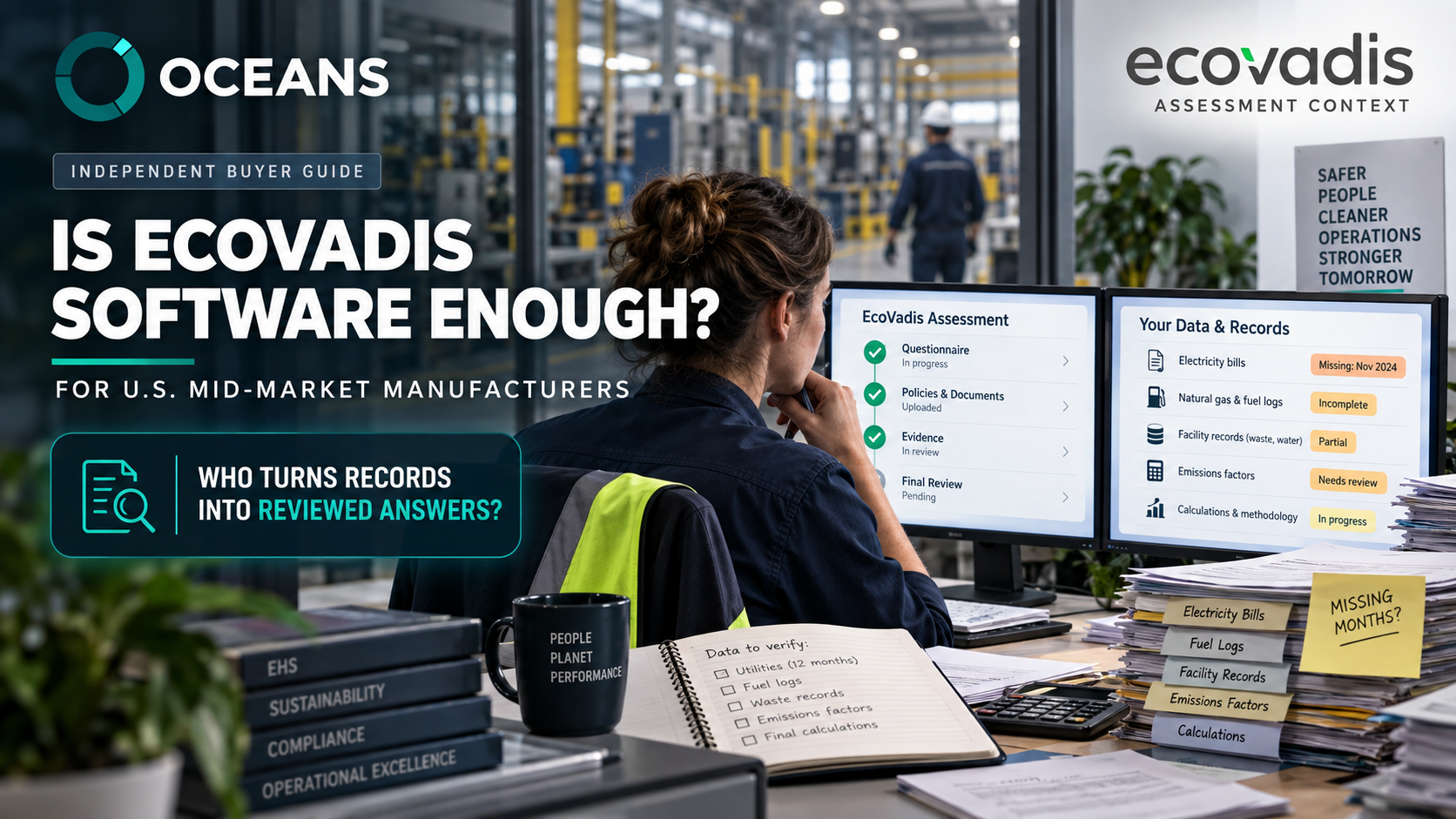
For EHS managers, Finance leaders and Operations teams at U.S. manufacturers responding to EcoVadis or customer sustainability requests.
The demonstration looks organized. Questions arrive in one workspace. Documents sit beside the answers. Owners receive tasks. Approved responses can be reused.
Then your EHS manager asks the question that matters:
“Who calculates our emissions if the number does not exist yet?”
For a U.S. manufacturer responding to a customer sustainability request, that question can determine whether a purchase removes work or simply gives the work a new home.
A well-designed questionnaire platform can be valuable. But if your starting point is twelve months of utility bills, inconsistent fuel logs and no reviewed emissions inventory, you need to understand what happens before an answer enters that platform.
The issue is the fit between your starting point and the work included in the offer. A vendor's European origin does not make it unsuitable for U.S. manufacturers. Nor does an enterprise label prove that implementation will be difficult. Some providers combine software, calculation tools and substantial expert support.
What matters is whether the engagement includes preparing the underlying information—or assumes your team already has it.
Is EcoVadis software enough for a U.S. manufacturer?
It can be, if your team already has suitable records, credible calculations and people who can maintain them. If those foundations are missing, you may also need hands-on data preparation, calculation and evidence support. Assess the complete service scope, not just the questionnaire interface.
Choose around your starting point:
- You have approved answers: evaluate evidence reuse and response-management software.
- You have raw records: evaluate calculation expertise and preparation support, whether delivered internally or by a provider.
- You need both: confirm who owns the handoff from calculation to questionnaire response.
OCEANS Sustainability's available founder-led service addresses the second and third situations within an agreed energy and greenhouse-gas scope. The buyer test throughout this guide is simple: who will turn your records into a reviewed answer?
This article focuses on energy and greenhouse-gas response preparation. EcoVadis assesses a broader sustainability management system across four themes, with questionnaires tailored to company characteristics. A carbon inventory alone does not complete the assessment. EcoVadis: Understanding my questionnaire
The gap between an enterprise workflow and a lean manufacturing team
Imagine two buyers. These are illustrative situations, not descriptions of every enterprise or mid-market business.
The first has an approved inventory, a sustainability lead, maintained policies and established department owners. Its problem is repetitive requests: different customers keep asking for information already available somewhere in the organization.
The second has a customer deadline and an EHS manager who also handles safety, permits and operational issues. Finance can export spending. Facilities can retrieve bills. Nobody has agreed the reporting boundary or reviewed the emissions calculations.
Both buyers need coordination. Only the second still needs to establish some of the answers.
| Starting point | Immediate need | What to confirm before buying |
|---|---|---|
| Reviewed emissions figures and approved documents | Retrieve and reuse information efficiently | Evidence mapping, version control and approvals |
| Raw utility and fuel records | Prepare a documented inventory for the agreed scope | Who organizes records, calculates and reviews |
| Existing figures with unclear origins | Investigate and substantiate the calculations | Whether reconstruction and correction are included |
| Repeated requests across sites | Maintain consistent information over time | Site ownership, update responsibilities and recurring support |
These situations can coexist within one business. Choose support around the work that remains, rather than assuming headcount alone determines the right solution.
EcoVadis software, carbon accounting and response support: what is the difference?
These are functions to evaluate, not mutually exclusive vendor categories. One provider may deliver several.
| Function | Primary job | Output to request in a demonstration or proposal |
|---|---|---|
| Questionnaire and evidence management | Connect existing information to requirements, owners and approvals | An answer linked to the appropriate document and review status |
| Carbon accounting | Convert defined business activity into emissions using documented methods | A calculation with its boundary, inputs, factors and assumptions |
| Hands-on response preparation | Carry out the agreed collection, calculation and drafting work with your team | Draft responses, supporting calculations and an unresolved-issues list |
An emissions calculation can be technically documented and still fail to answer the particular question asked. A well-organized questionnaire can still contain an unsupported number. Your purchasing decision needs to address both the calculation and its intended use.
Five jobs a questionnaire interface does not automatically complete
1. Establishing what the requested number covers
“Annual emissions” is not a sufficient calculation brief.
Does the request concern one facility or several entities? Which dates apply? Is the customer asking for company emissions, a product footprint or an allocated share?
The GHG Protocol Corporate Standard establishes the importance of organizational and operational boundaries in an inventory. A polished reporting interface does not remove the need to choose and document them appropriately. GHG Protocol Corporate Standard
Ask the provider to explain who resolves these questions before calculations begin.
For a related customer request, our guide to company versus product footprints explains why those outputs should not be treated as interchangeable. An OEM questionnaire and an EcoVadis assessment also need their own scope checks; one response format does not automatically satisfy the other.
2. Turning business records into usable activity data
An accounts-payable export can establish that a utility was paid. It may not include consumption, meter coverage or the relevant service dates.
A folder containing twelve invoices may still include a duplicate and a missing period. A fuel purchase may need further investigation before it can represent consumption during the reporting year.
The buying question is practical: will someone work through these issues, or will your team receive a list of fields to populate?
Either arrangement can work. The problem is discovering the division of responsibility after the contract is signed.
3. Applying a suitable calculation method
Selecting a factor is not just finding a number with “carbon” in its description. Activity type, geography, period, units and the calculation boundary matter.
For example, U.S. electricity calculations require attention to the relevant grid geography. EPA recommends eGRID subregion output rates for estimating electricity-use emissions and provides guidance on choosing data years. EPA eGRID guidance
Location-based and market-based Scope 2 also have different accounting bases; qualifying contractual information matters for the latter. GHG Protocol Scope 2 Guidance
An overseas provider can handle these requirements well. A U.S.-focused provider can handle them poorly. Ask to inspect the method and responsibilities rather than treating geography as a quality certificate.
4. Distinguishing evidence from a convincing explanation
AI can assist with extraction and drafting. But text describing a policy is not evidence that the policy has been implemented. A confident sentence about annual emissions does not establish the records behind it.
EcoVadis states that supporting documents should reflect the company's management system and match the assessment scope. It also excludes documents created solely to satisfy its questionnaire. That means response preparation must represent genuine practices and reporting—not manufacture a paper history of activities that never happened. EcoVadis: Understanding supporting documents
Calculations and source registers can support your internal reporting process. Which documents are appropriate to submit depends on the specific question and evidence requirements. Uploading every raw invoice is not a substitute for making that assessment.
5. Assigning responsibility for the finished response
A platform can route a task. Your proposal still needs to say who completes it.
Who follows up on missing records? Who reviews an estimate? Who checks that the final response matches the approved figures? Who answers a subsequent clarification, and is that work included?
These questions are especially important when a lean team is buying relief from workload. Access to a system and responsibility for preparing a deliverable are different commitments.
A simple manufacturing example: the bottleneck before the dashboard
Consider a fictional metal-components manufacturer with two plants and a customer reporting deadline.
Its shared folder contains electricity bills for both locations, a fuel spreadsheet and an earlier presentation mentioning a reduction target. The customer request concerns only one plant.
The immediate tasks are to separate the relevant records, check coverage, establish the calculation basis and confirm whether the target was actually approved. Only then can the team determine which answers are supported.
An evidence platform may help manage that work. A calculation tool may help perform part of it. A service provider may undertake it. A combined offer may cover all three.
The manufacturer should ask every prospective provider the same question:
“Starting with these records, what will you deliver, what must we do, and what remains outside the agreed scope?”
That question makes competing proposals easier to compare than a list of AI features.
Try a small evaluation exercise before committing. Share a fictional or appropriately redacted bill, a fuel-log excerpt and one representative question. Ask the provider to show what it can establish, what remains uncertain and which tasks your team would need to complete. This is an evaluation of the working relationship, not a request for a free full inventory.
What a useful proposal should make explicit
Before buying EcoVadis support or carbon-accounting software, request a written answer to these questions:
| Ask this | Look for this in the answer |
|---|---|
| Which questionnaire sections are covered? | Named questions or themes, facilities and reporting period |
| Who prepares the emissions calculations? | A responsible party and a defined review process |
| What records do we need to provide? | Specific inputs, owners and assumptions about completeness |
| What happens when data is missing? | A clarification process and documented treatment of unresolved gaps |
| What will we receive? | Identifiable outputs, not only access to a workspace |
| Can we retain usable records afterward? | Agreed exports, supporting files and access arrangements |
| What affects the timeline or fee? | Input dependencies, scope changes and additional-work terms |
| What is included after delivery? | Clear boundaries for revisions and follow-up questions |
Do not assume the cheapest software subscription is the lowest-effort option. Equally, do not assume a service engagement is automatically more efficient. Compare the vendor fee alongside the work your employees must still perform.
For a recurring program, software ownership and repeatability may matter most. For one defined request, a scoped preparation engagement may be the more practical starting point.
Compare the cost of the complete job
Use a simple budgeting view:
Total delivery cost = provider fees + internal staff time + separately scoped work.
For example, a fictional proposal leaving 30 hours of preparation with your team represents $1,800 of internal effort at an assumed loaded rate of $60 an hour, before provider fees. Those figures illustrate the calculation; they are not a market benchmark or an OCEANS savings claim.
Ask for responsibilities first, then compare prices on equivalent scope. Include any separate verification, additional facilities or post-delivery changes that your actual request requires.
Where OCEANS Sustainability fits
OCEANS Sustainability provides founder-led support for U.S. manufacturers preparing agreed Environment and greenhouse-gas responses. We organize supplied records, calculate applicable Scope 1 and Scope 2 emissions, document methods and gaps, and prepare a source-linked package for the customer's review and submission. OCEANS response engagement
Our emphasis is the connection between the operational record and the reported answer. The public methodology explains how boundaries, activity data, unit conversions and factor references support that connection. OCEANS calculation methodology
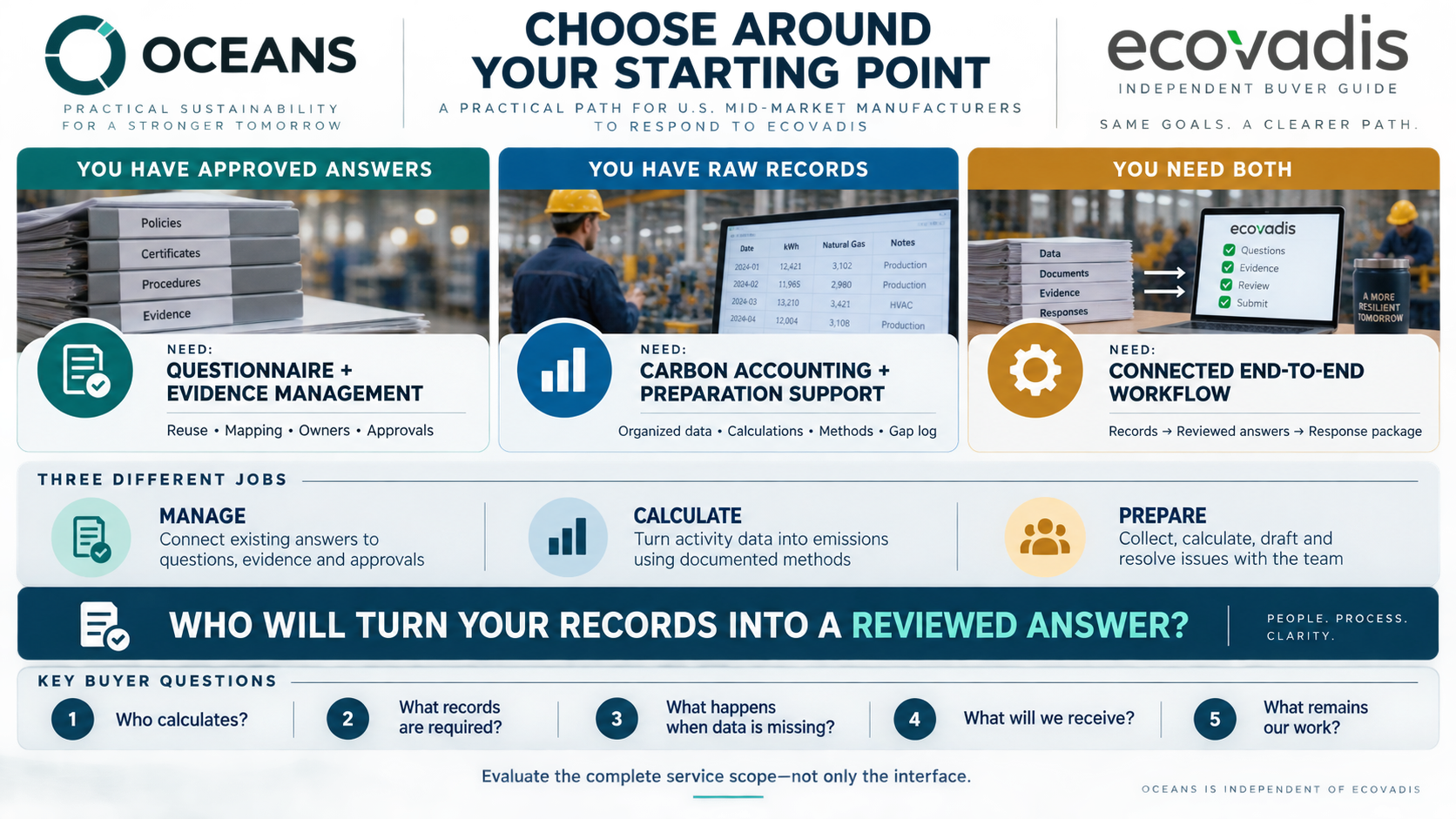
The public OCEANS method, expressed as review questions:
| Review question | What should be explainable |
|---|---|
| What are we answering? | Reporting purpose, period, facility and agreed scope |
| Where did the input come from? | Original activity record, quantity and unit |
| How was the result calculated? | Conversion, factor reference and calculation basis |
| What is still uncertain? | Missing records, estimates, exclusions and decisions required |
| Is this ready to report? | Review status and the customer's approval |
This describes the public methodology, not a claim that each control is an automated software feature.
For a buyer, traceability should be inspectable. You should be able to identify the source of a result, understand its calculation basis and distinguish an estimate from a reviewed figure. Our published data-quality approach addresses those questions without treating internal review as independent assurance. OCEANS data quality and traceability
Inspect a sample OCEANS response package before deciding whether to speak with us.
OCEANS may be a fit when a defined customer request is blocked by scattered records or unfinished calculations. A broad, established enterprise platform may be a better fit when your priority is organization-wide collaboration across many assessments and teams. You may also need both kinds of support at different stages.
The decision should follow the work you need completed.
Preparing for this deadline should leave something useful behind
Ask what your team will be able to reuse when the next customer request arrives.
A response without accessible supporting records can become another file that nobody wants to maintain. A useful handover should explain what the figures cover, what remains unresolved and what needs updating.
Reusability does not mean copying last year's answer unchanged. It means the next person has a clear starting point rather than an unexplained total.
That is the standard to bring to any software demonstration or service discussion: show us the output, the supporting information and the work that remains ours.
Have a customer request and no clear starting point?
Bring the questionnaire, deadline and a description of the records you have to OCEANS Sustainability. We confirm scope and a fixed-fee proposal before work begins.
The response engagement targets 10 business days after receipt of the agreed questionnaire and input pack; timing is confirmed for the specific scope. Additional Scope 3 work, product footprints, broader assessment themes and independent assurance are not automatically included. Your company approves and submits the response.
Founder-led support is available now. The software platform is in active development, with access through the Founding Design Partner Program. Service details and availability
Request a deadline review with the founder. No confidential documents are needed for the initial conversation. No score or acceptance is guaranteed.
Frequently asked questions
Is European EcoVadis software unsuitable for U.S. manufacturers?
No. Evaluate its capabilities, applicable methods and service scope. The potential mismatch is an offer that assumes prepared information when your team still needs help producing it—not the provider's country of origin.
Is EcoVadis response software the same as carbon-accounting software?
The functions can overlap, but the labels do not establish scope. Check whether the offer calculates emissions from operational records, manages existing information, prepares questionnaire responses, or combines these services.
Can AI complete our assessment from utility bills?
Utility bills provide only part of the information. EcoVadis covers multiple sustainability themes, and responses need appropriate evidence of your management system. Extraction and drafting assistance do not replace those underlying practices. EcoVadis questionnaire guidance
What should an EHS manager prepare before speaking with a provider?
Bring the request, deadline, facilities involved and a short description of the records available. Identify the person who will approve the response. You do not need to transfer confidential files simply to discuss fit and scope.
Should we buy software before calculating our first footprint?
There is no universal sequence. Software can support a first inventory when your team has suitable expertise and time, or when implementation support includes the work you need. If neither is available, agree preparation responsibilities before purchasing access.
Does a source-linked response guarantee an EcoVadis medal?
No. Traceability supports explanation and review. It does not guarantee an assessment outcome, replace independent verification or establish that every submitted document will be accepted.
Sources and further reading
- EcoVadis: Understanding my questionnaire
- EcoVadis: Understanding supporting documents
- GHG Protocol Corporate Standard
- GHG Protocol Scope 2 Guidance
- U.S. EPA eGRID guidance
Published by OCEANS Sustainability. This article presents a buyer-fit framework, not a finding about any unnamed vendor's capabilities. OCEANS is independent of EcoVadis. “EcoVadis software” here means third-party software used to support assessment preparation; it does not imply EcoVadis endorsement. The manufacturing scenario is fictional.
Sai Praneeth, Founder - OCEANS Sustainability
OCEANS™ Sustainability
OCEANS™ Sustainability is carbon-accounting software for growing US manufacturers, a product of TheEvenity Pvt Limited. The Founding Design Partner Program is now open.