
Your customer sends a spreadsheet asking for your plant's greenhouse-gas emissions. Purchasing forwards it to EHS. Finance has the utility payments. Facilities has the bills. Plant Operations has the fuel records.
Then someone notices two different electricity-emissions columns and a question about the customer's share of site revenue.
The deadline is approaching, but the first obstacle is more basic: which number belongs in each field, and what supports it?
For a Tier 1 or Tier 2 automotive supplier, answering that question takes more than adding a carbon total to a spreadsheet. The response needs the right site, reporting period, calculation basis and supporting records.
How do you answer an OEM carbon emissions questionnaire?
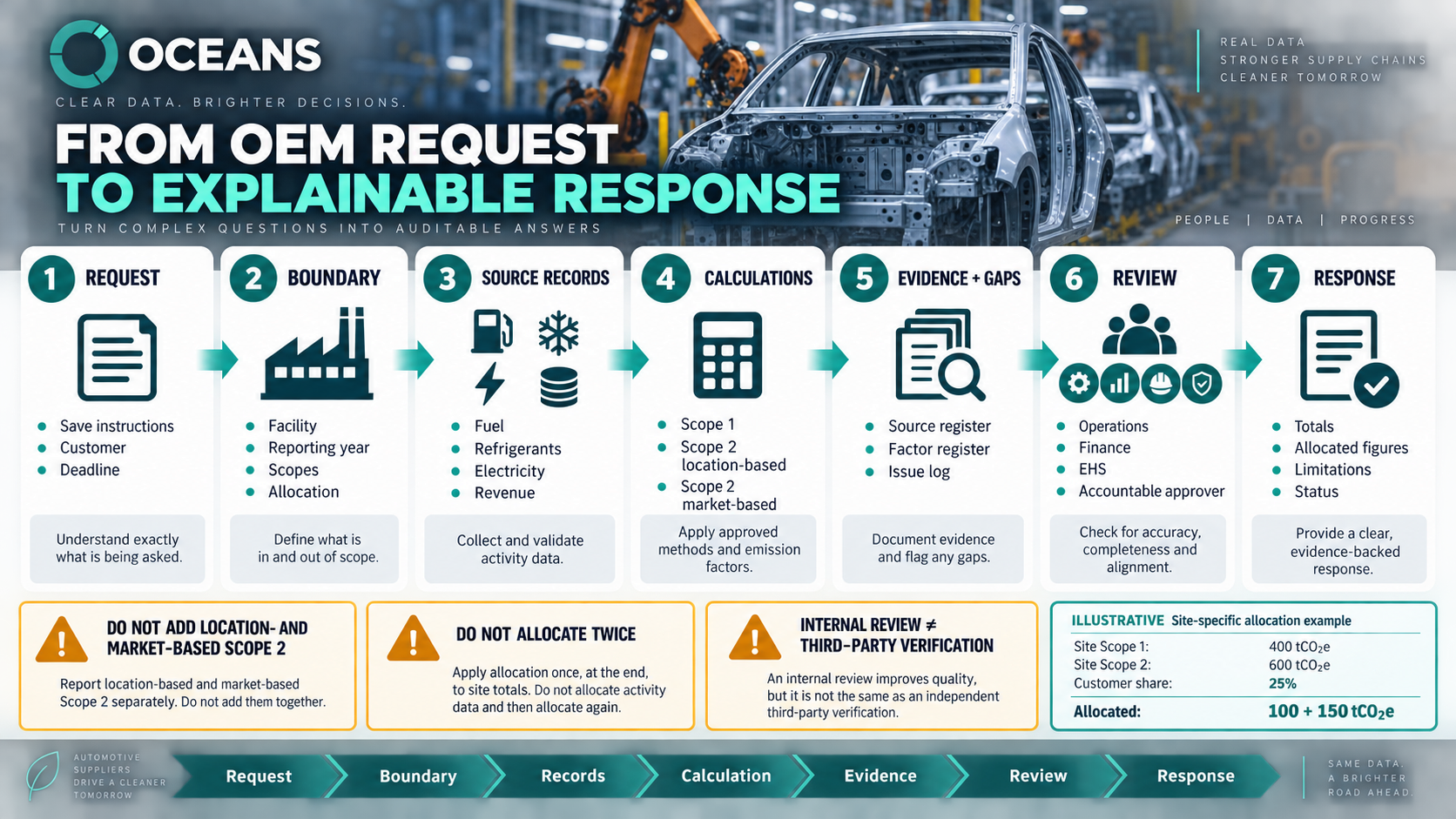
Start by confirming the requested facility, reporting year, emissions scopes and allocation basis. Collect the corresponding operational records, document the calculations, disclose gaps and connect each answer to supporting evidence. Have an accountable person approve the response before submission.
OCEANS Sustainability provides founder-led carbon-accounting and questionnaire-response support for U.S. manufacturers. Our focus is the connection between the request, the calculation and the evidence your team needs to explain its answer.
First, read the customer's request—not just last year's spreadsheet
The Suppliers Partnership for the Environment's April 2025 streamlined questionnaire provides a useful industry example. It covers site emissions, customer allocation, verification status and targets. Its use is voluntary; individual customers choose their questions. The published example requests 2024 data. Do not assume that year applies to a request received today. SP questionnaire
The broader SP framework also seeks consistency in supplier reporting, but it is not a universal OEM rule or reporting mandate. Your customer's actual instructions govern the response you are preparing. SP framework
Before asking colleagues for files, write a short request brief:
- Which customer and supplier identifier does this concern?
- Which facility or legal entity is in scope?
- What reporting dates apply?
- Is the customer asking for totals, allocated figures or product-level information?
- Who can resolve ambiguous instructions?
- Who will approve and submit the response?
This brief gives everyone the same assignment. Otherwise, Finance may deliver company-wide spend while EHS is preparing a plant-level inventory.
Translate the fields into an evidence request
The SP example distinguishes site totals from customer-allocated figures, separates location- and market-based Scope 2, and asks about third-party verification. SP questionnaire
Use the following as an original preparation checklist, adapting it to the request you actually received:
| Check before answering | Evidence to assemble | Mistake to prevent |
|---|---|---|
| Site identity and dates | Facility list, customer identifiers, agreed reporting-period note | Using records for the wrong plant or year |
| Direct emissions | Fuel-consumption records and an inventory of relevant equipment, process and refrigerant sources | Treating a gas bill as the entire Scope 1 inventory |
| Purchased energy | Consumption records and the applicable electricity or other purchased-energy method | Entering dollars where physical consumption is needed |
| Customer allocation | Agreed allocation instruction and the matching business records | Applying a company-wide percentage to one site's emissions |
| Verification statement | The actual verification report and its coverage, if one exists | Describing internal approval as independent verification |
| Targets | Approved target documentation and baseline information | Entering an aspiration as an established commitment |
Assign an owner beside each row. A request such as “send sustainability data” gives colleagues little direction. “Send the electricity-consumption export for this meter and these dates” is an actionable task.
Scope 1: check the source list before calculating
Scope 1 covers direct emissions from sources the organization owns or controls. For a manufacturer, the relevant inventory may include combustion, process emissions and refrigerant losses. The organizational boundary determines which operations are included. GHG Protocol Corporate Standard
Walk through your plant's sources with someone who understands its operations. Ask about backup generators, mobile equipment, process gases and refrigeration alongside the obvious heating fuel.
An invoice can show fuel purchased without proving how much was consumed during the period. A service record can show refrigerant added without explaining the event behind it. Treat these as questions to investigate rather than silently converting every available quantity into emissions.
For each material source, keep the activity unit and accounting treatment visible. This lets the reviewer distinguish an omitted source from one that was considered and found outside the defined boundary.
Scope 2: two methods do not mean two emissions to add together
Location-based Scope 2 reflects average emissions from the grid supplying electricity. Market-based Scope 2 reflects applicable contractual instruments and supplier information that meet the relevant quality requirements. Where the GHG Protocol's dual-reporting requirements apply, these are separate presentations of purchased-energy emissions—not amounts to sum. A renewable tariff label alone does not establish a valid zero-emissions result. GHG Protocol Scope 2 Guidance
For U.S. grid-electricity estimates, EPA recommends eGRID subregion output rates. Record the chosen dataset, factor, units and reporting-period rationale. EPA distinguishes inventory output rates from nonbaseload rates used to estimate avoided emissions; they are not interchangeable. EPA eGRID guidance
Practical checks before handing the file to your reviewer:
- Did you collect consumption rather than only expenditure?
- Are all relevant meters accounted for?
- Does a billing period cross the reporting-year boundary?
- Has an estimated bill subsequently been corrected?
- Can someone locate the exact factor used without searching your browser history?
Do not assume that twelve PDF files equal twelve complete months. Check the dates and meter coverage.
Customer allocation: a small percentage can create a large error
The SP streamlined example allows site totals with the customer's share of site revenue, or already allocated emissions using that share. This is a template-specific instruction, not a universal allocation method for every footprint. SP questionnaire
Consider this fictional arithmetic example, assuming the customer's instructions specify site-revenue allocation:
| Item | Illustrative value |
|---|---|
| Plant annual Scope 1 emissions | 400 tCO2e |
| Plant annual location-based Scope 2 emissions | 600 tCO2e |
| Plant revenue for the same period | $20 million |
| Revenue attributable to the requesting customer at that plant | $5 million |
| Customer share | 25% |
| Customer-allocated Scope 1 | 100 tCO2e |
| Customer-allocated location-based Scope 2 | 150 tCO2e |
The arithmetic is straightforward: $5 million ÷ $20 million = 25%; apply that share separately to each relevant site total.
Now imagine the preparer uses the group's $50 million revenue as the denominator. The share becomes 10%, producing 40 and 60 tCO2e. The spreadsheet still calculates correctly. The numerator and denominator no longer describe the same site boundary.
That is why the allocation record needs a Finance owner, period, source and explanation.
Also label whether the reported figures are already allocated. A recipient applying 25% again to the illustrative 100 tCO2e would obtain 25 tCO2e—an unintended second allocation.
These allocated operating figures are not automatically a cradle-to-gate product carbon footprint. For that distinction, read company footprint versus product footprint in an OEM request.
Missing data needs an explanation and an owner
Suppose a plant cannot locate one month's fuel record. Avoid both extremes: entering zero or inventing a precise quantity without explanation.
Record the gap, investigate available evidence, determine whether an estimate is suitable for the reporting purpose, and disclose the treatment. Ask the customer how to handle an unresolved field if the portal provides no appropriate option.
Use a compact issue log:
| Issue | Proposed next action | Owner | Response status |
|---|---|---|---|
| Fuel record missing for one period | Obtain replacement record; assess an estimate if unavailable | Plant Operations | Open |
| Customer revenue share unconfirmed | Reconcile site-specific revenue basis | Finance | Awaiting confirmation |
| Target mentioned in a slide deck | Locate approved target and baseline documentation | Management | Not yet substantiated |
For Scope 3, method selection depends on the category and available data; supplier-specific, physical-activity and spend-based approaches have different applications. Do not turn a missing value into a measured result simply because a form expects a number. GHG Protocol Scope 3 Calculation Guidance
How OCEANS organizes the response methodology
OCEANS Sustainability connects the requested output to a documented calculation basis. Our published methodology addresses boundaries, activity data, factor selection, conversions and assumptions. The factor must fit the activity and intended reporting purpose, including geography, period, units and gases covered. OCEANS calculation methodology
The public framework is:
Request → agreed boundary → source records → documented calculation → evidence and gaps → review → response.
For a manufacturing team evaluating this approach, three practical questions matter:
Can we explain the input? A result should retain enough context to identify the original quantity, unit, facility and period.
Can we explain the transformation? The path should show how the input became the result, including conversions and the chosen factor.
Can we explain its status? A calculated result, an estimate and a customer-approved response are different states. Independent assurance is a separate activity.
Our data-quality framework emphasizes source traceability, explicit limitations and visible review decisions. These controls make a result easier to investigate; they do not make uncertain information certain. OCEANS data quality and traceability
In the founder-led engagement, we organize the agreed records, prepare applicable Scope 1 and Scope 2 calculations, and assemble draft answers with the source and factor registers, calculation notes and gap log. Your company reviews, approves and submits the response. Additional Scope 3 or product-footprint work requires an agreed scope. OCEANS response engagement
Where AI helps—and where a reviewer still decides
Our service uses AI-assisted extraction and classification to support document processing, issue identification and response drafting, with human review. Source documents and customer decisions remain necessary. OCEANS response workflow
Consider a scanned bill containing an account number, invoice total and consumption quantity. Successful extraction means more than recognizing the digits: the reviewer must confirm which value belongs to the requested activity.
Likewise, an AI-written explanation can sound convincing while describing the wrong facility. Use the agreed request brief as a check against that drift.
The test for any AI-assisted carbon-accounting workflow is practical: can another person reproduce the reported result from its records and documented decisions?
What to do today if the deadline is approaching
- Save the exact request. Keep its version, instructions and correspondence together.
- Confirm the reporting boundary. Resolve site, year and allocation questions before chasing every possible document.
- Ask for specific records. Name the meter, facility, period, unit and responsible department.
- Create one open-issues list. Separate missing evidence from calculation questions and management approvals.
- Reserve review time. Set an internal review date ahead of the customer's submission deadline.
You do not need a perfectly organized data room to begin. You need a clear request, a responsible owner and visibility into what is missing.
Facing an OEM questionnaire deadline? Start with the request you have
OCEANS Sustainability helps U.S. manufacturers turn scattered operational records into a response their team can review and explain.
Bring the questionnaire, deadline and a description of the records available. We will discuss fit, scope and commercial terms before work begins. The founder-led response engagement has a 10-business-day target after receipt of the agreed questionnaire and input pack; scope and timing are confirmed first. Customer acceptance and independent assurance are not guaranteed.
Founder-led support is available now. The software platform remains in active development, with access through the Founding Design Partner Program. Current service and availability
Request a deadline review with the founder
Prefer to inspect the output first? View the OCEANS sample response package.
Frequently asked questions
Can I reuse a previous customer response?
Use it as a starting point, then check the new request's boundary, dates, units and instructions. Keep a record of what changed instead of silently overwriting the prior submission.
Do I need to upload confidential records to ask OCEANS for help?
No confidential records are needed for an initial conversation. Start with the type of request, its deadline and your data situation. Agree appropriate document-sharing arrangements before transferring sensitive information.
What if the questionnaire has nowhere to explain a limitation?
Ask the customer's reporting contact how to provide a supporting note. Retain that clarification alongside the submitted version. A required numeric field does not resolve uncertainty in the underlying data.
Does a reviewed calculation mean third-party verified?
No. Internal review and preparation support are different from an independent verification engagement. Describe only the verification status supported by the relevant documentation.
Sources and further reading
- Suppliers Partnership: Streamlined Carbon Emissions Questionnaire, April 2025
- Suppliers Partnership: Automotive Climate Action Questionnaire Framework
- GHG Protocol Corporate Standard
- GHG Protocol Scope 2 Guidance
- U.S. EPA: eGRID frequently asked questions
- GHG Protocol Scope 3 Calculation Guidance
This article is published by OCEANS Sustainability. OCEANS is independent of Suppliers Partnership, automotive OEMs and the standards organizations referenced. The worked example is fictional. Customer instructions and the applicable accounting guidance determine the appropriate response.
Sai Praneeth, Founder of OCEANS Sustainability
OCEANS™ Sustainability
OCEANS™ Sustainability is carbon-accounting software for growing US manufacturers, a product of TheEvenity Pvt Limited. The Founding Design Partner Program is now open.